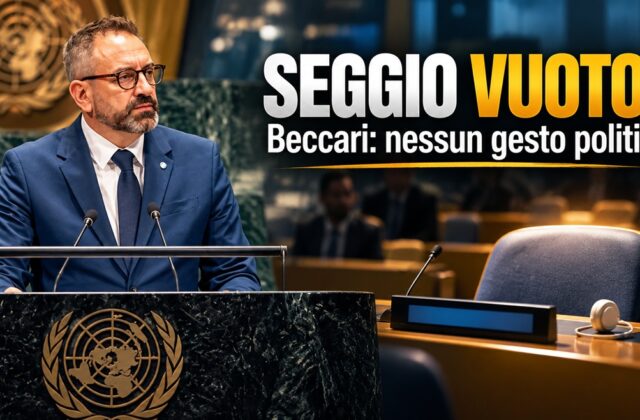
Organizing the arrival of European rules without congesting the Grand and General Council (Consiglio Grande e Generale) and its commissions. That is the goal outlined by Foreign Affairs Secretary of State Luca Beccari, speaking at the joint session of the Council Commissions on Monday, October 12. According to Beccari, the busiest period will be the first three or four years after the agreement enters into force. San Marino already has the legislative tools it needs, but must decide how to manage the workload.
The government proposes differentiating the procedural pathways, allowing more room for debate on political choices while simplifying the passage of technical provisions. Beccari cites the example of European production standards: amending them would effectively render a product non-compliant. “What would be the point of transposing a regulation on technical standards through a full law – with a first reading, committee review and a second reading – if it contains no political element requiring that process?”
The proposed solution is an annual transposition law, dubbed the “omnibus” law, which would establish which rules to adopt and which procedure to follow for each. The Council would decide which measures to handle through ordinary legislation, which to delegate to the government via decrees later submitted for ratification, and which to transpose by directly referencing the European legislation. The same process would also resolve conflicts between provisions, avoiding the scattering of transitional rules and delegations across numerous separate measures.
The choice would therefore remain in the Council’s hands. The annual planning could be updated during the year and would indicate in advance which measures could follow the urgent procedure, without having to debate each time whether to invoke it. Beccari also proposed the option of examining delegated decrees in commission under the “sede redigente” drafting procedure.
For matters that introduce far-reaching changes to the legal system, the first step would instead have to go through an ordinary law. The secretary cited residency rules, competition and state aid as examples. Even where delegated powers are already available, the government’s commitment is to address the most significant changes through a process that allows for full examination. The more specific, subsequent aspects could then potentially be handled through decrees.
Beccari also drew a distinction between referencing a European rule in its current version and automatically linking to its future amendments as well. For now, the government is sticking with the first approach: every update will have to be transposed through a new domestic procedure. The automatic mechanism, known as “dynamic referral,” remains an option to be considered further down the line and could require amending the Declaration on the Rights of Citizens (Carta dei diritti), since the Council would be binding itself to the evolution of external legislation it does not control.
On timing, the secretary made clear that discussion remains open: “This is a proposal, not a text you will find before you for a first reading at the next Council session.” The goal is to agree, by the end of 2026, on launching the Council procedure, so that the new rules can enter into force in the very first months of 2027.
As for the adjustments required by the agreement, Beccari urged a sector-by-sector approach. “There are many, but as I always say, we are not starting from scratch – we’re not in the legislative Stone Age.” On competition, a regulatory framework that is currently absent will need to be built, while on labor the secretary noted a level of alignment already greater than in other areas. Corporate law is more complex, as it will need to allow for transactions between San Marino companies and foreign corporate structures not currently envisaged – such as a merger with a Greek or Finnish company.