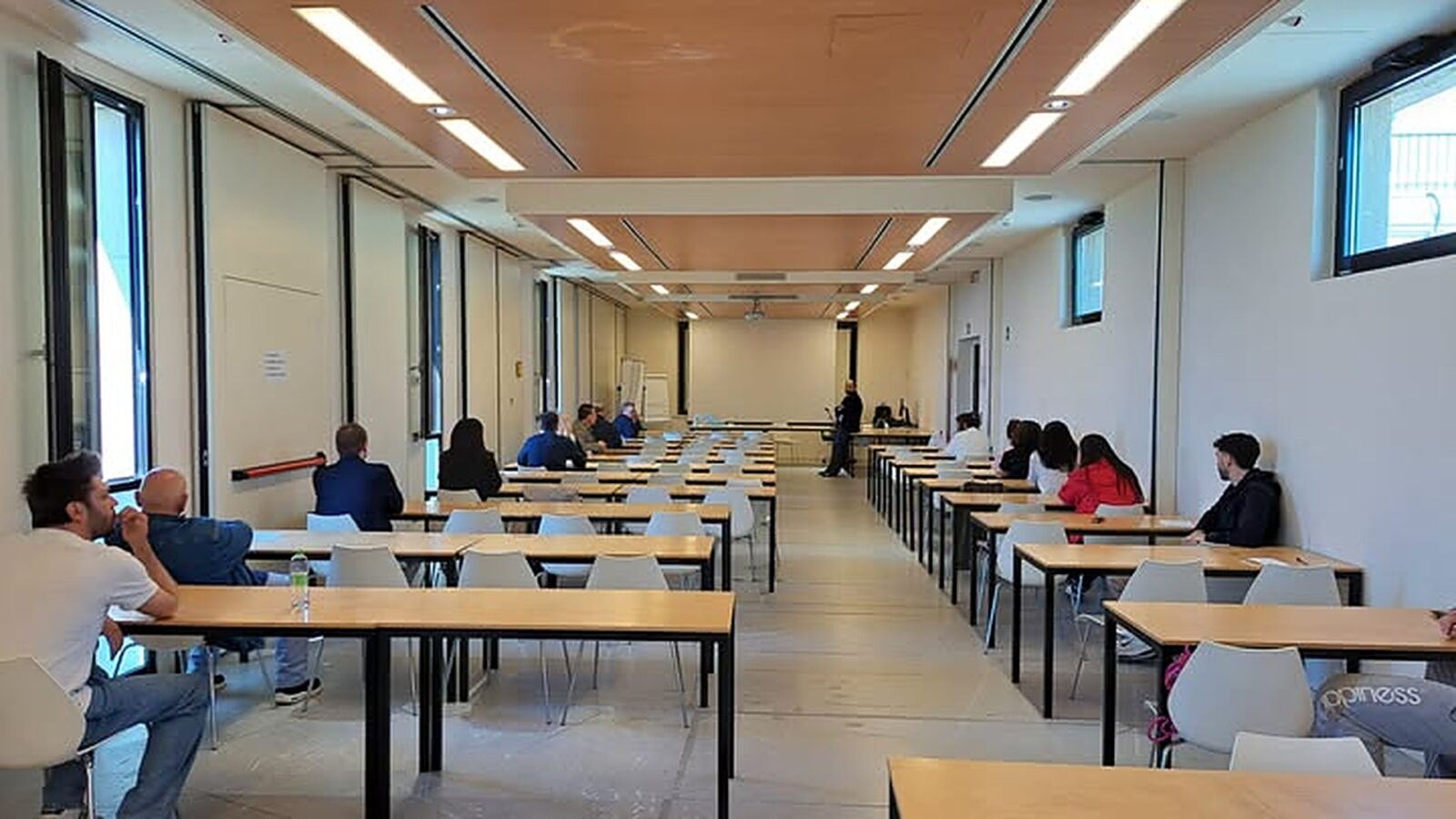
87 out of 105 candidates passed the test on San Marino’s history and institutions, the exam that from 2026 becomes a mandatory requirement for filing a naturalization application. The exams were held on Saturday, September 26, and were graded on September 30 by the examining commission, made up of the Director of Institutional and Internal Affairs, the Director of the Department of Foreign Affairs, and the Director of the Department of Education and Culture.
What stands out, however, is not the pass rate. A total of 170 people had registered for the exam, but only 105 actually sat down to take it: sixty-five skipped the appointment altogether, nearly four in ten registrants. Comparing this with the first session, held on April 18, reveals another difference: back then, 149 people took part and 140 passed, for a success rate of 94 percent, while this time the figure drops to 83 percent.
The test consisted of fifteen multiple-choice questions, and passing required at least two-thirds correct answers, meaning ten. According to the commission, the questions varied widely in difficulty, ranging from basic ones — such as the length of the Captains Regent’s term — to constitutional law questions, like identifying who is entitled to directly request the Guarantee Panel (Collegio Garante) to review the constitutional legitimacy of a law. Some candidates achieved a perfect score, answering all fifteen questions correctly.
Alongside the top scores, the commission also chose to make public a few errors described as “curious,” two of which were in fact near-misses. One candidate claimed that Monte Titano was a gift from Emperor Diocletian: Diocletian does figure in the Republic’s founding story, but as the persecutor from whom Marino fled — not as a benefactor. Another attributed to San Marino the acquisition, in 1463, of the castles of Urbino, Pesaro and Gradara: the date was correct, but the castles were wrong, since that year actually saw Serravalle, Faetano, Fiorentino, Domagnano and Montegiardino join the Republic, following the war against Sigismondo Pandolfo Malatesta. The third mistake was perhaps the most forgivable: Ulisse Balsimelli, “a popular choice” cited as the composer of the national anthem, according to the official report. The current anthem was actually written by Federico Consolo, adopted by the Grand and General Council (Consiglio Grande e Generale) on September 11, 1894, and performed for the first time on September 30 of that year at the inauguration of the Palazzo Pubblico. Before Consolo’s composition, however, the Republic’s official anthem was indeed a military march by Maestro Balsimelli.
Those who failed the test will have the chance to retake it in the next session, expected in late November, tentatively set for the 21st, pending confirmation. The regular calendar provides for two sessions a year, in April and November, while the September session was an extraordinary addition due to the high number of registrations. The Department of Institutional and Internal Affairs is informing candidates of their results directly; the certificate must then be attached to the naturalization application submitted to the Civil Registry Offices.
Andrea Belluzzi, Secretary of State for Internal Affairs, Civil Service, Legal and Legislative Affairs, Relations with the Castle Assemblies (Giunta di Castello), Technological Innovation and Information, reads the results in a positive light. “Seeing more than a hundred people take on this test with seriousness and preparation is an encouraging sign,” he said, pushing back on the idea that the test represents an additional barrier. “The new naturalization process was designed precisely for this reason: not to add an obstacle, but to give real meaning to the moment when someone asks to become a citizen of San Marino.” For Belluzzi, citizenship “is not merely a legal status, but a pact between a community and those who choose to become part of it,” and the test “is not a finish line, but the beginning of a shared journey.”