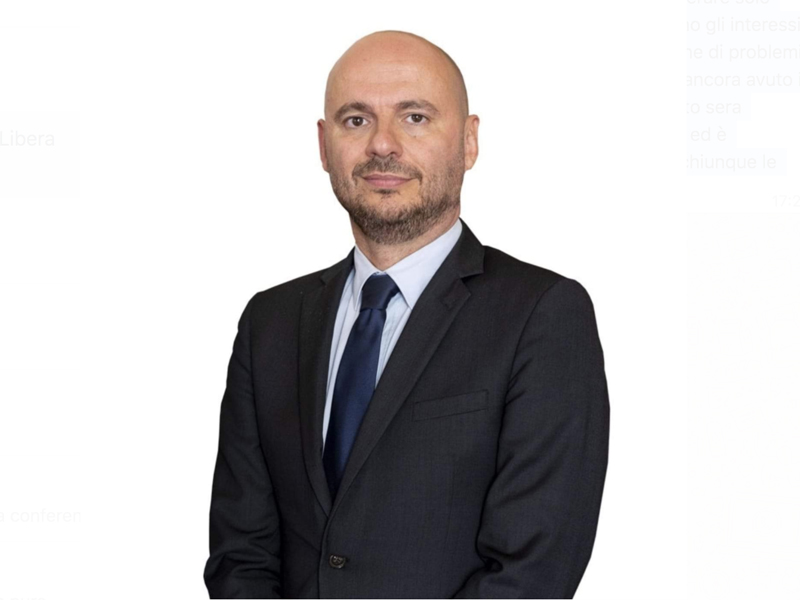
The need to support Ukraine’s right to self-defense, without abandoning the search for a diplomatic solution, and the role Europe must play in building a lasting peace. These are the themes at the heart of a statement by Libera councillor Luca Boschi.
More than four years after Russia’s invasion of Ukraine, Boschi reiterates the need to uphold the principle of respect for the sovereignty and territorial integrity of states, pointing to the implications that a violation of international law carries even for smaller entities like San Marino.
“We cannot put the aggressor and the victim on the same level. Russia violated the sovereignty and territorial integrity of an independent state. This principle doesn’t only concern Ukraine. It concerns Europe, and it also concerns small countries like ours, because if international law becomes subordinate to military force, no state can truly feel safe anymore.”
For the Libera representative, condemning Russian aggression must go hand in hand with the search for a political solution to the conflict, avoiding a scenario in which the end of hostilities amounts to Ukraine’s surrender or a truce destined to collapse.
“Stopping the fighting without creating the conditions to prevent the war from starting again tomorrow could simply mean preparing for the next conflict. On the other hand, though, we also have to be honest enough to recognize that after years of war it’s not enough to keep repeating that we must fight on to victory without defining what the political exit actually looks like.”
At the core of Boschi’s remarks is above all the role of Europe in peace negotiations. The councillor highlights the European Union’s difficulty in defining a shared political strategy to bring the conflict to an end.
“We have often had a common position on the war, but we still don’t have a real common strategy on peace. And this, in my view, is the most important political issue. Europe cannot simply be the territory where a war is fought while also being the one that bears the economic, energy and social consequences of that war. It must become a protagonist in building peace.”
According to Boschi, Europe needs to gain enough political weight to engage directly with Washington, Kyiv and, when the conditions allow, Moscow as well.
“We must therefore support Ukraine in its self-defense, but we must also support, with equal conviction, every serious diplomatic initiative that could lead to the end of hostilities. The two things are not contradictory. Diplomacy and deterrence are not alternatives. They can and must go hand in hand.”
As for the conditions of any eventual agreement, the councillor points to several key elements: respect for Ukrainian sovereignty, credible security guarantees, an international mechanism to monitor a ceasefire, a pathway for the country’s reconstruction, and a European political and economic perspective for Kyiv.
“And above all, we must avoid a situation where Ukraine is simply presented with a deal decided by others. Peace in Ukraine cannot be decided without Ukraine.”
Boschi then broadens the discussion to the issue of European strategic autonomy, dwelling on the energy, military and political vulnerabilities that have emerged over the course of the conflict.
“The answer cannot simply be increasing military spending. Europe certainly needs greater defense capability. But security also means energy, diplomacy, economic cooperation, infrastructure protection, cybersecurity and the ability to prevent conflicts. European security cannot be built with more weapons alone. It must also be built with more Europe.”
Within this framework, according to the Libera representative, San Marino too can offer its contribution by defending international law, the sovereignty of states and diplomatic dialogue.
“As a center-left force, I believe this must be our position. We shouldn’t have to choose between being pacifists and being realists. We must be pacifists precisely because we are realists. Because we know no war can last forever. And we also know that a poorly built peace can be nothing more than the pause between two wars.”
“Our goal must therefore be more ambitious: not simply to stop this war, but to build the conditions so that it doesn’t start again,” Boschi concludes, calling for “a Europe that is stronger, more autonomous, more united and, above all, capable of being the protagonist of its own peace.”