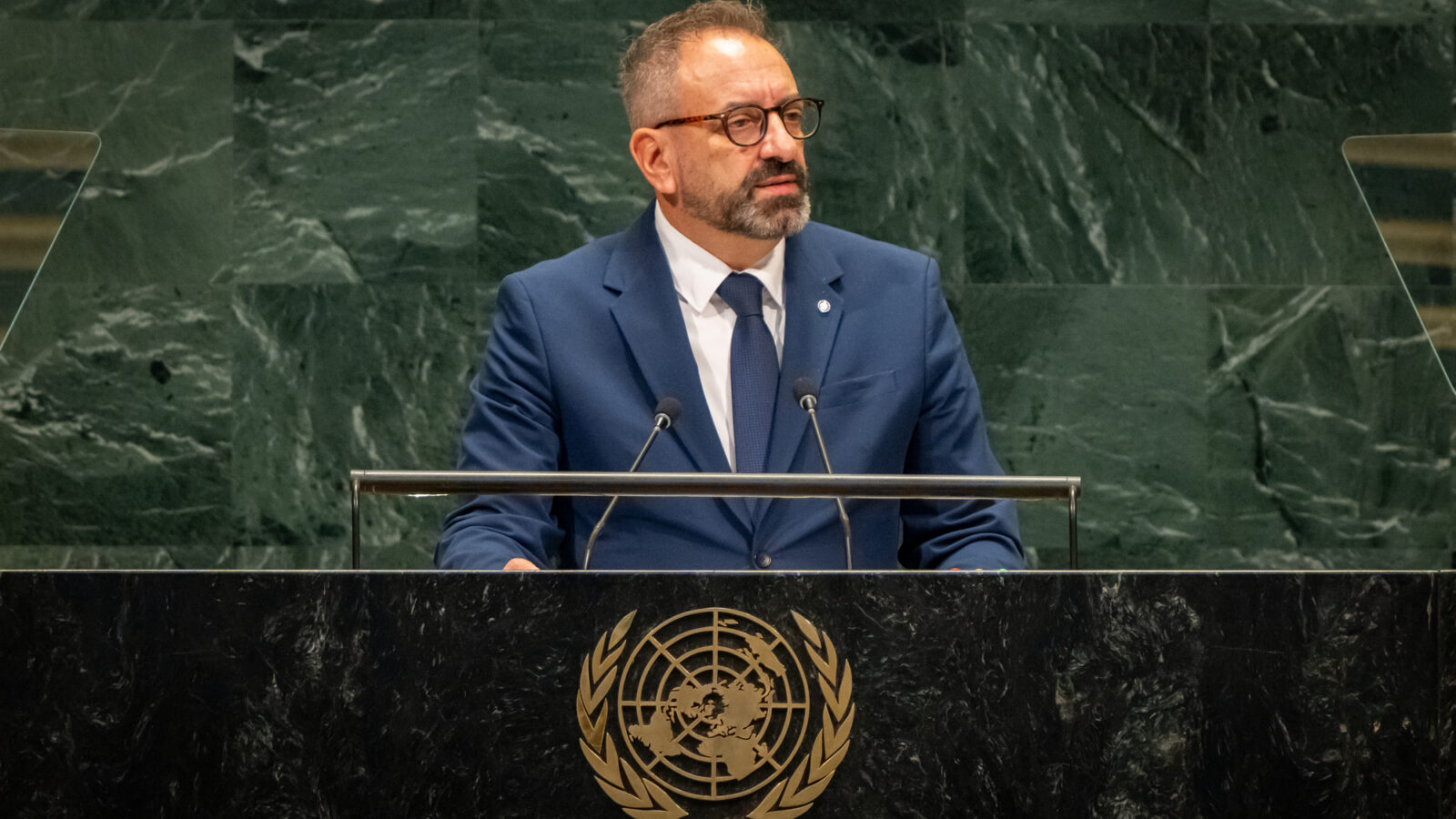
In his closing reply, Foreign Affairs Secretary Luca Beccari addressed the question of timelines for transposing European legislation and the prospects opened up by the Agreement.
The address was delivered on the morning of Wednesday, 25 November 2026, in the Grand and General Council (Consiglio Grande e Generale), during the replies on paragraph 7, ahead of the ratification of the Association Agreement with the European Union.
The full text of the address follows.
Luca Beccari (Secretary of State): I will try to respond quickly to just about everyone, also bearing in mind the limited time I have for this closing speech. I take note of Councillor Fabio Righi’s invitation to a duel outside this chamber. I will even tie one arm behind my back to give him an advantage, so we’ll do it that way. Jokes aside, I do not really want to use the time I have left to fuel further controversy, not least because I believe these latest clashes do not reflect the content of the debate we developed yesterday. Yesterday’s debate was, in my view, on the whole a very measured one, a debate that managed to correctly grasp the meaning and importance of the issue we are discussing. First of all, I would like to try to reassure everyone — not only the councillors sitting in this chamber, but also all those listening to us from outside the Grand and General Council — about what the consequences of the provisional application of the Association Agreement will be. It is clear that the provisional entry into force of the Agreement will open a new phase of parliamentary work, during which we will be called upon to approve numerous pieces of legislation and to address a whole series of issues. However, this is work that the offices of our Public Administration have already been engaged in for some time. I keep hearing talk of delays, of constant delays, but I would also like to understand on the basis of what elements and what criteria these alleged delays are being measured. Once the Agreement enters into force provisionally, we will not in fact have an immediate obligation to produce and approve all the legislation whose transposition is envisaged during the first year of the Agreement’s application. We naturally have very specific commitments that we will have to honour, but we also have margins and timeframes within which to carry out the work required of us, both during the first year and in the years that follow. We will do this work, and I also take up the invitation put forward by the opposition political forces, who have expressed their wish to play an active part in this process. We are already working on drafting what, if we manage to bring it to completion, will be a bill that will allow us to simplify the way council proceedings are organised and conducted, precisely in light of the new requirements arising from the implementation of the Association Agreement. So there is a machine that has already been set in motion, and I hope that, following today’s vote, we will be able to meet again in this council chamber, as well as in the various technical settings, to begin concretely addressing issues more closely linked to the content and methods of transposing European legislation. This is also work that is intertwined with the need to act on many pieces of legislation currently in force in our country — legislation that we would have needed to update in any case, even independently of the signing of the Association Agreement with the European Union. Today truly represents a historic moment for the Republic of San Marino. We represent a new political generation or, in any case, a new phase of San Marino’s political class, one that is guiding the country towards an international repositioning that, just fifteen years ago, would have been absolutely unthinkable. So fears are fine, concerns are fine, doubts and clarifications that each of us feels the need to raise are fine. Let us get a few things off our chest and say everything we feel we need to say, but let us try to do so perhaps during the subsequent paragraphs of this session, because we will certainly still have plenty of opportunities to discuss these issues as well. Today, however, let us try to fully grasp the significance of the vote each of you will be called upon to cast. Today’s vote is not simply a vote in favour of or against an international agreement; it is a vote that marks a fundamental dividing line between the path the Republic of San Marino followed during the darkest years of its recent history — years marked by economic crises, political instability and strong institutional tensions — and what will be our country’s new international standing. An international outlook that, until a few years ago, would have seemed almost beyond hope. Let us also remember what the 2013 referendum represented, which, at that particular moment in San Marino’s history, amounted almost to a cry of desperation from the population in the face of the economic, political and international conditions our country was experiencing at the time. Today we are also responding to those concerns through an important step forward — a step that I believe will be able to bring benefits to all our citizens, including those who today express greater scepticism about this path, and including those who continue, in some way, to use the Association Agreement as a tool for political confrontation, both inside and outside this chamber. Let us therefore try to set aside, at least for a moment, these divisions and focus on the meaning of what we are doing today. Starting tomorrow, a new phase will open — one that will certainly represent continuity with the path we have pursued over all these years, but which must above all be the phase in which we are called upon to put in place, concretely, all the tools needed to allow the Republic of San Marino to fully reap the benefits and opportunities that may arise from this remarkable agreement with the European Union.