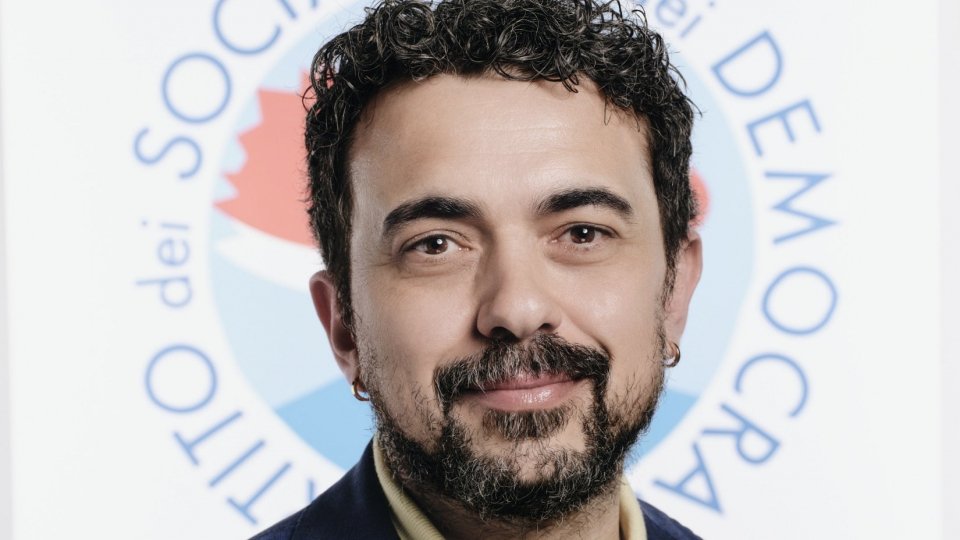
Luca Lazzari (Psd) spoke during the debate on item 7 of the Grand and General Council (Consiglio Grande e Generale) agenda, dedicated to the ratification of the Association Agreement between the Republic of San Marino and the European Union.
The councillor examined the relationship between European integration, sovereignty and citizens’ freedom, dwelling on the need to go beyond mere transposition of EU rules.
His speech also focused on the demographic emergency, the exodus of young Sammarinese, opportunities for cooperation with Emilia-Romagna and the Marche region, and the need to build a political project for the country’s development.
Below is Luca Lazzari’s full speech.
Your Excellencies, honourable councillors, first of all I would like to acknowledge the merit of those who believed in Europe when, for the Republic of San Marino, Europe was still a very distant prospect in the political choices being made, and of all those who subsequently worked to allow us to reach this important milestone.
I am thinking of the successive heads of the Ministry of Foreign Affairs over the years, of San Marino’s diplomatic corps, and of the officials and technical staff of our public administration.
Special recognition goes to Secretary of State Luca Beccari, who, in this long relay, was the torchbearer who had the honour of lighting the brazier. In that flame lies the work of many people, but also the disappointments, the setbacks, the second thoughts and the courage to start again that have characterised this long journey.
Having said that, I don’t know what your impression was, but during this debate I sensed a somewhat suspended atmosphere. There is certainly great satisfaction for the milestone we have reached, but I also sensed that particular weariness that comes when a tension lasting so long finally eases.
Perhaps this is also because, over the last steps that have brought us to this point, we have experienced very different emotions.
We experienced the moment of deadlock at Coreper, with all the uncertainty over how this matter would turn out.
Then we experienced the signing of the Agreement in Brussels, with all the solemnity that marked that occasion, followed by the passage through the Foreign Affairs Committee, where it seemed to me that awareness finally began to take hold that we had truly reached this important milestone.
Now we are here, within the Grand and General Council, to take a further step bringing us closer to the entry into force of the Association Agreement with the European Union, albeit initially through its provisional application. We know that things will change — not overnight, certainly, but gradually, over time.
Some things will change sooner, others later, and much will also depend on our ability to tackle this path and on what we are actually able to achieve. I believe there is also a certain curiosity about finally seeing how everything we have discussed for so long will concretely become part of our lives.
At this point, one might almost wonder whether it still makes sense to explain the reasons why we support the Association Agreement. Put that way, it might seem like a question raised too late and, in some respects, it might even raise a smile.
And yet, I believe it is still necessary to do so, because within our country there are still doubts, suspicions and resistance to this path, and not all of these positions can be regarded in the same way.
There are, first of all, the reasons of those who propose resorting to a referendum. These are, personally, the reasons that concern me least — not because I consider them unimportant, but because they are expressed openly and seek to find a democratic path through which to assert themselves.
Then there are those who have tried to stop the Association Agreement by operating in the shadows, letting other people expose themselves publicly instead.
I believe that, over this long journey, we have also encountered this kind of resistance — the weight of an old world that, through the Republic of San Marino’s opening to the outside, feared losing its own power and tried, unsuccessfully, to prevent this result from being achieved.
But there is also another form of uncertainty, much more widespread within our society, which we must be able to listen to and understand.
It is the uncertainty of those who, at least in part, trust the path we have undertaken, but who, at the same time, wonder whether we will truly be capable of facing the change ahead of us, and whether, in the course of this transformation, something of what we know and hold dear risks being lost.
After all, we come from a history in which we have often sought our security through closure, through the possibility of finding an exception, an expedient or a solution that was ours alone.
This is a way of thinking that has accompanied the Republic of San Marino for a long time, and signing an international agreement is certainly not enough to leave it definitively behind. It is precisely for this reason that I believe it still makes sense to explain the motivations behind our support for the Association Agreement with the European Union.
Perhaps the first thing we should do is try to avoid letting the judgment each of us makes about the European Union automatically determine the judgment we make about the Association Agreement that the Republic of San Marino has negotiated.
We can see the European Union as the most advanced political and legal construction in the world, an attempt to establish common rules to govern coexistence among different peoples, to defend people’s rights and to ensure that peace represents something more than a mere truce between states.
Or we can see the European Union as a kind of cage, a distant and strict power, capable of demanding sacrifices in the name of market requirements, but much less capable of concretely protecting those people who are then called upon to bear the consequences of those sacrifices.
These are profoundly different judgments, and personally, I can also share some of the criticisms directed at the European Union, in some cases even quite radical ones. However, I believe that even those who express the harshest judgment towards the European Union must be able to answer one very specific question.
What other concrete path did the Republic of San Marino have before it? Could we really have thought of entrenching ourselves within our borders and behaving as if we were not geographically located within the European continent, as if we were not part of its economy, and as if we were not tied daily to the decisions made by European institutions?
Our businesses sell their products within that market, our young people study and work in European countries, and we use the same currency. All the transformations affecting trade, finance and technology inevitably cross the borders of our Republic, even when we would prefer to keep them outside our territory.
Remaining still in the position we found ourselves in would certainly not have protected us from the effects of globalisation, international competition, or the rules adopted within the European Union.
We would have continued to suffer the effects of these transformations, while also having to continue facing all the obstacles and uncertainties arising from our country’s particular position.
For this reason, even to those who do not like this Europe at all, I would like to say that the alternative to the Association Agreement was not the possibility of preserving intact the sovereignty we believed we previously enjoyed. The alternative was to find ourselves, progressively, with ever fewer tools through which to actually exercise our sovereignty.
The first condition for a state to be able to exercise its sovereignty is that other states recognise and respect that sovereignty. For a small state like the Republic of San Marino, this has never been something to take for granted.
Having managed to preserve our sovereignty over the centuries is therefore an extraordinary achievement, one of which we should be proud — but in order to continue doing so in the years to come, we must continue cultivating the relationships and international recognition that have helped make it possible.
This is precisely the meaning of our presence within the United Nations and the Council of Europe. Through the Association Agreement with the European Union, we take a further step in this direction.
The European Union and its twenty-seven member states take on commitments towards the Republic of San Marino and recognise the role and position of our country within a relationship governed by mutual rights and obligations.
We live in a world in which great powers confront each other, compete, reach agreements and then clash again. Europe itself, at this particular point in history, struggles to find a political voice truly commensurate with its historical and economic weight.
Within a world characterised by these dynamics, how can we think we will manage to preserve a space for the Republic of San Marino by remaining on the margins of even that European market to which, in reality, we are already deeply tied?
This, in my view, is the first fundamental reason to support the Association Agreement with the European Union: the need to give our sovereignty the tools through which it can continue to exist and to count.
There is then a second reason why I believe it is important to support this Agreement: expanding people’s freedom of choice within our own country. When opportunities are few, those who control access to those opportunities end up wielding enormous power.
If, in order to work, start one’s own business, or simply get a response from institutions, one needs to be able to count on a patron, what should be a right ends up becoming a favour instead.
It is precisely through these mechanisms that power tends to stagnate within monopolies, family circles and personal relationships that end up carrying more weight than people’s actual abilities and skills.
Every change becomes extremely difficult, because before one can even demonstrate that a given change might be useful for the country, one must first obtain permission from those who fear they might lose something as a result of that transformation.
The European single market can be the hammer that breaks this system, because it opens up new alternatives, widens the pool of possible partners, and can offer anyone with a project, an idea, or something they want to achieve, the chance to do so without being forced to always knock on the same doors.
Of course, none of this will happen automatically. The Association Agreement gives us a tool, but actually being able to use that tool will require clear political will.
This too is why we support the Agreement: because we believe the sovereignty of the Republic of San Marino must serve, above all, to make the people living in our country freer. A country in which people can choose freely, without being forced to depend on a favour, is a freer country.
There is also the whole major issue of implementing the Association Agreement, and we well know what commitments this phase will entail for our institutions.
I am thinking of the review of the EU acquis that we will need to transpose into our legal system, of drawing up a timeline for regulatory adjustments, of managing the various transitional arrangements provided for by the Agreement, of assigning responsibilities to individual public administration offices, and of defining the entire architecture through which we will have to proceed with the transposition and subsequent updating of European legislation.
I am thinking of the European law, of the delegation instruments that may be used, and of the need to clearly define the relationship between adjustments that are predominantly technical in nature and those that, instead, must be submitted for discussion and resolution by this Grand and General Council.
There is also the entire administrative capacity we will need to build, through careful analysis of our public administration’s needs, through staff training, restructuring of departments, and the recruitment of specialist expertise that is currently lacking.
We will have to address all the issues relating to supervisory and regulatory functions, to the authorities that will need to be established or adapted, to the need to guarantee their independence, and to the resources that will need to be made available to them so they can function properly.
We will have to address issues relating to the regulation of public procurement and concessions, the requirements for in-house awards, competition law, and the regulation of state aid.
It is clear that all of this will require serious planning, adequate resources, and the ability to carry out precise checks on the work being carried out. The Government will need to clearly state what will be done, by what deadlines it must be done, and who will be responsible for achieving each individual objective.
However, I believe we should also ask ourselves whether we can really reduce the entire political debate on the Association Agreement solely to these aspects. Are we ready? How many people will we need to hire? Won’t that be too many? Who will draft all these regulations? Who will be responsible for applying them in practice?
Will we actually be able to carry out this work? These are all questions that will certainly need precise answers, but we cannot mistake this set of operational issues for the entire political project we must build for the future of the Republic of San Marino.
Let us line up everything that needs to be done and start doing it. There will certainly be difficulties, there will be delays we will need to be able to recover from, and perhaps there will also be decisions that, along the way, we will realise need to be corrected. But these are problems that can be addressed and solved through hard work.
I believe that we should demand greater political ambition from this Grand and General Council. Implementing the Agreement is a task we are called upon to complete, while defining a political project for the future of the Republic of San Marino is the true political responsibility from which we cannot shy away.
It is precisely on this ground that I believe our debate must be capable of taking a further step.
This political project, in my view, should start from one fundamental question: how can we use the new European dimension we are entering through the Association Agreement to ensure the demographic survival and future of the Republic of San Marino? In 2015, 269 children were born in our country. Ten years later, only 166 were born — a decline of almost 40%.
I believe we should pause for a moment to reflect on these figures, because they offer us a particularly telling picture of what is happening within our society.
The very generations to whom we entrust the future of the Republic of San Marino are becoming progressively smaller, and the smaller these generations become in number, the harder it will become to reverse this trend.
To this phenomenon we must add that of the many young Sammarinese who decide to leave, or who, having completed their studies abroad, decide never to return to our Republic. In other countries, the discontent of younger generations fills the streets and finds particularly visible forms of public expression.
Here, this discontent makes far less noise. A suitcase is packed, a city is chosen in which to test oneself, in which to try to build one’s own life and career, and the moment of return to San Marino keeps being postponed, until eventually there is no return at all.
This is a silent loss for our country. We lose skills, we lose energy, we also lose those children who could have been born here, and above all, we progressively lose the trust and conviction that it is worth investing one’s life in the Republic of San Marino. Meanwhile, our population continues to age without sufficient generational turnover.
This demographic fragility also directly affects our economic model. We are fortunate to have a particularly strong manufacturing sector, with businesses that produce, export and create jobs — but this very strength of our productive system makes the contradiction we are experiencing even more evident.
Our productive system needs new workers, while our country struggles to renew its population and to retain within its borders the skills it helps to train.
In the private sector today, one worker in two comes from across the border. Without the contribution of cross-border workers, our economy would not be able to hold up, and we must therefore recognise how essential their contribution is to the functioning and development of the Republic of San Marino.
This contribution, however, cannot replace the need to identify and pursue policies capable of growing, alongside our businesses, the community that lives permanently within our territory.
This, I believe, is what the Association Agreement with the European Union must truly be used for. It must serve to make an effort of political imagination, an effort capable of giving the Republic of San Marino a future outlook.
The European single market opens up new possibilities for us. Our fiscal autonomy can help us attract new economic activities and new skills. European project funding and more structured cooperation with neighbouring territories can provide our projects with knowledge, tools and a scale that we would hardly be able to achieve on our own.
This is also because Europe begins immediately beyond the borders of our Republic, and we are fortunate to have neighbouring territories such as Emilia-Romagna and the Marche, areas home to universities, research centres, major industrial districts, services and significant experience in territorial governance.
Right there, immediately outside our borders, lies an important part of that Europe alongside which we can try to build the future of the Republic of San Marino.
I am thinking of the possibility of developing international training programmes capable of bringing young people into our country and connecting them with our businesses. I am thinking of the opportunities offered by research and artificial intelligence, which can help further strengthen our manufacturing sector and create new economic activities.
I am thinking of the possibility of attracting new investment and new professional skills, but I am also thinking of all those policies that directly affect the quality of life of people who choose to live within our Republic.
I am thinking of the need to guarantee access to housing at affordable conditions, to provide adequate childcare services, and to create the conditions that allow people to better balance their work and family commitments.
I am thinking of the possibility of developing more structured forms of healthcare cooperation, improving care services, and carrying out joint projects with surrounding territories regarding water resource management, energy supply and mobility.
This is the wealth of possibilities we can build starting from the Association Agreement with the European Union.
It is up to us to be able to bring all these opportunities together, to turn them into an overall political project that can offer those who decide to leave a reason to come back, offer those who choose to stay a real chance to fulfil themselves, and offer those who wish to have a child the confidence needed to make that choice.
Today we are called upon to ratify an Agreement. Our task, from this moment on, will be to turn this Agreement into jobs, to turn it into knowledge, and to turn it into concrete opportunities, so that a young person can look at the Republic of San Marino and think that it is here, in their own country, that they can build their life.