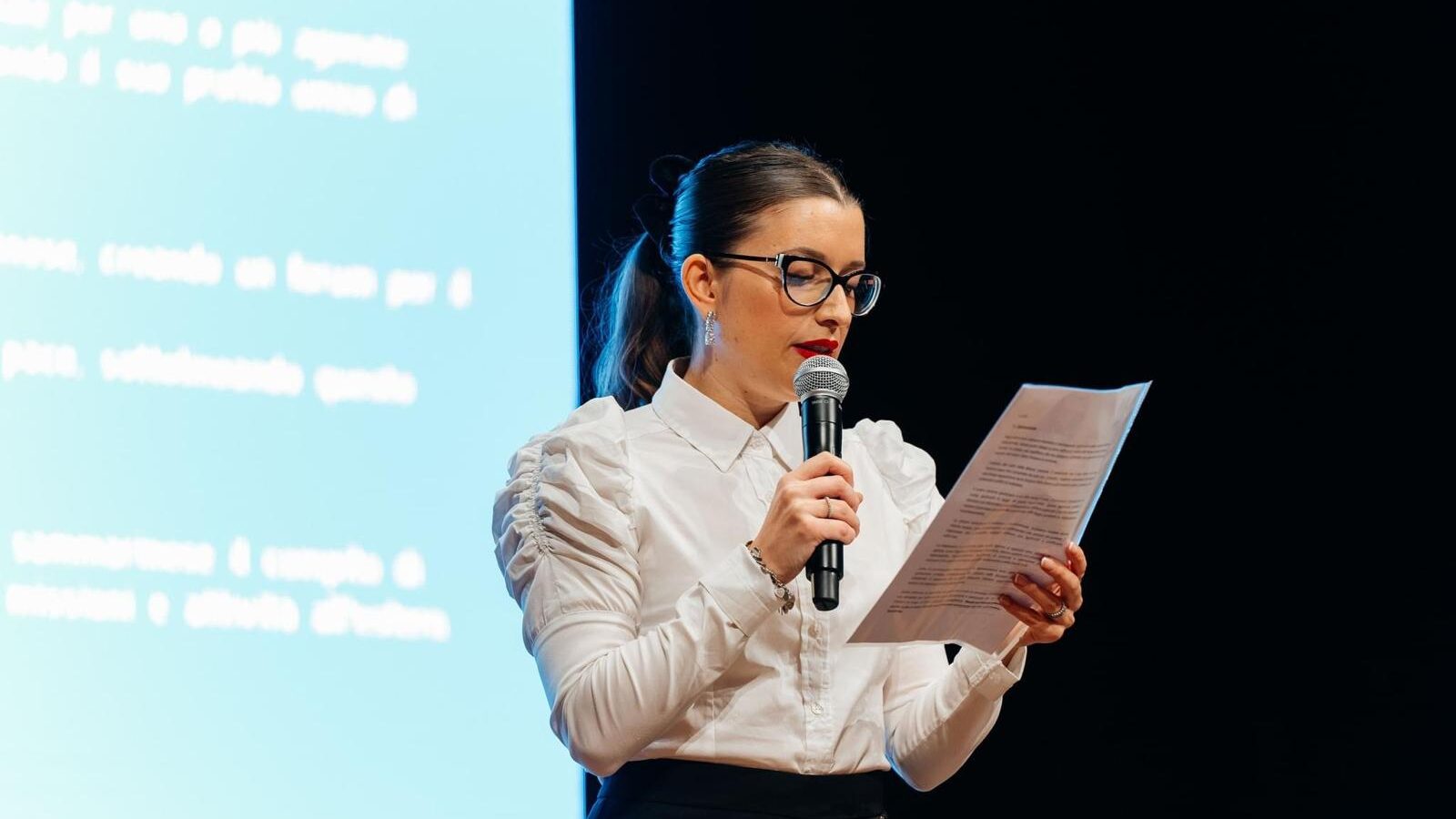
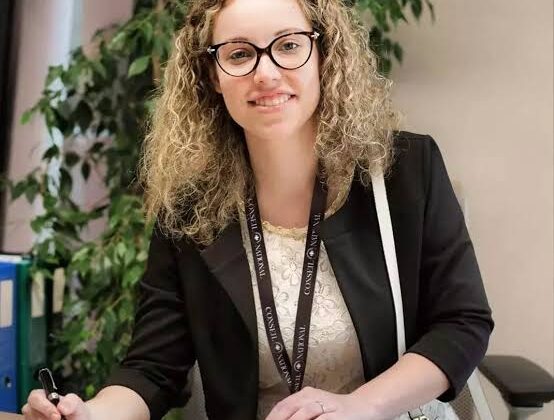
Councillor Ilaria Bacciocchi of the Party of Socialists and Democrats (PSD) spoke on the morning of Tuesday 24 November during the debate on item 7 of the Grand and General Council’s agenda, dedicated to the ratification of the Association Agreement between the Republic of San Marino and the European Union.
Below is the full text of her speech.
With the ratification of the Association Agreement with the European Union, we are facing a choice that concerns the future of the Republic of San Marino, and I believe that today we must ask ourselves, above all, how to use the result we have achieved to grow our country and concretely improve people’s lives.
For the Party of Socialists and Democrats, this step carries a precise political meaning.
European integration has been a choice of our party since its founding in 2005. In 2007, when the Secretariat of State for Foreign Affairs was held by the PSD, we promoted a formal initiative towards the European Commission. We supported the referendum process and, later, the negotiating process, even when results still seemed very far off.
Recalling these steps helps us understand where we come from and what political path we have taken. For years San Marino struggled to open up, and the fear of losing our sovereignty and identity long accompanied the political debate on Europe.
Yet the experience of international isolation and the economic crisis showed us just how fragile the prospect of keeping everything exactly as it was really was.
Those who, in those years, argued for the need to open up more to the outside world were right, and I believe the PSD can claim credit for the consistency of the position it maintained over time, while also acknowledging that the result achieved today is the work of different governments, of San Marino’s diplomacy, and of the various technical structures that contributed to carrying out the negotiation.
We recognise the merit of Secretary of State Luca Beccari and his team in bringing this long process to completion.
Now, however, a new responsibility opens up for the whole of San Marino’s political class. After the crisis, we had to recover economic stability and international credibility, but in doing so we also, in some respects, grew accustomed to simply managing the status quo.
The Association Agreement instead asks us to return to planning the future of our country, to ask ourselves which economic activities we want to develop, which job opportunities we want to create, and which prospects we want to offer the people who live here.
I would like to start precisely with the issue of businesses and employment. We have an industrial sector that exports, invests and competes in European markets. Our businesses have already built economic and trade relationships that go well beyond the Republic’s borders, and our country must show that it is capable of supporting them on this path.
When a business has to deal with particularly complicated procedures or an inadequate indirect taxation system, it inevitably runs into obstacles to its growth and its ability to compete.
For this reason, VAT reform is also a matter of competitiveness for our economic system. Putting businesses in a position to work better means helping them to invest and, as a result, to create new jobs.
Access to credit and the quality of banking services are also part of this process. San Marino families and businesses today bear higher costs and, in some cases, less competitive services.
As far as the financial sector is concerned, the Association Agreement sets out precise conditions and a fifteen-year transition period. We must use that time to prepare a banking and financial system that is more solid and more open, working also through dialogue and cooperation with the Bank of Italy and with European authorities.
The same attention must be given to professionals, craftsmen and small businesses. Opportunities to operate within the European market will open up once the provisions have been implemented and the conditions set out in the Agreement have been met.
There will certainly be greater competition, and our task will be to prepare these economic operators to face it, through training, the availability of adequate tools, and the definition of clear rules.
This process, however, only makes sense if it is able to open up new prospects for our young people too. Many young Sammarinese study outside our country, learn new languages, acquire skills and, once they complete their education, struggle to find job opportunities in San Marino that match the qualifications they have achieved.
We must create the conditions for these young people to be able to choose to come back, start their own business, or put the skills they have acquired at the service of our economic and social system. A young person should be able to imagine living in San Marino while also working and engaging with the international world.
For this prospect to become concrete, we need businesses capable of valuing the skills of our young people, a closer relationship between universities, training and the labour market, and a public administration able to welcome and make use of new skills.
Our public administration, too, will need people trained in European law, languages and international procedures. Digitalisation and training — which must also involve those already working within the public administration — must help make the relationship between institutions, citizens and businesses simpler.
This is how an institutional transformation can translate into a concrete improvement in people’s lives and in the functioning of the country.
All these opportunities, however, need clear political direction. The Association Agreement opens up possibilities, but it is up to us to decide what kind of economy we want to build.
For this reason, we are calling for a genuine national development plan to be drawn up, a plan that clearly indicates which activities we intend to promote, which skills we need to train, which investments we want to encourage, and which infrastructure will be needed to sustain this growth process.
A development plan that must be built through dialogue with businesses, trade unions, the university, the world of education, professionals and, above all, young people. We cannot keep talking about their future without listening to them and without involving them in the decisions that will affect them.
We must also be able to anticipate the consequences of economic growth. The arrival of new businesses and new workers will require housing, transport, energy, services and an adequate healthcare system. For the PSD, development is measured by the quality of work, the level of incomes, and our economic system’s ability to sustain education and social protection.
We want economic growth to help improve people’s quality of life, while respecting the characteristics and needs of our territory.
The Government will need to organise the implementation of the Agreement through clear responsibilities, effective coordination between the various Secretariats of State, and adequately prepared offices. The transposition of European legislation must become an ordinary function of our institutions. This is precisely the value of the work that will need to be carried out through the European law.
It is the task of this Grand and General Council to provide political direction and to concretely verify its implementation. We must be put in a position to know, on a regular basis, which sectors are ready, where delays are building up, and what resources are needed to carry the work forward.
This commitment therefore concerns the entire Government and the whole public administration, not only the bodies that were directly involved in the negotiation.
As the Party of Socialists and Democrats, we are proud to have believed in this choice and to have supported it over the years. Now we must follow through on it with the same conviction and with the responsibility that this important step demands.