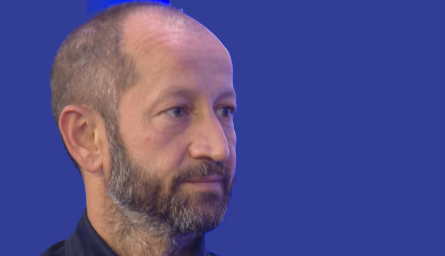
Libera councillor Vladimiro Selva spoke on the morning of Tuesday 24 November during the debate under item 7 of the Grand and General Council’s agenda, dedicated to the ratification of the Association Agreement between the Republic of San Marino and the European Union.
Below is the full text of his address.
I would like to begin by acknowledging the work of everyone who, over many years and with great dedication, has contributed to achieving this result, starting of course with Secretary of State Luca Beccari, who in recent years has embodied this commitment.
In many ways, he has also been the one who, more than anyone else, has had to bear the weight of this process during moments of difficulty, standing at the forefront of those determined to see through the work that has led the Republic of San Marino to be recognised as a partner by the European Union, to sit at the negotiating table alongside Andorra, and to reach the signing of an agreement.
I believe this is the crucial element, beyond what is actually written in the Agreement — which is of course fundamental, important, and will be the subject of our discussions and further analysis. The key point is precisely the fact that San Marino has been recognised by the European Union as a state with which to establish, in full standing, a relationship of association.
I believe this in itself represents a historic moment — the fact that we sat at a negotiating table with the European Union on the other side, which recognised us as an autonomous and sovereign state with which to open relations of association, not accession, as the Secretary of the Christian Democratic Party also reminded us on several occasions.
In this regard, we must remember that the position we had taken back in 2013 was framed differently. We were strongly convinced then, and honestly remain so today, that full membership of the European Union could have offered our citizens further advantages, starting with the fact that they would have become European citizens to all intents and purposes.
With the Association Agreement, we remain San Marino citizens, not European citizens, but as San Marino citizens we will have the opportunity to move freely within the territory of the European Union, to do business there, and to move capital and goods within the European market.
It is clear that this crucial element also brings obligations for the Republic of San Marino.
These are obligations, however, that belong to a political horizon we have shared and embraced for some time — that of respecting international rules and recognising that, if we want to engage with other states and with the international community, we must abide by the rules that community has set for itself to govern relations between states.
This is the political horizon in which we recognise ourselves, and, to be fair, I must say it is not confined to the majority political forces alone. Several opposition forces too, such as Repubblica Futura and Rete itself, are strongly convinced of the need to move in this direction, at least based on what has emerged from their statements, and they share this important step.
Recognising oneself in this horizon and embracing it as a goal also represents, in my view, a kind of dividing line between those of us who believe we can lead the country from now on, and those who instead cling to a backward-looking vision, one that would bring San Marino back to a model built on certain old pillars.
I am referring to those pillars that truly caused a great deal of damage to our financial and economic system, such as banking secrecy and corporate anonymity.
We should remember how difficult it was to deal with certain situations. In 2005, we even chose to reject an agreement with Italy, and from that choice stemmed a whole series of dynamics that we know all too well, the consequences of which took us more than ten years to overcome.
Today we have many opportunities before us, and this legislature’s very government programme started from this premise — the will to support the Association Agreement, first by achieving its signature and then by working on its implementation.
This is because the implementation of the Agreement will not automatically produce positive results, as one might sometimes be led to think, even in good faith, by praising the merits of signing the Agreement itself.
I too am absolutely convinced of the merit of this step, but we must be aware that a new journey begins today. A journey that will require study, in-depth analysis and the drafting of regulations, always in compliance with international rules, in order to put ourselves in a position to seize some advantages in economic and competitive terms as well.
This is because it is not true that all European Union regulations must automatically be transposed and reproduced in exactly the same way. The principles and logic underlying those regulations must be respected, but every country has the ability to adapt them according to the characteristics of its own reality.
Precisely through that process of adaptation, in some cases, opportunities for development may also emerge for our economic system.
All of this, however, belongs to the phase that opens from today onwards — a phase in which we will truly need to get used to engaging with European regulations in a much more in-depth way than we have done so far.
I am not referring so much to compliance with the rules, because if we wanted to trade with Italy or sell our products on the Italian market, those rules had to be respected regardless of whether an association agreement existed or not.
Today we have the advantage of being able to interact more, first and foremost at the moment when those rules are being drafted. There will be bodies within which San Marino too will be able to express its position and provide its contribution.
Later, when those regulations need to be applied, we will also have the opportunity to adapt them in a specific way, taking into account the characteristics of our community and seeking to obtain the greatest possible advantage for our economic system.
Returning to the more strictly political aspect, as my colleague Giuseppe Maria Morganti — who is here beside me today — recalled yesterday at the opening of the debate, this Agreement and the willingness to embrace this path define a political horizon in which several political forces have recognised themselves and which they intend to pursue.
I believe that this majority, as well as the majorities that will follow in the future, cannot disregard this premise — namely, the determination to achieve the best possible outcome for the country through the implementation of the rules and commitments contained in the Agreement we are about to ratify today.
From this point of view, I believe credit should also be given to the role of the Christian Democratic Party itself, which has been one of the political forces that has most consistently pursued this goal, also having put forward, through its own party, the Secretary of State for Foreign Affairs.
This is something that deserves recognition because, indeed, based on some of the remarks we have heard, it is probably not always easy for a party of conservative inspiration to adopt an approach of this kind.
Yet this is a necessary innovation, a useful one for the future of our country. It is an innovation around which we have found common ground, and one that we trust we will be able to continue pursuing, in the best possible way, in the interest of the Republic of San Marino.