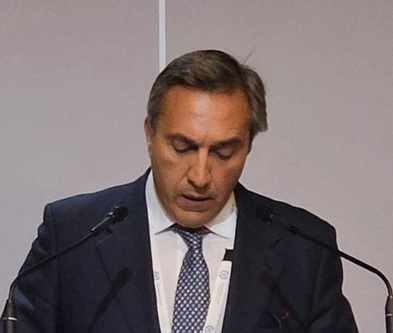
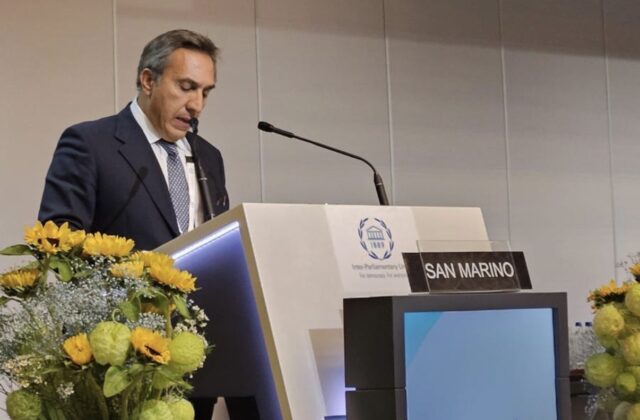
Francesco Mussoni, a councillor for the Sammarinese Christian Democratic Party (PDCS), spoke on the morning of Tuesday, 24 November, during the debate on item 7 of the Grand and General Council (Consiglio Grande e Generale) agenda, dedicated to the ratification of the Association Agreement between the Republic of San Marino and the European Union.
Below is his speech in full.
I must say that, as was also underlined yesterday at the opening of the item devoted to Europe, today’s session is indeed a historic one. It is historic because we are discussing the ratification of the Association Agreement with the European Union, and this undoubtedly represents a unique turning point for our country.
On this point I would like to offer a reflection that has perhaps already been made, but which I would like to frame in a somewhat different way.
I believe that, considering this process essentially began in 2012, with all the work carried out on the dossier and the involvement of the various governments that have succeeded one another, the Agreement is also the product of a political class, of a political generation that had to face particularly complex historical moments for the Republic of San Marino.
I think, for example, of the situation in 2010, when our country was living through a period of political encirclement, going through a severe economic crisis and having to deal with a particularly high level of unemployment.
I recall that we had an unemployment rate of 12%, with around 1,100 people out of work.
I also recall the budget problems of 2012, 2013, 2014 and again 2016, the issues of international credibility our country faced, the difficulties in relations with other states, and the need to rebuild and consolidate those relationships.
I particularly recall, too, the discussions on the budget of the Social Security Institute (Istituto per la Sicurezza Sociale), when we found ourselves having to reason over a budget of 64 million euros.
About ten years have passed, which is not a particularly long time, and yet the factors at play have changed profoundly.
I mention this, drawing somewhat on memory, to recall what we went through and what the political class, in certain years, had to face in order to steer the fate of the State, to overcome the difficulties tied to international credibility, and to accompany a process of repositioning and reorganisation of the country, made necessary by crises that were certainly banking and financial in nature, but which also affected the overall credibility of the Sammarinese system.
The political generation, the political class of which I too believe I have been part in these years, has developed this path of association with the European Union.
As a result, governments, political forces, but also trade associations, unions and, more broadly, Sammarinese society as a whole, wanted to make a systemic choice.
It was the choice of a ruling class and a country that no longer accepted that political reasoning be confined solely to the San Marino-Rome relationship, but that wanted to broaden that reasoning, the organisation of the State, its potential, and the rights and opportunities of its citizens, placing them within a European dimension.
It was a conscious choice, not a random one.
It was a choice developed by a political class that wanted to avoid recreating those mechanisms and situations we suffered in the past, which, as it happens, had also stemmed from the failure to sign the agreement against double taxation with Italy.
These were situations arising from a lack of willingness to cooperate, to open up exchanges, to organise the exchange of information, and above all from a fundamental political error: that of thinking that we were simply ourselves and that everyone else did not exist.
That is not the case, because we are part of a European context, a context of rules and exchanges that has its own workings and its own characteristics.
All of this will be set out through the Association Agreement across various sectors, particularly the banking and financial sector, on which I see discussion continuing a great deal. But can we really think of accessing the European market as we wish, while keeping only our own rules?
Can we think that our country can carry on doing as it pleases within a European market made up of 27 states?
I believe that this Agreement represents a great opportunity for the banking and financial sector as well. It is clear that it is an opportunity only insofar as we accept to play by the rules, to play on equal footing with others, to work on capital, investment and services for the benefit of citizens and businesses, without thinking we can play a different game.
Since we, as a political class, have played this game over the years, together with Sammarinese society, trade associations and broad sections of the business world, I believe that this is truly the match of the future. It is the match that concerns our country’s future political generation, Sammarinese young people and, more broadly, all our citizens.
It is clear that this new institutional framework and this new system of rules bring with them challenges, concerns, important work to be done, and paths that, in some respects, still present uncertainties. We must not forget, however, why we made this choice, where we come from, and what perspective we want to move within.
I therefore believe this is an extremely significant starting point, one that also contains within it a historical and political reading of the last ten or fifteen years of our economic and political history, years that have had very particular characteristics.
I believe a new political foundation and a new axis of institutional reasoning is opening up between San Marino and Brussels, one that will, in my view, positively involve people, their rights and also their duties, within a dimension different from the one we have known until today.
This is indeed a major systemic change. We will remain ourselves, because we will continue to be a third country and will retain our institutional characteristics.
Certainly, though, our way of reasoning will change, as will the level of complexity of the issues we will have to address, the methods for transposing regulations, and the rights that our citizens and young people will be able to benefit from.
The way the political class must engage and relate with European institutions will also change.
From my point of view, this will be a challenge and a change that we must know how to embrace without excessive fear, welcoming with enthusiasm the new approaches and new working methods we will be called upon to adopt.
Today’s session is therefore truly a historic moment.
A new phase is beginning and, in my view, a particularly important historical and economic phase for our country is coming to a close.
I believe this result certainly belongs to the current Government and majority, but it also belongs to a political class that, over these years, has shown commitment, identified a goal and built a horizon, all while having to manage a particularly complex political, economic and institutional reality.
A reality that, in some respects, will still need to be supported going forward, because certainly the problems will not end with the ratification of the Agreement.