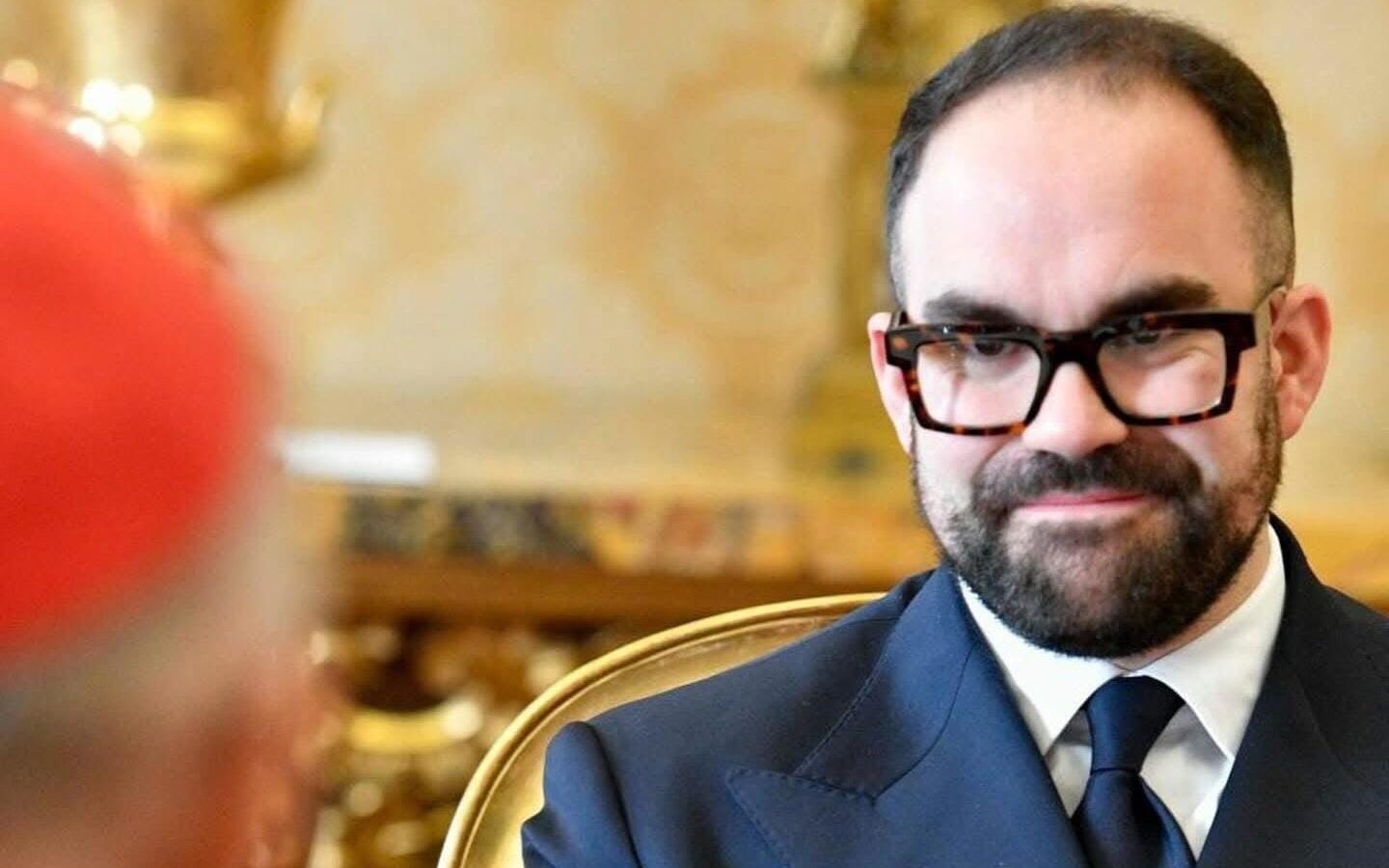
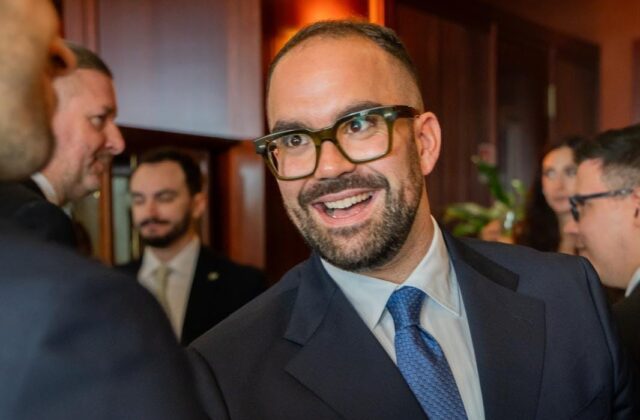
Lorenzo Bugli (Pdcs) spoke during the debate on item 7 of the agenda of the Grand and General Council, dedicated to the ratification of the Association Agreement between the Republic of San Marino and the European Union. The councillor retraced the political and electoral milestones that accompanied the negotiation, responding to those who argue that citizens were never involved in the European choice.
At the heart of his speech was also the need to speed up regulatory adjustments and to approach the implementation phase of the Agreement with seriousness and responsibility.
Below is the full text of Lorenzo Bugli’s address.
Today, at last, with this ratification, we close the first round of what has been a journey spanning twelve years of work, four governments, four Secretaries of State, four general elections and four different ruling majorities.
This is because, as Councillor Francesco Mussoni, who spoke before me, rightly said, this has been a path born of a conscious choice — the choice of a mature political class that wanted to close a dark and gloomy chapter of our history and open a virtuous, transparent path forward.
It is a path along which we sought to engage with those partners who, like us, needed San Marino to speak a mature language — a European language, a language of transparency and prosperity.
Secretary of State Alessandro Bevitori, who spoke before me, said that this has been a path about which, with few exceptions, politics never had doubts. In truth, I believe no one had doubts about the need to undertake this journey.
We must be extremely clear on this point, because, as I said earlier, four different majorities, made up of the political forces represented in this chamber, have firmly carried forward the path of association with the European Union.
They did so because it is a choice of responsibility, a conscious choice that looks to the future of our generations.
I would like to share another figure, because this morning I enjoy making this point through numbers. The Association Agreement with the European Union, European integration or even EU membership have featured, from 2008 to today, in no fewer than fourteen different political programmes.
Across those election rounds, voter turnout went from 89.82% of eligible voters in 2008 to 76.98% in 2024.
So we are talking about a significant turnout at the polls, and about political forces that had included European integration or membership within their own programmes. If we then look at the composition of the ruling majorities, we see that we have gone from a majority that in 2008 represented 54.22% of the vote to one in 2024 representing 69.8%.
When we hear it said that citizens were never able to take part in shaping the country’s future, and that this was not a shared choice, I believe there is something that does not add up in that reasoning. If we look at the numbers, we see four governments and four different majorities, which obtained levels of support often significantly above 50%.
Citizens have had their say, they have voted, and through that vote, they asked for this country’s economic model to change.
They asked for a better, more transparent model to be built — one capable of looking to the future of new generations, with a system that, as the colleagues who spoke before me also recalled, can help the banking sector evolve, improve healthcare agreements and develop all the useful negotiations needed to allow our country to engage with its international partners.
A system that allows us to adopt the rules and, above all, to seize the great opportunities offered by the European market. That is the true meaning of the Association Agreement with the European Union.
This is a political agreement, not a merely technical one. It is not an agreement that someone drew up in secret and that suddenly landed on the attention of this chamber. It is a deliberately political agreement, one that the political forces represented here chose, through a precise decision, to bring to completion.
This Agreement matters because, from today, it opens what we might call the second round. As soon as we ratify this step within the Grand and General Council, this second phase will begin.
We will then see whether anyone among those who were part of the majorities that supported this path will today decide to abstain or take other positions, perhaps hoping to pick up a few extra votes.
I believe that today, with the ratification of the Agreement, we open the second round — a round of great responsibility.
This is a phase whose foundations we know well, because we ourselves negotiated that Agreement, through precise political choices.
We have seen the work of our technical experts at the negotiating tables, our officials, our diplomatic corps and all those who, over the years, contributed to carrying this Agreement forward, while preserving and safeguarding our distinctive character as a small sovereign State — a State that must find its way within a larger market without losing its own identity in the process.
We know that Agreement well, and the second round is called responsibility. It is a responsibility that calls on us to make a series of fundamental choices, which can no longer be postponed and which, above all, we ourselves chose to pursue.
We will need to move forward swiftly on the various dossiers, in order to be ready and accountable to the partners with whom we conducted these negotiations.
This second round will therefore keep us very busy, and the whole political class must be involved and aware of what needs to be done, without continuing to carry with it the nostalgia that some, at times, still hold in their hearts for an old Republic — for a model of country built on opacity. That model is no longer possible.
This second round demands seriousness and responsibility. That is what I wanted to bring to the attention of this chamber through my address.
When we speak of the awareness behind this political choice, we must recognise that this Agreement represents one of the most conscious political decisions we have ever made. It is an agreement about which everyone in this chamber knew exactly what was at stake.
The various political forces took part, over the years, in four governments, had included this goal in their own programmes, and citizens voted for them also so that they would carry this path forward.
The narrative suggesting that no one knows what the Agreement contains, or that we are not ready to face its consequences, as I already said a few days ago in the Foreign Affairs Committee, simply does not hold up.
Unless, of course, someone is trying to win over the support of those hundred keyboard lions who, perhaps, once the Agreement comes into force and Amazon’s services are finally unblocked, will dwindle to fifty.
Mind you, I am not saying the Agreement is perfect or that everything will work automatically — but we cannot build a political argument on the basis of the opinions expressed by a small number of people on social media. The numbers speak clearly: there have been strong majorities, citizens have voted, and they have expressed their will.
Today we ratify the Agreement, and we begin the second round.