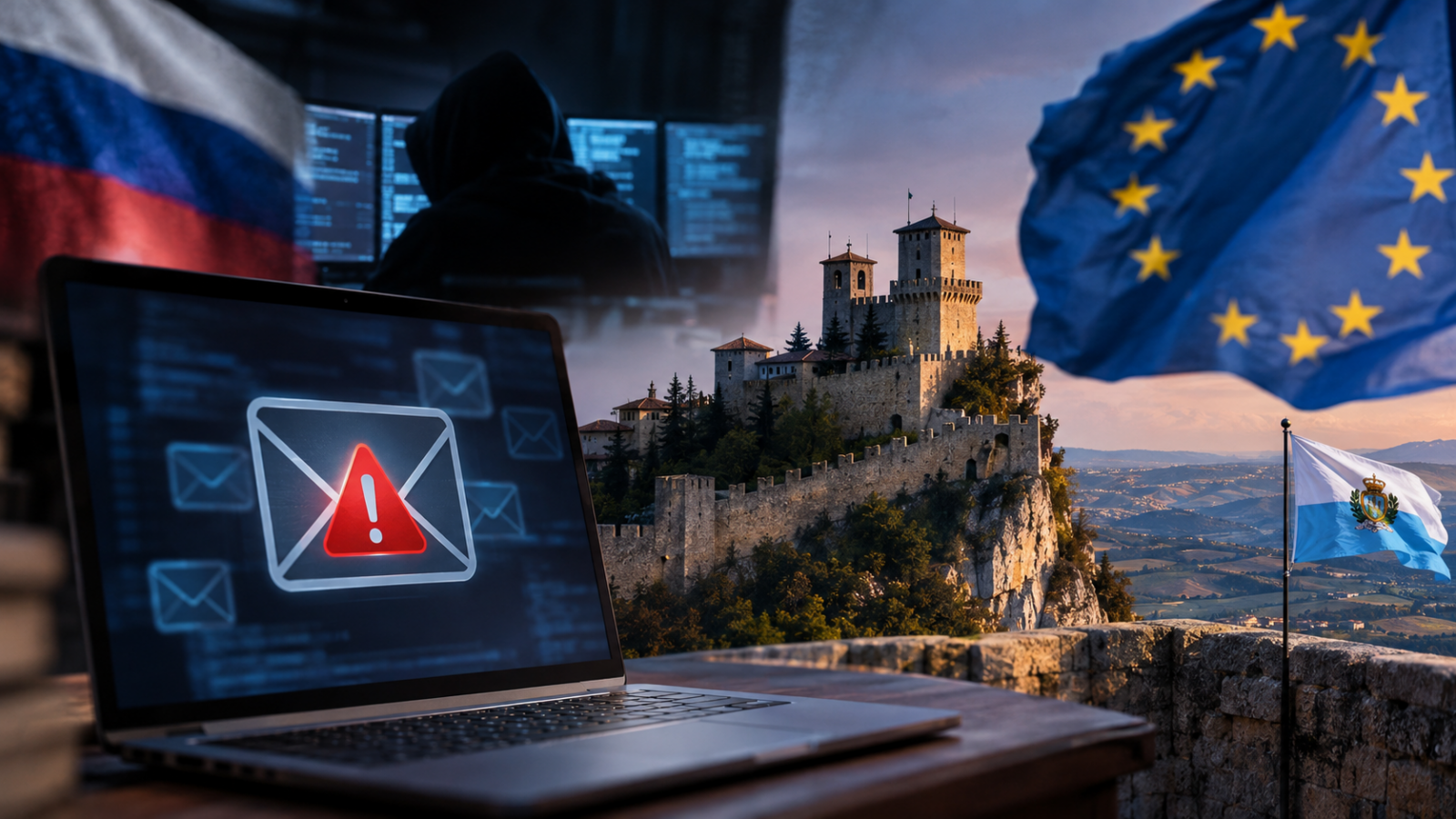
On October 19, the same day San Marino signed the Association Agreement with the European Union in Brussels, a hundred Italian schools received emails announcing non-existent bombs. A coincidence, almost certainly.
But between now and ratification, the Titano is entering a season in which small countries moving closer to Europe become interesting to those who wage war without declaring it.
And it takes very little to hit San Marino.
The precedent worth studying isn’t Ukraine — it’s Moldova.
Between 2022 and 2023, Moldova logged more than four hundred fake bomb alerts, and its prime minister said they were coordinated from abroad by those seeking to halt the country’s European integration. San Marino is not Moldova: it has no disputed borders and no foreign troops on its soil.
But it shares two things that matter: it is small, and it is heading toward Brussels. For Moscow, moreover, the Titano has officially been a hostile country since March 2022, when it landed on the same list as Italy and the entire European Union.
The rest is arithmetic.
With roughly 34,000 inhabitants, a hundred fake profiles in a Facebook group amount to 0.3 percent of the population: to achieve the same proportional weight in Italy, you would need more than 170,000 of them.
A single email can empty every school in the Republic in one morning, and a false rumor can circle the country before lunchtime. Hybrid warfare thinks like a business: maximum effect, minimum cost. On the Titano, the cost is nearly zero.
The tools, moreover, have already been tested here.
The Central Bank had to debunk fake AI-generated videos in which its president appeared to be inviting people to invest.
In February 2025, an attack attributed to pro-Russian hackers knocked the website of the Municipality of Rimini — just a few kilometers from the border — offline.
And the emails of recent weeks were also sent from compromised accounts: a San Marino company’s inbox secured with a ten-year-old password is worth just as much to an attacker as a government ministry’s.
The good news is that defense, too, is cheap. What’s needed is a single coordinating body able to tell a school or an office within ten minutes whether a threat is credible.
What’s needed is a direct line to those in Italy who see the same emails at the same moment, because the Agreement opens up the European market to San Marino — not the rooms where Europe shares its alerts. What’s needed are businesses that stop believing they’re too small to be worth targeting. And what’s needed is a media that verifies before amplifying, especially in the coming months, as the Grand and General Council (Consiglio Grande e Generale) prepares to vote on ratification.
On the Agreement, the people of San Marino have every right to be divided, and to be so openly. What matters is that they are the ones deciding — not a hundred profiles created the week before.
Neutrality protects San Marino from tanks. Not from the mail.
Osservatorio Strategic.sm