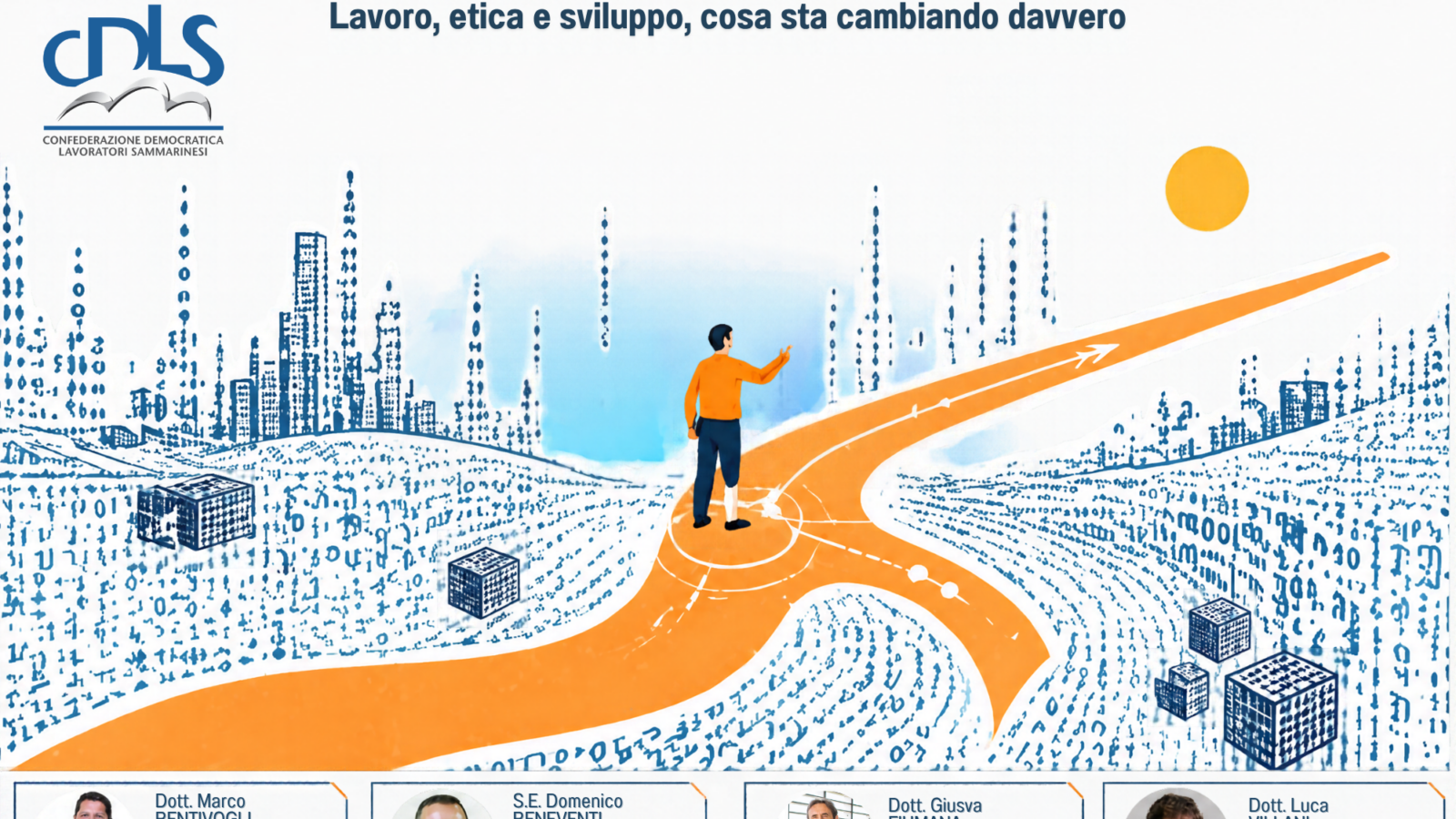
How is the world of work changing under the influence of artificial intelligence? What opportunities are opening up for businesses, and what risks need to be addressed? These are some of the questions at the heart of a meeting organised by the CDLS (Democratic Confederation of Sammarinese Workers) for Thursday 19 November at 3pm, at the Sala Joe Cassar in Borgo Maggiore.
The debate, titled “Artificial Intelligence: two years on. Work, ethics and development: what is really changing”, picks up the conversation the union launched two years ago, when attention was focused mainly on the risks and opportunities of a technology still in its early stages of adoption.
Today, artificial intelligence is increasingly present in companies, services and professions. The CDLS therefore wants to take a closer look at its concrete effects on employment, on the skills demanded of workers, and on the choices that San Marino itself will have to make.
Opening the discussion will be Marco Bentivogli, an expert in labour policy and industrial innovation and former secretary-general of Italy’s FIM CISL union. He will analyse the impact of artificial intelligence on productive activities, job roles and the evolving labour market.
The Bishop of San Marino-Montefeltro, Monsignor Domenico Beneventi, will instead address the ethical dimension, focusing on the centrality of the human person, the responsibility behind automated decisions, and the limits that should be placed on the use of new technologies.
Business perspectives will be represented by Giusva Fiumana, ICT director at Passepartout S.p.A., who will outline the concrete applications of artificial intelligence within San Marino’s economic fabric, along with the opportunities for growth and the challenges that remain.
Finally, Luca Villani of the CDLS Research and Studies Office will examine the policies and initiatives through which San Marino is seeking to carve out a role for itself in the field of technological innovation.
The aim of the meeting is to bring together these different perspectives and discuss how to support the digital transformation while protecting jobs and valuing skills, without overlooking its economic and social consequences.