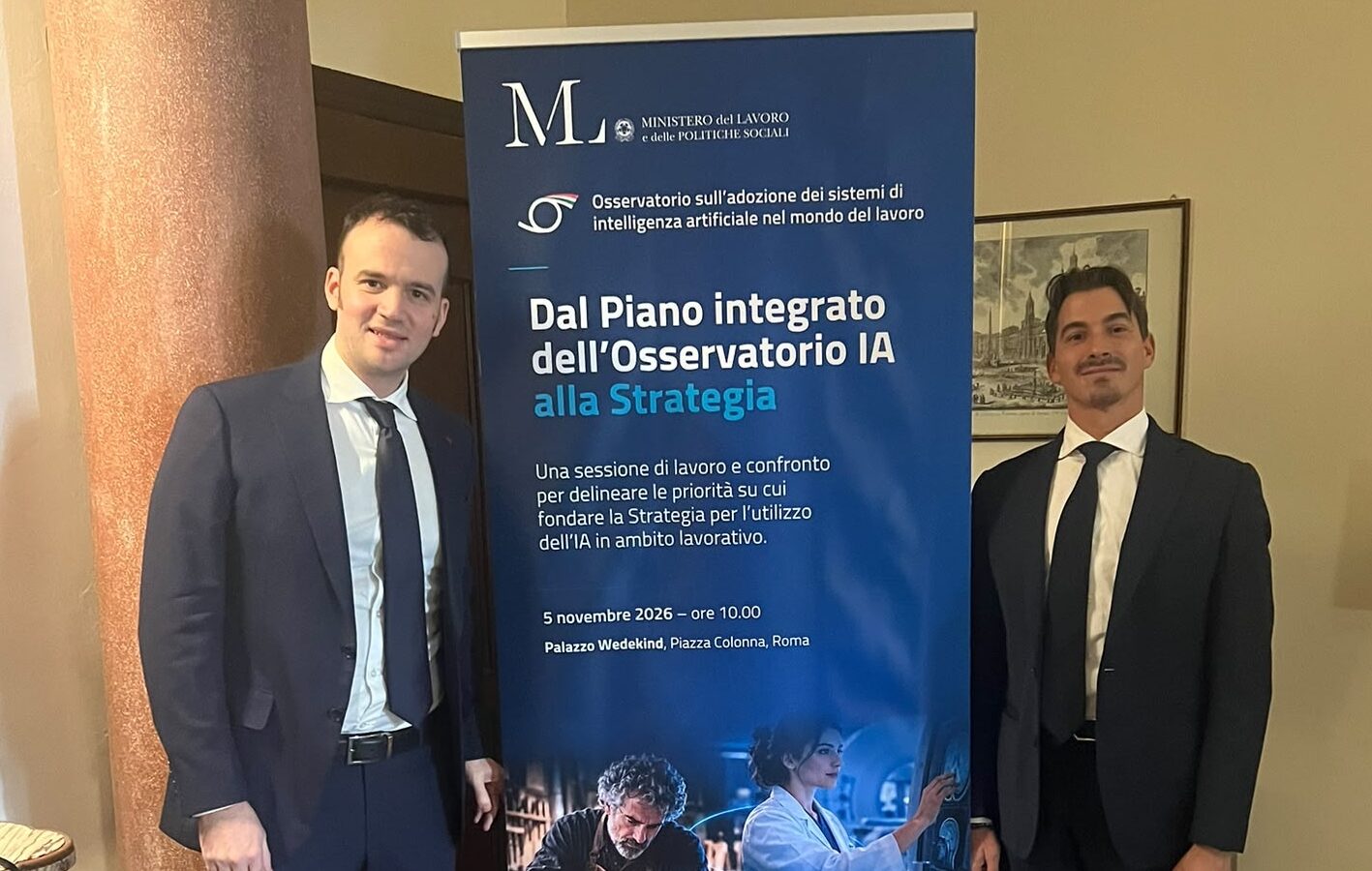
San Marino took part in the proceedings of the Observatory on the adoption of artificial intelligence systems in the workplace, which convened today, 5 November, in Rome at the headquarters of Italy’s Ministry of Labour and Social Policies.
Representing the Sammarinese government was Stiven Ciacci, private secretary at the Secretariat of State for Labour. The participation follows talks held in recent days in Geneva with Italian minister Marina Calderone.
“Being present in Rome,” Ciacci commented, “allows us to place San Marino within a high-profile institutional network, essential for understanding and anticipating the profound transformations that artificial intelligence is bringing to the labour market and to corporate dynamics.”
The Observatory’s task is to analyse the effects of artificial intelligence on production processes, businesses and worker protections. According to the Secretariat, the body was established under Italian law no. 132 of 23 September 2025, regulated by the subsequent ministerial decree no. 173, and became fully operational last June.
Working in collaboration with INAPP (Italy’s National Institute for Public Policy Analysis), it monitors the sectors most affected by these changes, with particular attention to training and professional retraining.
During the session — attended by institutional representatives, the Social Partners’ Council and experts from the technical-scientific committee — discussions focused on the impact of automation on employment, the ethics of algorithms and corporate adaptation strategies.
“Technological evolution is not an external variable to simply endure, but a structural challenge that calls for far-sighted, shared governance,” said Secretary of State for Labour Alessandro Bevitori.
“Taking part in the national observatory has allowed us to engage directly with the best European practices and to place San Marino’s digital transition policies within a regulatory and strategic framework of the highest standing.
The work we are carrying out on the ecological and technological transition must go hand in hand with the protection of rights and the enhancement of our citizens’ skills.”
According to the Secretariat, participation at the table serves to strengthen cooperation with Italy and to gather useful insights to support Sammarinese businesses in adopting new technologies — balancing competitiveness, job quality and workers’ rights.