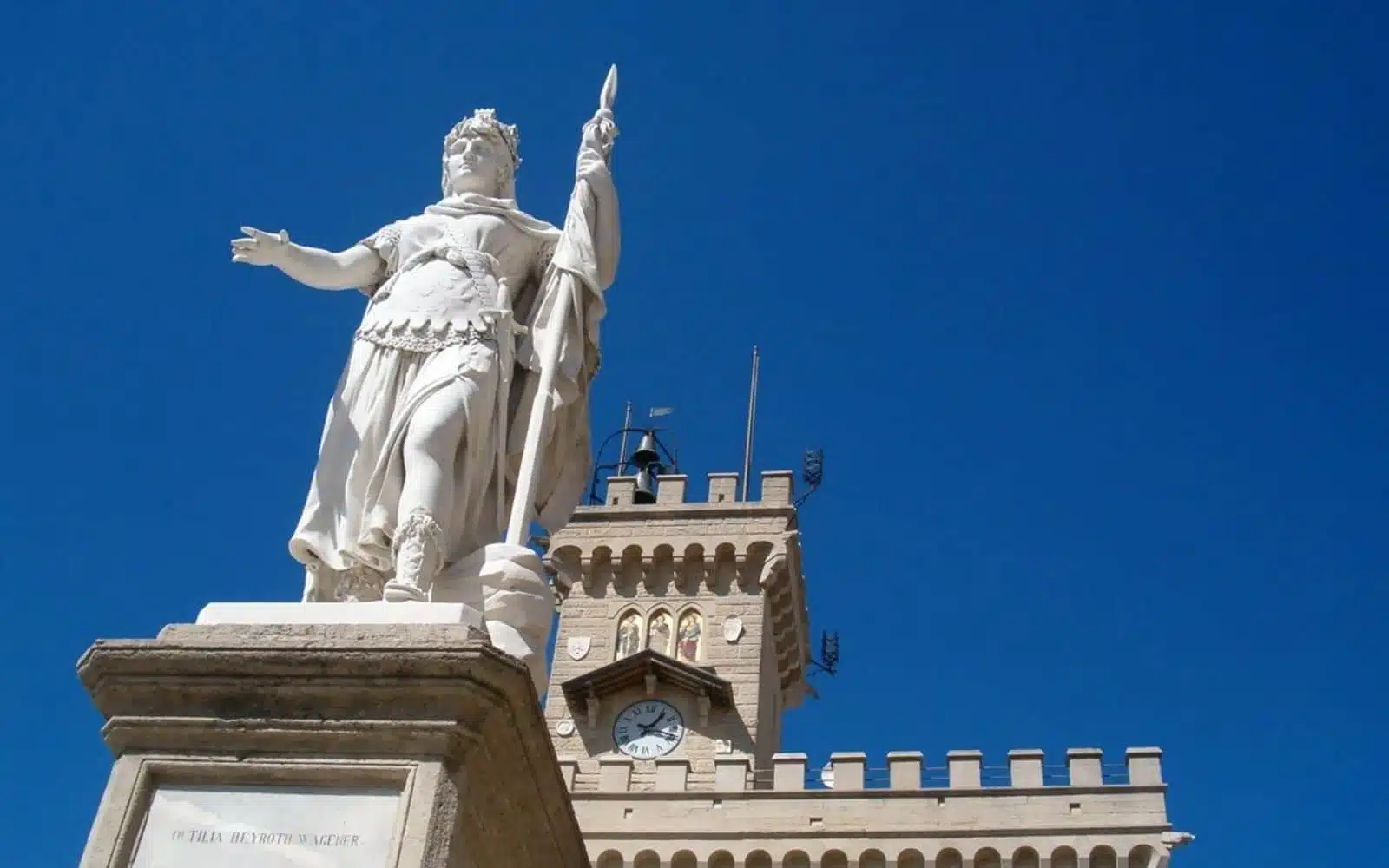
The threshold for direct awards of goods and services by the public administration rises from 2,600 to 25,000 euros. This is one of the changes approved by the Grand and General Council (Consiglio Grande e Generale) on the afternoon of Thursday, October 29, a session dedicated to the ratification of decrees.
Majority approval was also given to rules protecting San Marino’s name in sport, on the recovery of impermeable soils, on private university institutes, on controlling the pigeon population, and on tax agreements for companies operating in multiple countries.
On procurement, debate centred on the balance between faster procedures and spending controls. Secretary of State Andrea Belluzzi defended the higher threshold as a necessary step to allow managers to work with greater autonomy.
“We cannot demand accountability and managerial autonomy and then limit the ability to act directly to just 2,600 euros,” he observed. Artificially splitting purchases to circumvent procedures remains prohibited.
Calls for safeguards also came from within the majority.
Iro Belluzzi, of Libera, shared the objective but warned that “everything becomes discretionary — perhaps too discretionary,” proposing that the reasoning behind awards be documented. Carlotta Andruccioli, of D-ML, called for attention to prices, competition and supplier selection, urging that “simplification should not be confused with a reduction in safeguards.”
For Matteo Rossi, of the PSD, the current procedures can instead create real difficulties, especially in schools, where tender timelines risk forcing the use of substitute services and additional costs. “Cutting red tape does not necessarily mean cutting controls,” he argued.
Alignment with European rules was also on the table. Matteo Casali and Antonella Mularoni, of RF, asked about the progress of the regulatory review.
Andrea Belluzzi announced that the consolidated law on public procurement is at an advanced stage and that, after this council session, discussions with political forces could begin. He also expressed willingness to consider a circular to guide administrations in choosing procedures.
Casali welcomed the announcement, asking that small and medium-sized San Marino businesses be prepared for the change.
The afternoon opened with debate on protecting the name and image of the Republic in sporting activities, with the San Marino Calcio case at the centre of discussion. Doubts were also raised about the powers granted to the Sammarinese National Olympic Committee and the consequences of a name change mid-season.
Luca Della Balda, of Libera and former president of San Marino Calcio, announced his opposition, criticising the urgency of the measure and certain aspects of the liquidation of the sports association linked to the team competing in the Italian Eccellenza championship.
“We are councillors of the Republic, and legislative power belongs to the Grand and General Council, not to the Congress of State,” he stated.
Secretary of State Rossano Fabbri rejected the idea that the measure was aimed against Montanari. He explained that the urgency stems from the compulsory liquidation of the association holding the registration required to compete in Italian championships, confirmed on appeal, distinguishing its position from that of the joint-stock company.
These clarifications brought positions closer together. “The reasoning changes.
It changes completely,” acknowledged Zeppa, while still maintaining calls for safeguards.
During the review, an amendment was accepted that limits the measure’s application to associations, federations and sports clubs under Sammarinese law. Fabbri also confirmed that CONS regulations had already been corrected regarding foreign clubs. Rete withdrew its amendments seeking to strike down the measure, though it maintained doubts about the thirty-day window for name changes and about the penalties involved.
The debate grew more heated over measures to remove impermeable paving and restore green space. The measure, presented by Secretary of State Alessandro Bevitori, aims to reduce heat in urbanised areas and improve rainwater absorption.
It provides for the identification of priority public areas and a reduced 5% single-phase tax rate on plants and vegetation materials used for such projects.
Francesco Mussoni and Massimo Maiani, of the PDCS, backed the measure, calling for efforts to be concentrated in the most heavily built-up areas, town centres and industrial zones.
Casali, however, criticised land management policy, challenging references to Piazzale Menicucci and Parking Area 6 in the absence of a broader plan for parking and connections to the historic centre. “We keep moving forward by slogans,” he said.
Secretary of State Matteo Ciacci responded sharply: “Some get things done, others go to the microphone to sing their own praises.” Ciacci defended the initiatives already under way, acknowledging that the new measure alone will not solve the problem but offers a concrete tool for reclaiming impermeable surfaces.
He also put the estimated cost of the broader redevelopment referenced in the debate at 40 million euros, explaining that adequate time will be needed.
Michela Pelliccioni, of the mixed group, called for these measures to be incorporated into a broader climate risk strategy, involving Civil Protection and the University.
Sara Conti, of RF, urged a comprehensive vision and clarity on incentives for private citizens.
From the Libera benches, Giuseppe Maria Morganti, Giulia Muratori and Dalibor Riccardi defended the secretariat’s work, pointing to maintenance projects and works already carried out.
Debate was calmer on private higher education institutions. The new rule places the cost of evaluations needed to confirm accreditation on the requesting institutions, avoiding further public expense. Secretary of State Teodoro Lonfernini reported that UIPA and Regent European University are now operational, while three other initiatives are awaiting evaluation.
Nicola Renzi, of RF, called for an updated overview and close oversight.
Maria Donatella Merlini, of the PSD, insisted on quality standards: “Accreditation cannot be reduced to a bureaucratic formality or an initial document check — it must be a substantial guarantee.”
Lonfernini agreed with this approach, explaining that private institutions must complement public education provision and remain subject to rigorous monitoring.
The council also gave the green light to measures against pigeon overpopulation. Ciacci cited hygiene and health concerns, as well as incidents that forced the temporary closure of some offices at Palazzo Giangi. Ordinances and fines against feeding the birds will now be possible, as part of a strategy that does not include culling.
Aida Maria Adele Selva, of the PDCS, explained that population control relies on anti-fertility substances, and that uncontrolled feeding undermines their effectiveness. Casali questioned the need for a decree on the matter, while Zeppa called for periodic reviews of results to be reported to the relevant committees.
The final ratification concerned advance agreements for internationally operating companies, designed to provide greater tax certainty for businesses operating in multiple states through permanent establishments or affiliated companies.
Secretary of State Marco Gatti explained that the tool was developed partly through dialogue with Italy’s Ministry of Economy and Finance, but could also be used in dealings with other foreign tax administrations.
Management of the scheme will fall under the Secretariat of State for Finance and Budget, through the tax office.
Proceedings concluded shortly after 7:30 p.m. The Council will resume on Wednesday, November 4, at 9 a.m. at Palazzo Pubblico.