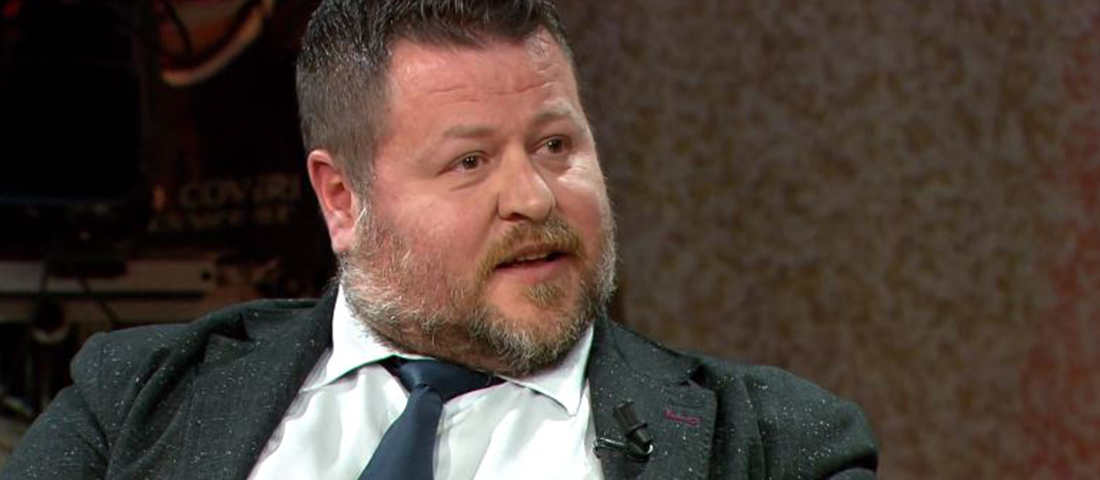
Below is the full text of Emanuele Santi’s (Rete) remarks in the Grand and General Council (Consiglio Grande e Generale) during the communications item.
Emanuele Santi (Rete): I too join in wishing you well for your six-month term, and I thank you for your opening address and for the messages you left us in this chamber, which we will try to take to heart. I cannot but start with the signing of the Association Agreement. It is a milestone, a historic step for our country — one that Rete had already called for back in 2013. When the referendum on full EU membership was held, we were opposed, but we argued that an association agreement, a bespoke arrangement, was the right path for San Marino. That is precisely the road that was eventually taken, and one we supported. I believe that, from the statements made today by the Secretaries of State, there is full awareness that the time for celebrations and toasts is over. It’s good that they took place, but today we absolutely must start working, because a great deal of time has already been lost over these three years. Just a week ago, in the joint First and Second Commissions, Secretary Beccari presented us with a list of the laws that need to be passed. We had a rough idea of what they would be. Now we have it in black and white: we will need to make at least twenty legislative changes to be compliant with the regulations. Some will also require several implementing decrees. Since it has long been known that these measures would be necessary, I think too much time — far too much — has been wasted. Many measures should already have been ready. Instead, we’re still at the stage where consultancy work has been commissioned — necessary, granted — but set for September 2026. Secretaries of State, perhaps that work could have started a little earlier, studying the regulations and preparing the groundwork. We are confident, and if the forthcoming legislation aligns with our principles and values, we will have no hesitation in supporting it. But we cannot keep describing the Association Agreement merely as a “potential opportunity.” Opportunities must be seized, and to seize them we need to start moving faster. Very little has been done on the information front. Even today, people stop us in the street and have no idea what was actually signed. That is serious. In our small way, as an opposition force, we have tried to explain it; other governing forces have tried too. But too little has been done, and we need to admit that to ourselves. Among the population, it is still not at all clear what this agreement actually is. So the goal must be for all of us, together, to do much more on communication, which has so far been, to put it mildly, poor — if not irrelevant. As for the state of the country, I think there is little room for triumphalism and little to celebrate. We have the housing emergency, which is turning into a social emergency. Families are struggling to make ends meet. The cost of living has risen exponentially in recent days and will rise further still. Look at what is happening in Italy: transport strikes, fuel prices through the roof. These are the issues we need to start addressing, and above all we need to bring forward initiatives and ideas, which we will do shortly. We need to start acting, not just repeat that the agreement offers opportunities: we are not seizing them, and we have problems to solve today that are sitting right there on paper. Buying a home has become an ordeal — not to say impossible — for a young couple, with prices sky-high for both purchases and rentals. We are very concerned about this situation, and it seems to me that the government is more focused on self-praise than on solving citizens’ problems. I did not like Secretary Gatti’s remarks, but that is nothing new. A Secretary of State who comes here to report on the Titano Games and on the ship affair gives us two statements in which he downplays the scale of what happened. I will not accept that. Titano Games is a company wholly owned by the State, which generates more than twenty million euros a year in revenue and employs more than a hundred people. It is a company that must be safeguarded. But can we really say that all the safeguards are in place? Yes, perhaps all the safeguards exist on paper, but if the accusation is that someone potentially managed to launder seven and a half million euros, then clearly some safeguard failed. So fine, let’s have the audit, but we need to start acknowledging that in this country the rules and regulations probably leave loopholes wide enough for someone to slip through and keep engaging in practices we claim to want to eradicate. If this did happen — and it will be established in criminal proceedings — then as politicians we must ask ourselves: are the rules too loose, or are there dishonest administrators or staff working there who sought out, or found, a loophole? We cannot simply say everything is fine, because in the end it is the State — the image of the State — that pays the price. It is not the opposition saying things are going badly. Our country’s image has been damaged by this affair, and that is not the opposition’s fault. We knew nothing about it; this investigation came to light, and we found ourselves caught up in a probe perhaps bigger than we are, yet those seven and a half million euros would have been laundered there. So we need to establish responsibility and perhaps also start asking whether, in certain top positions, after a certain number of years, some turnover might be necessary. We are not making accusations, but on this we cannot simply come here and say: the controls are in place, let’s do the audit. This is a serious problem, because we are talking about seven and a half million euros laundered. And that’s only what we know about — if there is more, we simply don’t know. If someone had found a way through, then we are not talking about just a few million euros circulating there: we are talking about hundreds of millions of euros potentially exposed to this risk. So let’s not joke about this, Secretaries of State — let’s not downplay it. We must get to the bottom of this and establish both responsibility and the truth. If there is a loophole that is too wide, we must act, because we cannot afford to walk into Europe while someone keeps exploiting our system to play games.
Another issue: everything here gets swept under the rug, everything is apparently fine. For four years now we have periodically had incidents involving ships. Two or three years ago, a ship — again in the Black Sea — was struck by a drone, and nothing more was ever heard about it. Six months ago, in international waters off Israel, one of our vessels flying the Sammarinese flag was seized by the Israeli National Guard, and again nothing more was heard. Now we learn that another drone has struck a ship. Secretary Gatti speaks of it as if it were a routine matter. Granted, ships sail the seas, but shouldn’t we be asking ourselves why these ships are always in the Black Sea, always in war zones, and why it is always ours that get hit? Proportionally speaking, Secretary, there are two hundred countries out there, there have been four attacks, and every single time it’s us. Is that a coincidence? We need to start asking why. There needs to be a thorough review of what is registered in our shipping registry, of where these vessels actually sail, and above all of whose interests they serve — because I would hate to think that someone, through these ships, is running some strange operation, perhaps involving oil.
One last point, as I’m running short on time: mammograms. Once again, someone stands up in this chamber and accuses the opposition of scaremongering. Let me read from this document: “Objective: mammography screening in line with the most up-to-date international guidelines. Action: ensure appropriate prescription of screening mammograms, adjusting the screening interval to two years. Result: a reduction in mammograms of at least 25% compared to 2025.” I did not make this up — these are the objectives set by the Executive Committee. So the Executive Committee had made a decision: to extend the screening interval from one year to two, thereby reducing the number of mammograms. A decision was made — only it was caught red-handed, and now it has had to be reversed. I remember it well: officials came here, to this very chamber, to defend that choice and to claim that we had been exposing our women to risk through too many mammograms. We remember that very clearly. So let’s not engage in demagoguery on these matters. There was a decision here, made at the expense of our women’s health, which was fortunately exposed, and has now been reversed. So this is not the opposition being nasty and obstructive: this is the opposition uncovering facts and decisions that were made. Then, as it happens, we learn that a private Sammarinese company had bought a mammography machine. Clearly, that is entirely lawful — private clinics do that sort of thing. They bought the mammography machine, with staff hired around the same period, no less. So on one hand we create hardship in the public system, in order to push patients toward the private sector. For us, that is unacceptable.