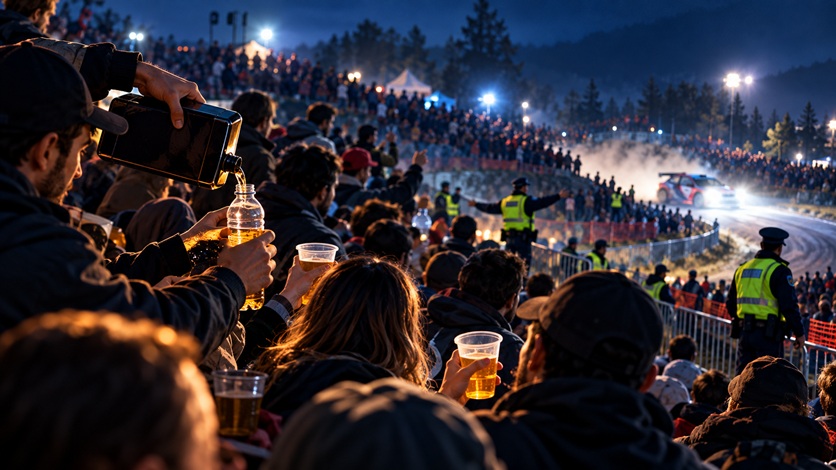
One evening during Rallylegend, 9:01pm, trackside: a fan drinks from a plastic bottle. Water or vodka? From that minute on, the difference is worth a thousand euros — and it will fall to a police officer, in the dark, surrounded by thousands of people, to tell them apart. This is the toughest special stage of the 2026 edition, and it won’t be run by the drivers.
Readers spotted the problem immediately: who’s actually going to check?
What if someone buys a strong spirit before 9pm and pours it into a plastic bottle? Technically, that’s allowed.
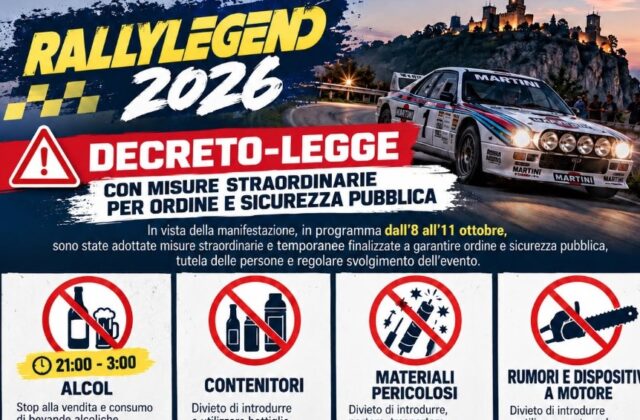
The decree bans glass and metal containers, not plastic. It bans drinking after 9pm, not carrying a bottle in a backpack. Thermal-camera drones can detect body heat, not the alcohol content of a cup.
Then there are the paradoxes.
For four days, San Marino fills with people who have come specifically for the noise — and yet, during exactly those days, it is forbidden to make noise with chainsaws (even without a chain), brush cutters and rigged devices.
Rally cars, fortunately, are exempt: no one is going to send them out on a special stage fitted with a silencer.
Alcohol is banned from 9pm to 3am — not before.
Anyone who started drinking at four in the afternoon will have had plenty of time to finish by nine.
Meanwhile, anyone dining at a restaurant within the restricted perimeter will have to forgo a glass of wine. It’s no surprise that one of the most-liked comments calls for the ban to apply all day.
And the restricted perimeter extends to 500 metres from the racing areas.
No one will be walking around with a tape measure: the line between a lawful drink and a thousand-euro fine will, once again, be drawn by the officers on the ground.
The numbers tell the rest of the story.
Last year, according to organisers, attendance topped 110,000 — more than three times the Republic’s population. This year there are seventy additional personnel on duty, along with cameras, drones and body cams. But across kilometres of mountain roads and woodland, that still amounts to a loosely woven net.
Yet the objection — “they’ll never be able to check everyone anyway” — misses the point.
The decree isn’t designed to fine a hundred and ten thousand spectators. It’s meant to give those out on the streets a clear rule and an immediate sanction against a reckless minority — the kind that last year turned the festival into a medical incident report, after firecrackers were thrown into the crowd at the “La Casa” stage, injuring eight people.
This year, there’s a thousand-euro bill that officers can issue on the spot.
It applies to anyone caught with a smoke bomb in their pocket, or firing up a chainsaw at two in the morning. Repeat offenders will find themselves on the brink of a stadium-style banning order (Daspo).
Rallylegend 2026 won’t be judged by how many fines are issued, but by how many ambulances are never needed.
For that, a uniform won’t be enough.
It will take the public doing its part too: the chainsaw can stay in the garage, and that drink after nine o’clock can wait.
The real roar will come from the cars.