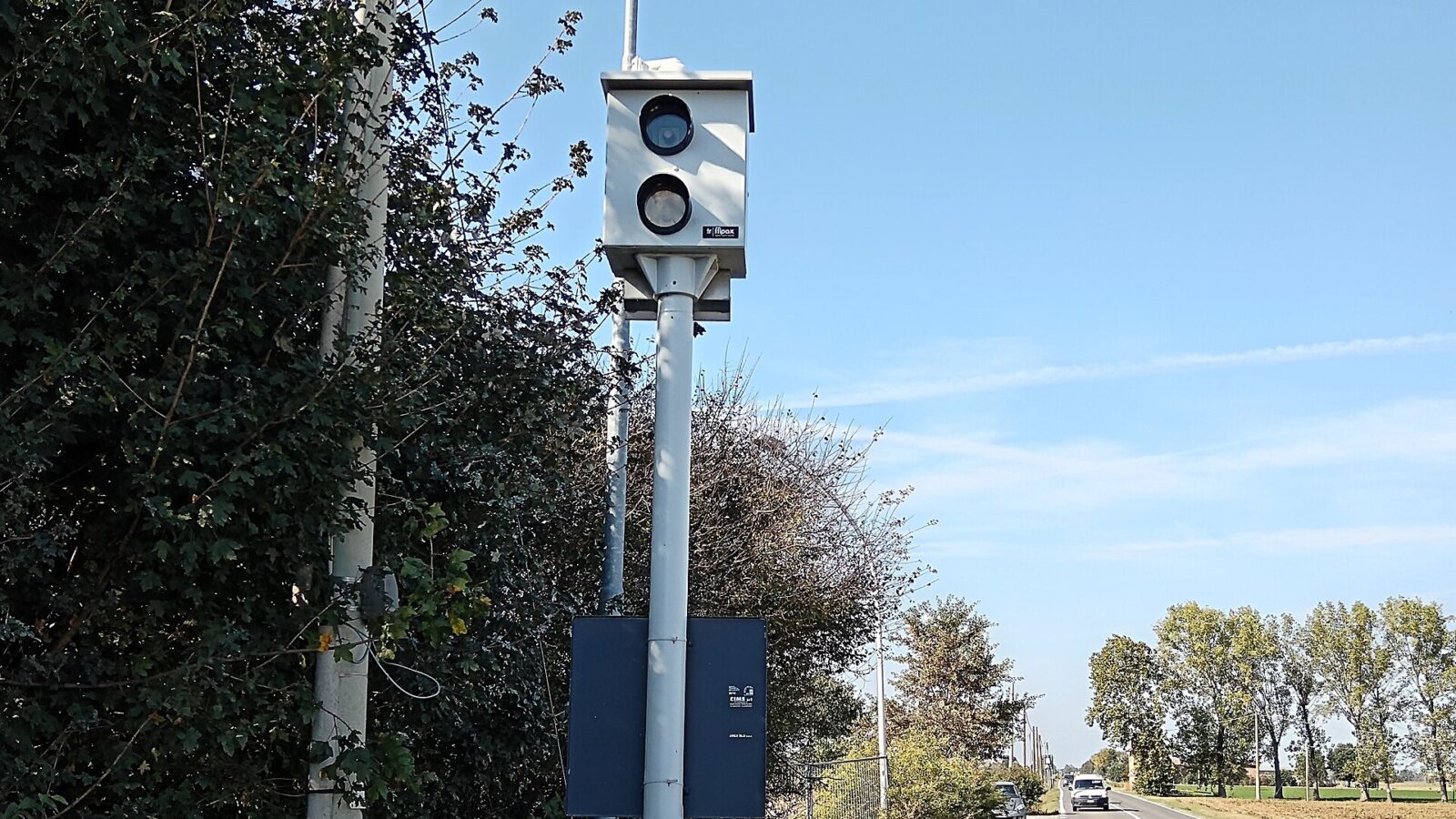
Two new speed detection systems are coming to Fiorentino. A bidirectional pole-mounted camera costing roughly 48,800 euros will be installed on Via del Passetto, while for Via XXI Settembre authorization has already been granted through a resolution passed by the Congress of State on 2 September 2025. The news was announced by the Secretary of State for Territory and Environment, Matteo Ciacci, during Council Commission IV, in the section dedicated to Arengo Petitions (Istanze d’Arengo) on road safety.
The process for Via del Passetto was a long one. The petition dates back to 8 October 2023; the Castle Council (Giunta di Castello) gave its favourable opinion on 19 November of that same year, and the Road Safety Working Group authorized the bidirectional speed camera on 4 June 2024. The real challenge was finding the right location: the intersection with Via delle Bruciate, the exit of Via Cà Bernardo, and the side near a local business all presented visibility issues, parking concerns and pedestrian crossings — and above all, they conflicted with a precise technical requirement, namely 21 metres of clear road before and after the induction loops that must be embedded in the asphalt.
This led the Working Group to unanimously opt for a different technology: a Velox system with a pole-mounted camera, which requires no loops and can monitor both lanes over a stretch of about one hundred metres using a single device. It costs more, but it can be relocated elsewhere in the future and could eventually be integrated with the territorial video surveillance system managed by AASS, potentially allowing for license plate recognition as well.
This case, however, opened up a broader debate, raised by Matteo Casali of Repubblica Futura: is it appropriate for an Arengo Petition to determine where a speed camera should be placed? “Should the Grand and General Council (Consiglio Grande e Generale) really be the body deciding the exact spot for installing a Velox camera?” he asked, warning against the risk of “scattering speed cameras across the territory” simply because one group of residents requests it, followed shortly after by another. According to Casali, the assessment should first and foremost be a technical one.
Ciacci agreed with this approach, citing the case of Via Monte Olivo, where two speed cameras ended up installed very close to one another. “When a citizen comes to the Secretary of State for Territory, or submits an Arengo Petition requesting the installation of a speed camera, we refer the matter to the Road Safety Working Group for assessment. This isn’t a way of washing our hands of the issue, but rather an acknowledgment that it is, first and foremost, a technical decision,” he said. On Via del Passetto, he noted, the petition, the Castle Council and the technical review all reached the same conclusion. He added a remark that stands as a general principle: “We cannot approach this in political terms, saying that if Guerrino Zanotti requests it, the camera gets installed, but if someone else asks, it doesn’t.”
The most curious moment of the session, however, concerned Strada La Venezia in Chiesanuova, where a 2021 petition had called for restrictions on heavy vehicle traffic. Beyond resurfacing part of the road and installing a sign with flashing lights, the government is also taking action on navigation app algorithms. In collaboration with a young San Marino citizen with IT expertise, Ciacci explained, a project was developed to ensure that ordinances, road closures and traffic restrictions are correctly recognized by Google Maps, Waze and Apple Maps.
As a result, a tourist arriving in San Marino is now automatically rerouted when a road is closed for an event, and anyone heading toward Chiesanuova from Galavotto is no longer directed to take Strada La Venezia as the preferred route. “Early feedback shows that traffic has already decreased significantly,” the Secretary reported.
The news was less encouraging for Lesignano, where an October 2023 petition had requested improvements at the intersection of Via dei Dativi, Strada Vitalba, Strada Genga dell’Acqua and Strada Selve Belle. The Road Safety Working Group confirmed that the 30 km/h speed limit is already clearly signposted, and that the layout of the road does not allow for the structural changes originally proposed, including a small roundabout. What remains are improvements to the road surface and signage. This prompted a proposal from Casali, welcomed by Ciacci: that road safety petitions be submitted to technical bodies for review before being put to a Council vote.