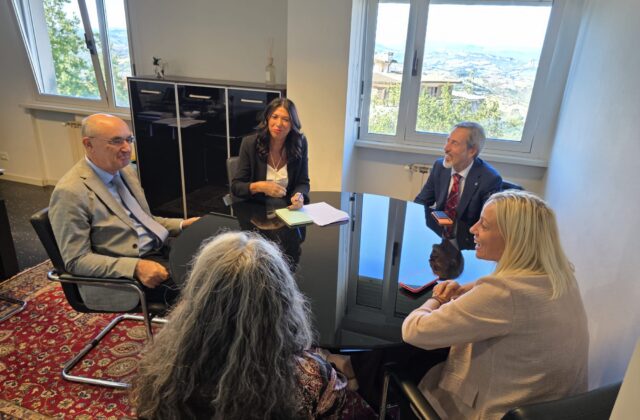
From organ donation to suicide prevention, by way of smartphones, schools, disability and the European Social Charter — Wednesday, September 16 was a session of the Grand and General Council (Consiglio Grande e Generale) devoted almost entirely to the Arengo petitions (Istanze d’Arengo). The final tally: ten petitions examined, seven approved and three rejected.
Among the issues that sparked the liveliest debate was the proposal to ban smartphones for children under 14. Petition No. 56 called for an outright prohibition below that age threshold — a path the Government did not consider effective. Education Secretary Teodoro Lonfernini acknowledged the risks of early, unsupervised device use, but argued that the way forward lies in education and guided support, involving schools, families and social services.
Several councillors shared this view. Michele Muratori (Libera) said he opposed any form of “prohibitionism,” while Nicola Renzi (Rf) drew a distinction between smartphone use and access to social networks. Mirko Dolcini (D-ML), speaking in a personal capacity, took a different stance, arguing that the risk of addiction called for a stricter measure. Carlotta Andruccioli (D-ML), while questioning whether an outright ban could realistically be enforced, called for tougher rules on minors’ access to social media. In the end, the petition was rejected by majority vote.
The outcome was entirely different for the request on organ, tissue and cell donation after death. Petition No. 5, which aims to let citizens express their wishes while alive and to create a national registry, received the unanimous approval of the chamber. Health Secretary Massimo Andrea Ugolini pointed to the need to connect San Marino with specialist networks, reach agreements with Italy, and update the IT systems of the Institute for Social Security (ISS). The petition’s subject matter and its call for a national registry are also confirmed in the Council’s official documentation.
Another unanimous vote came on a particularly sensitive topic: suicide prevention and support for people experiencing psychological and emotional crisis. The petition calls for building an integrated system that strengthens existing services. Among the options outlined by the Government are protected spaces where cases of severe distress could be observed and monitored for at least 48 hours, expanded training, and the possible strengthening of a dedicated helpline.
Several points resurfaced throughout the debate: identifying distress earlier, supporting families, fighting stigma, and reinforcing the network of services. Michele Muratori (Libera) also renewed calls for a dedicated psychiatric diagnosis and treatment facility in the territory, while Michela Pelliccioni (Mixed Group) pressed for a 24-hour toll-free helpline. The petition was approved unanimously.
A unanimous green light was also given to the effective implementation of the Individualized Life Plan for people with disabilities. The new framework aims to bring together health, education, employment, housing, sport, relationships and social participation, with a Case Manager acting as the reference point for the person and their family. Councillors also called for verification that the plan, once on paper, is actually put into practice.
Among the day’s approvals was also the establishment of a Liceo delle Scienze Umane (Human Sciences High School) within San Marino’s school system. The Council resumed debate on Petition No. 54, previously suspended for lack of quorum, and this time passed it by majority vote.
Also approved was the petition calling on San Marino to accede to the revised European Social Charter. The Republic signed the Charter in 2001 but never ratified it. The Government voiced support in principle, while warning that the process will be complex and unlikely to be completed within the standard six-month period usually allotted to follow up on Arengo petitions. Both opposition and majority benches urged that the commitment not be left without a clear timeline. In the end, this request too was approved by majority vote. Official documentation confirms that Petition No. 51 concerns the Republic’s accession to the European Social Charter.
Also approved was the request to bring order to the rules on the expiry of driving licences for people with medical conditions or disabilities, avoiding overlap between a licence’s standard validity period and the shorter deadlines set by health authorities.
However, the proposal to introduce a public selection process based on qualifications and examinations for the role of Conductor-Director of the Military Band did not pass. The Government defended the current system, stressing the difficulty of altering a procedure already underway, while leaving open the possibility of reviewing it in future. Nicola Renzi (Rf) challenged the Executive’s position, invoking the principles of transparency and merit. The petition was rejected.
Also rejected was the request to allocate the former Banca CIS building to the community of Serravalle. Secretary Marco Gatti explained that the building was designed for banking operations, that converting it would be costly, and that the spaces are still in use by the units handling the management and recovery of the former bank’s credits. The debate nonetheless left open the broader question of finding space for associations and volunteer groups.
The session closed with the Cailungo Park. The petition to complete its redevelopment and enhance its facilities and services won unanimous support, though not without political debate over work already carried out and what remains to be done. The Government explained that several interventions have already begun or been scheduled together with the Castle Council (Giunta di Castello) of Borgo Maggiore. On the final outcome, however, there was no division: a unanimous vote in favour.