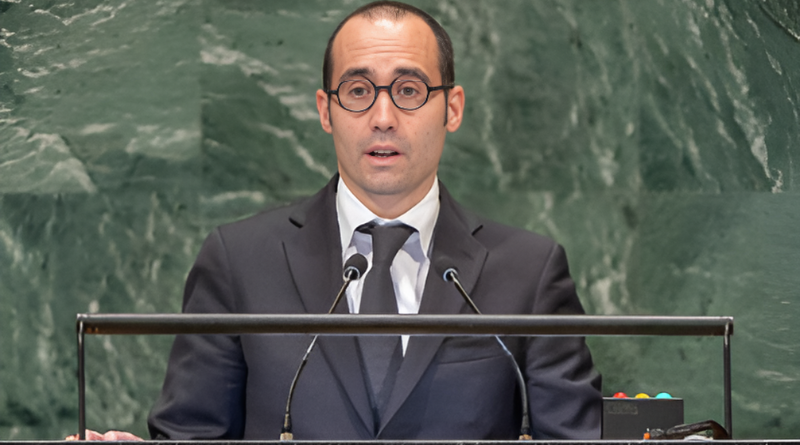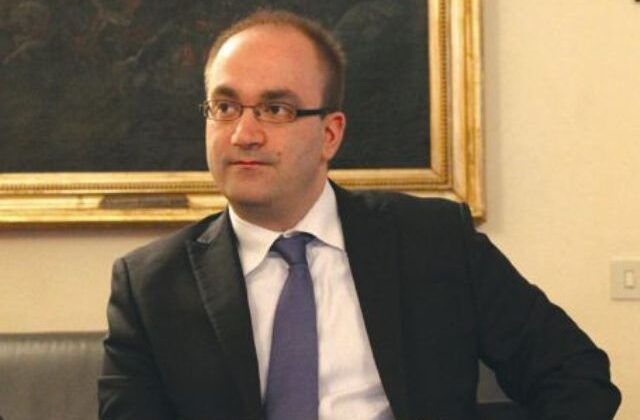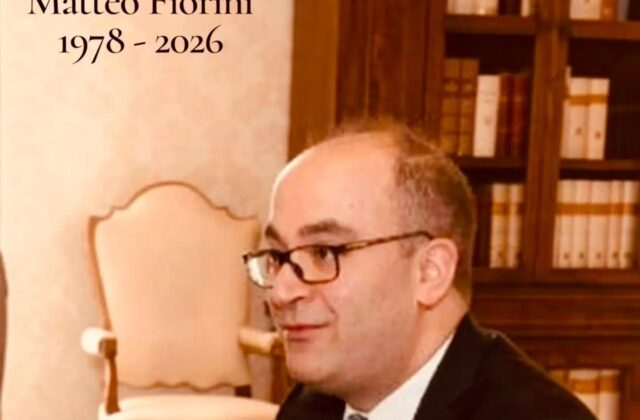
During the communications item of the Grand and General Council (Consiglio Grande e Generale), Nicola Renzi (Repubblica Futura) spoke to remember Matteo Fiorini, retracing his personal, political and institutional journey and the long-standing relationship that bound the two men together. Below is Renzi’s speech in full.
Nicola Renzi (RF): Thank you, Excellencies, and thank you too for the words you have dedicated to Matteo Fiorini. I too will try to say a few words, though it won’t be easy. Remembering Matteo from the microphones of this Chamber, as I am about to do, is a difficult undertaking. We never wanted to live through this moment. Indeed, for me, simply being here without Matteo beside me has been, and still is, an enormous injustice. It was not a lack of will or courage that kept Matteo from being here in recent years, nor was it any shortage of public support, which was always strong and encouraging. Rather, it was a choice – because, as you used to tell us, one must be serene, free, calm and determined to govern a country, and unfortunately the illness did not allow you all these great privileges. That did not stop you from always being present, though. Through your advice, our conversations, your example, we never felt alone. You were there. In these days, when fate and grief have taken the upper hand, I was struck by the crowd of people who wished to bid Matteo farewell. I don’t think anyone was surprised. Just as striking is how many families, how many communities he nurtured and helped grow: his own first of all, Marina and Alice, his parents, his brother, his uncles, aunts and cousins, of course. Then his working life, his beloved SIT, his friends, his closest circle. I will speak about our community, first Alleanza Popolare and then Repubblica Futura, and the fundamental role Matteo played and will continue to play within it. I truly hope, Matteo, that once again all our affection has reached you, along with that deep sense of need we have felt for you. It’s easy for me to explain. The moment I learned that your condition had worsened and that the end was near, faced with the choice of what to do to be useful, to honour your memory, to pay tribute to you, and also to find the strength to face such a terrible and unprecedented situation, I found myself thinking: let’s hear what Matte thinks about this. And yet, of course, that was no longer possible. Perhaps that is the deepest meaning of the word “to miss someone.” I can say that I began my political life with you, first in Bologna, when we used to meet to talk about our country, on trains, on buses, in cafés, on those trains that carried us back and forth. One day you told me you were going to run for office, and from that very moment I did everything I could to support you. It came naturally, and it went well. The next time, I ran too. Throughout this complicated journey, you always went ahead of me and marked the way. You were a Councillor, a Captain Regent, and Secretary of State before me, and in all that long journey, I don’t recall a single moment of envy, of disagreement, of quarrel. We walked that road together, and perhaps the most beautiful part was doing it side by side. Matteo was very demanding of himself, and precisely for that reason he expected a great deal from others, but he also understood the deep meaning of a now-forgotten word: indulgence. He knew how to reward effort and good will, even when the outcome fell short. He grasped human weaknesses instantly. Sometimes he liked to laugh about it, with biting wit, but he also knew, and practised, forgiveness. Some would call it mercy. How many times, sitting in Council, did we allow ourselves to exchange jokes and banter. Once, referring to a not particularly sharp councillor, you said privately: “In a normal country, it wouldn’t be him looking after the State, but the State looking after him.” We burst out laughing, barely holding it in. But these jokes were our way of exorcising our very human, small-town side. They stayed between us, and they never stopped you from showing respect and attentiveness to everyone. Arrogance was banished, and perhaps that is one of the most distinctive marks of your political commitment: helping those in need. It was precisely the people in greatest difficulty, those touched in some way by life’s harshness, who were at the centre of your concerns. Modest to an almost excessive degree, despite truly special gifts, Matteo despised arrogance; he had a keen sense of justice and fairness, and he used them as yardsticks for judging laws and measures, as well as people. All those who worked with him – certainly in the Secretariat of State, in the Department of Territory, within our movement, in the institutional secretariat during his terms as Captain Regent, or in the Department of Foreign Affairs – carry an unforgettable memory of him. We saw further proof of this at his funeral. Truly gentle. I don’t believe anyone ever heard him shout, raise his voice, withhold a greeting or a kind word, even in the tensest moments. He was truly a kind person, and kindness is not weakness. On the contrary, it means having the strength to remain clear-headed and in control, not to be swept away by fleeting emotions, never to forget one’s humanity. I never once heard the word revenge or retaliation from Matteo. And perhaps it was precisely in that kindness that the roots of the firmness and vigour with which you carried out your work lay. In our assemblies, in coordination meetings, in Council, you likewise always practised loyalty and honoured your word. Matteo was certainly a point of reference. Today we would call him a leader, one of those people whose opinion truly matters. Whenever there were complicated situations, even in recent months, it was always Matteo who stepped in. He knew how to talk to people, to listen, to explain the situation, and perhaps even to persuade them of the opposite view. I remember, for instance, when we had to make the politically significant decision to leave a governing majority in order to try to form another one. I wanted nothing to do with it. Then, as always, you arrived, we went to dinner, we had a good time, we analysed the whole situation and the various options. In the end, I remember it well, I told you: “Matte, you know, to me this seems like madness.” “But if you say it’s the right thing to do, we’ll do it.” And we did it. Later we found ourselves once again in Council, this time with reversed roles – me as Secretary and you as Councillor – and once again you were essential in navigating extremely difficult moments. I remember how thoughtfully you would ask how I was doing and encourage me to hold firm. When you again served as Captain Regent, we faced even harder times, and once more your determination proved crucial. What made it all the more remarkable was that, even as you were also grappling with the terrible illness that accompanied you for fourteen years, it was you who gave us courage and hope. You were a dreamer, a visionary. Even with a rationally shortened life expectancy, in politics too you managed to look beyond legislative terms, beyond the years, beyond short-term manoeuvring. You were truly one of the very few in whom I clearly perceived a vision – an idea of what San Marino should become – and you never spared yourself in trying to make that project a reality. Today we must come to terms with these terrible days, in which this temporary separation makes us feel the full weight of your absence. We thought you had given us the illusion of defeating this terrible illness. No, we were wrong. You gave us the certainty of being able to live forever, in the living memory of all of us. The certainty that your example, your wonderful smile – as one of our members chose to describe it – will continue to inspire our battles, and that, after all this pain, we will feel the joy of your constant presence, which will give us strength forever. Thank you, Matteo. Thank you for every moment.