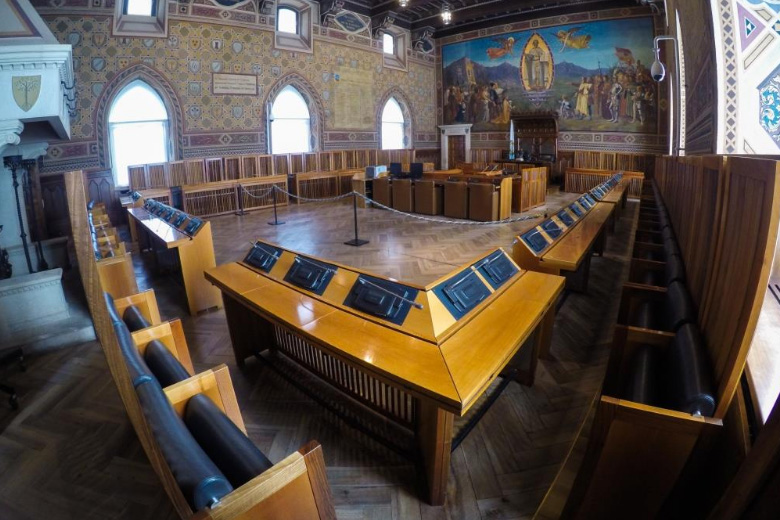
The association agreement between San Marino and the European Union is heading to the Grand and General Council (Consiglio Grande e Generale) for ratification.
The item is on the agenda of the session convened for 23, 24, 25, 26, 27 and 30 November. Under the same agenda point, councillors will also be asked to ratify the agreement amending the 2012 monetary convention. Both agreements were signed in Brussels on 19 October 2026.
At the heart of the agreement is access to the European internal market. The goal is to «guarantee the respective participation of the associated states in the internal market, which includes the free movement of persons, the free movement of goods, the free movement of services and the free movement of capital, as well as equal conditions between the contracting parties in accordance with this agreement».
The signing also involves Andorra, which takes part «as a separate party». The framework is shared, with specific rules for each of the two countries.
For those seeking work across the border, the guiding principle is equal treatment. «The free movement of workers implies the abolition of any discrimination based on nationality between workers of the EU member states and those of the associated state concerned, as regards employment, remuneration and other working conditions.»
Among the rights provided for are the ability to respond to a job offer, to move in order to take it up, to settle in the country where one works, and to remain there after having held employment, under the conditions set out. Public administration jobs remain outside the scope of these provisions.
For both employees and self-employed workers, there is also a chapter on social security. It provides for «the aggregation of all periods taken into account under the various national legislations, both for the purpose of acquiring and retaining the right to benefits and for the purpose of calculating them». In practice, those who have worked in different countries can have the periods accrued under each system counted when entitlement to a benefit arises and when its amount is calculated.
On the goods front, the basic principle is the ban on tariffs in trade between the associated parties. «Customs duties on imports or exports, or charges having equivalent effect, are prohibited between the associated parties. The prohibition under this article also applies to customs duties of a fiscal nature.»
The ban extends to quantitative restrictions on the import or export of goods and to measures having equivalent effect.
For banks, insurers, asset managers and securities markets, access to the European market is subject to a verification process. San Marino will have to apply the relevant European sector rules, demonstrate that its supervisory system works, and agree with the European authorities on how to cooperate and exchange information.
The European Commission will examine «the financial sector of the associated state», the application of the rules and the functioning of supervision. The assessment will begin at the request of the associated state.
San Marino will also be able to choose which sectors to start with, postponing the request for access for one or more areas. «The derogation referred to in paragraph 1 of this article shall not exceed 15 years from the date of entry into force of this agreement.»
Fifteen years is therefore the maximum limit for any postponement. Opening up another sector at a later stage will require a new assessment.
Another rule concerns those wishing to buy a second home on Titano. In light of the limited housing stock and scarcity of buildable land, San Marino will be able to retain authorisation procedures for purchases by EU citizens who «have not been legally resident in San Marino for at least five years».
Authorisations must follow «public, objective, consistent and transparent criteria», applied without discrimination.
The Council vote is San Marino’s part of the process. For the agreement’s final entry into force, it will be necessary to wait until «the first day of the second month following the last notification of the deposit of the instruments of ratification, conclusion or approval».
Before then, under the conditions set out, the parties may «apply this agreement provisionally, in whole or in part».
There is also provision for the possibility of beginning provisional application between the European Union and only one of the two associated states.