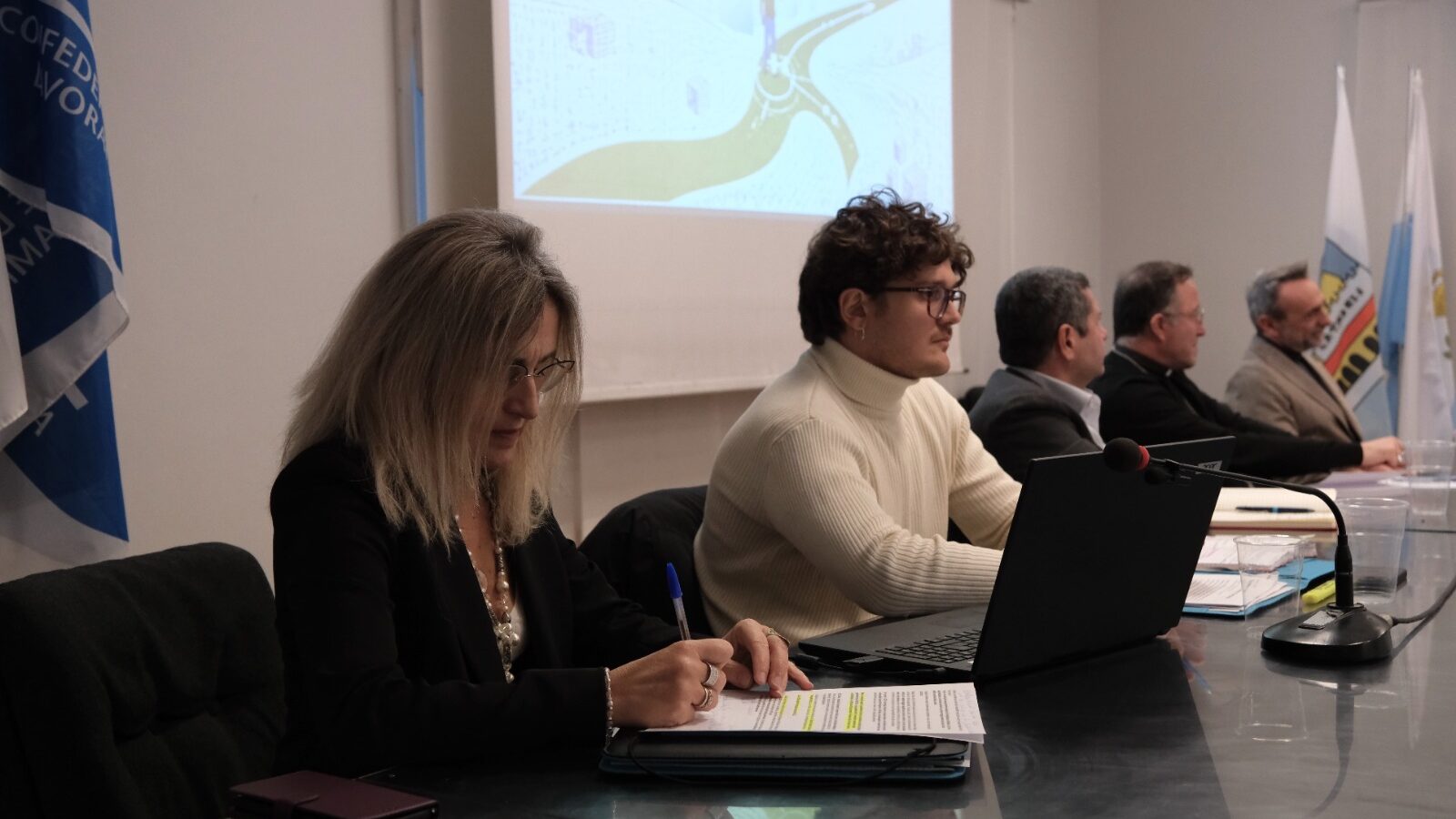
The Confederazione Democratica Lavoratori Sammarinesi (CDLS) is proposing a roundtable between institutions and social partners to discuss the impact of artificial intelligence on employment and business organisation.
The request emerged from a conference held at the Sala Joe Cassar in Borgo Maggiore, which brought together representatives from institutions, the labour world and the Church.
The meeting opened a series of in-depth discussions marking the Confederation’s approach to its 70th anniversary.
“How are professions changing, and how is San Marino preparing for it?” asked CDLS general secretary Milena Frulli in her opening remarks. “We can and must build the future of work together, through dialogue and engagement between all parties.
We cannot simply adapt to the transformations being presented to us, now and in the future.” In their opening greetings, the Secretaries of State for Internal Affairs, Foreign Affairs, Industry and Labour all expressed their willingness to engage on the issues raised by the union.
According to Marco Bentivogli, an expert in labour policy and industrial innovation, unions must take part in decisions on how AI is introduced into companies, with close attention to training and digital skills. “The responsibility resting on unions is enormous,” he said.
“Talking only about risks doesn’t contain them, and it prevents us from seizing the opportunities.” The Bishop of San Marino-Montefeltro, Domenico Beneventi, cited Pope Leo’s encyclical Magnifica Humanitas and urged union organisations to keep workers’ dignity at the centre of their efforts.
Bringing the business perspective was Giusva Fiumana, ICT director at Passepartout, who described how artificial intelligence is being used in the company’s internal processes and in supporting users of its products. Addressing the possible impact of automation on jobs, Fiumana recalled Passepartout’s own growth, from 15 to more than 200 employees.
Luca Villani, from the CDLS Studies and Research Office, presented the Confederation’s proposals for San Marino. The union is calling for greater transparency on the effects of incentives granted to innovative businesses, with particular attention to wages and contract stability.
On regulatory sandboxes — tools that allow new technologies to be tested within a regulated framework — the CDLS is proposing a permanent presence for social partners and the Data Protection Authority on the review committee.
Villani also presented a simulator developed by the Studies Office to estimate the water and electricity consumption of the planned public data centre at Cà Rigo. On this project, the CDLS is asking that the criteria and findings of the feasibility study be shared with citizens and social partners, so that the services the infrastructure could offer, and the resources needed to build it, can be properly discussed.