Insider put six questions to Revolut. One asked for an explanation of the 265 suspicious transaction reports that, according to Reuters, other banks filed on 24 individuals under investigation or already convicted — while Revolut, by contrast, reportedly filed none. For now the bank has responded with its official statement, without addressing the specifics.
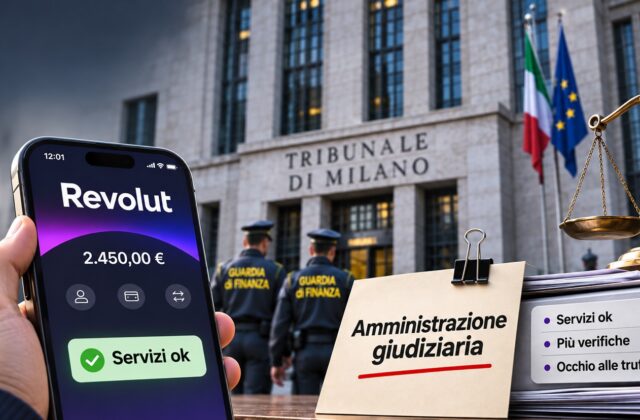
Following the Milan Court’s decision to place the digital bank’s Italian branch under judicial administration for one year, our newsroom wrote to Revolut’s press office on Monday, 16 November.
The reply arrived in just over two hours. It contained the spokesperson’s statement, which had already been circulated before our request, along with a note that the bank could not provide further details at this time.
“Revolut acknowledges the decision of the Milan Court and will fully cooperate with the Italian authorities,” the statement reads. “While we cannot comment on specific accounts or ongoing legal and administrative proceedings, we can confirm that our retail and business banking services in Italy continue to operate normally, with no disruption for our customers.”
In the same statement, the spokesperson said the bank takes regulatory obligations and anti-money laundering controls “extremely seriously,” and that it continually invests in strengthening its financial crime systems, transaction monitoring and compliance teams.
The questions that remain unanswered.
We asked whether, in the coming months, Italian customers should expect more document requests, checks on the origin of funds, operational limits or longer waiting times to open an account. We also asked whether the review of the accounts flagged by prosecutors could lead to restrictions or closures, and if so, how affected customers would be informed.
We also asked whether any operational changes are planned for Revolut Business customers in Italy, what measures the bank has already taken on controls following the Guardia di Finanza’s inspection of the group’s cryptocurrency-focused company, and how quickly it intends to implement the plan required by the decree.
Finally, we asked whether the bank intends to file observations or appeal the measure ahead of the hearing scheduled for 25 February 2027.
Another question was based on figures reported by Reuters, which reviewed the court decree.
Between 2021 and 2026, €41.9 million passing through Revolut accounts was reportedly linked to 24 individuals under investigation or already convicted. On those same individuals, other banks are said to have filed 265 suspicious transaction reports — the alerts sent to anti-money laundering authorities when money movements appear anomalous.
Revolut, according to the same reconstruction, filed none. We asked the bank how it responds to this finding in the decree.
On this point, the bank did not go into detail, reiterating in its statement that it cannot comment on specific accounts or ongoing proceedings.
We had requested a response, even a partial one, by noon on Tuesday, 17 November, and the bank replied well before that deadline.
This is not the first time Revolut has responded to Insider. On 20 October, during the app outage that Reuters linked to a power failure at Google Cloud’s London servers, the bank told us that customers’ money and data were safe.
As we previously explained, Revolut itself is not under investigation. Judicial administration is a preventive measure: for one year, renewable, two administrators appointed by the court will work alongside the Italian branch’s leadership on anti-money laundering controls and report back to the judge.
The measure concerns these controls, not the bank’s financial soundness.
Deposits remain protected up to €100,000 per person under Lithuania’s guarantee scheme, where Revolut Bank UAB is headquartered.
What to do if you have a Revolut account.
Services are operating normally, as confirmed by the bank. If you receive requests for documents or explanations in the coming months, respond only within the app. And be wary of texts, emails or phone calls that exploit this news to pressure you: no bank ever asks for passwords or codes by message or phone call.
Insider will continue to follow this story.
If Revolut provides further information, we will publish it.