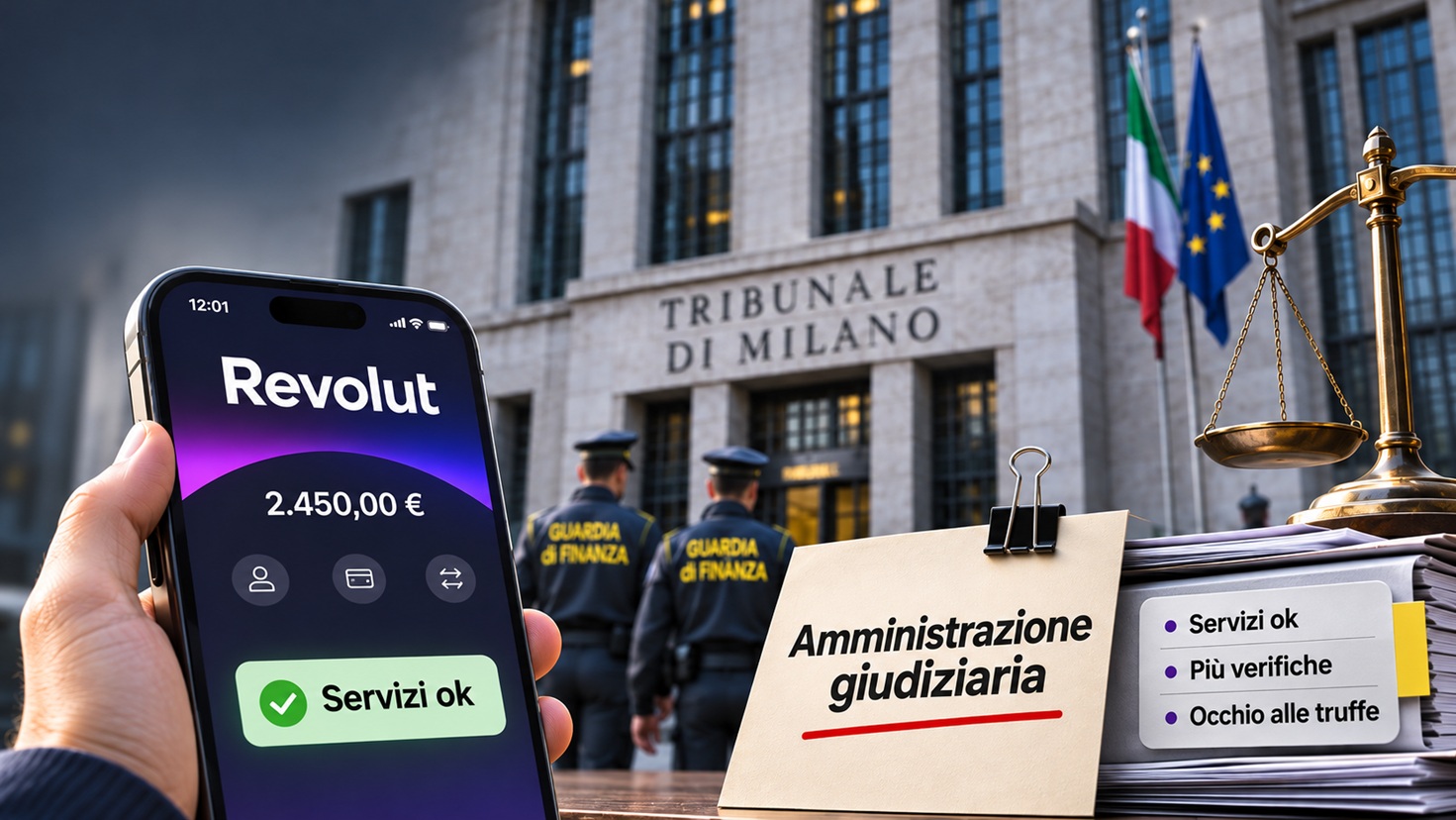
Revolut accounts, cards and transfers are working normally. As of today, however, the digital bank’s Italian branch operates with two court-appointed administrators at its side.
The Milan Court has placed it under judicial administration for one year over serious shortcomings in anti-money laundering controls: according to prosecutors, individuals under investigation or already convicted — in some cases with the mafia aggravating circumstance — allegedly used its accounts to move and conceal €76.5 million.
Revolut itself is not under investigation and has assured that services continue without interruption.
Who decided, and when.
The order was signed on 12 November by the Court’s Preventive Measures Section, at the request of public prosecutor Paolo Storari, and was carried out this morning by the Guardia di Finanza (Italy’s financial police). It concerns the Italian branch of Revolut Bank UAB, the group’s bank operating under a Lithuanian licence, which since late 2024 has managed accounts with Italian IBANs: as of October, customers in Italy had surpassed six million.
The appointed administrators are lawyer Ilaria Ramoni and Piero Antonio Capitini.
The first hearing is set for 25 February 2027.
Hundreds of reports from other banks, zero from Revolut.
This is the detail that weighs most heavily.
According to Reuters, which reviewed the 39-page order, 24 individuals under investigation or already convicted allegedly concealed flows totalling €41.9 million between 2021 and 2026 through Revolut accounts.
On these same names, other banks filed 265 suspicious transaction reports — the kind required by law when a transaction doesn’t add up. Revolut filed none.
There is also a company based in Pero, on the outskirts of Milan, which investigators say sold tax evasion and money laundering services: roughly €17 million flowed in and out of a single Revolut account, with other banks filing 273 reports on it. Revolut, again, filed zero.
Prosecutors add that more than €4.6 million, already subject to precautionary measures, was allegedly moved before authorities could intercept it.
A pattern, not an oversight.
Milan’s chief prosecutor Marcello Viola describes it as a «stable management model».
In the order, judges list poorly identified customers, public information about their legal troubles that went unchecked, and accounts opened or used right around the time of seizures.
According to investigators, the ease of opening an account — via app, ID document and selfie — was not matched by automated controls capable of catching anomalies.
And for the Court, automation «does not loosen, but tightens» the obligation to carry out checks.
The investigation originated from a Guardia di Finanza inspection of a group company active in cryptocurrencies, where more than a million violations were found concerning customer checks and data retention.
What it is not: this is not a bankruptcy, not a seizure, and not the kind of special administration imposed on banks in crisis.
Judicial administration, provided for under Article 34 of Italy’s Anti-Mafia Code, applies to companies that end up facilitating criminals through negligence — not complicity. The Milan Court has used it in recent years against major names in fashion and logistics.
The administrators do not replace senior management.
They work alongside them, with access to data and systems, and report to the judge — but only on the areas where problems have emerged. The closest precedent is Banca Progetto, the first Italian bank placed under judicial administration, in November 2024, which exited early in July 2025 after overhauling its anti-money laundering procedures.
According to Reuters, the order sets out fifteen points with tight deadlines: an initial report from the administrators within thirty days, a full assessment of controls within ninety, and updates to the judge at least every three months.
Under scrutiny are online account opening, cards, transaction monitoring, and the accounts flagged by prosecutors.
If the bank fails to cooperate, the administrators’ powers can be expanded; if it puts things in order sooner, the measure could be lifted early.
It runs for one year, renewable, but by law not beyond two.
For account holders, nothing changes today. The order does not affect deposits, cards, transfers or the app.
The bank confirms that services in Italy continue «without any interruption», and at midday Downdetector, the site that tracks user-reported issues, showed no problems. The deposit guarantee also remains unchanged: up to €100,000 per person, covered by the Lithuanian deposit guarantee fund, since Revolut Bank UAB is a Lithuanian bank.
In fact, that guarantee isn’t even relevant here: the order concerns the bank’s controls, not its financial soundness.
What could change in the coming months.
If controls need to be overhauled, it’s reasonable to expect more requests for documents, data updates or explanations about the source of funds, along with a less instantaneous account-opening process.
Customers with unusual transaction patterns, or who use personal accounts for business, may be asked for clarifications or face limits.
A few reports of blocked accounts have appeared online, but nothing links them to the order: checks and blocks on individual customers existed even before this.
What customers should do.
There’s no need to rush to move money: the order gives no grounds for that.
It’s best to keep identification documents and personal data up to date, respond to requests only through the app, and — for those using Revolut for business — keep invoices and contracts on hand. And beware of scammers, who thrive on news like this: no bank ever asks for passwords or codes via SMS, email or phone call, and no link can “unlock” or “secure” your account.
The bank said it has taken note of the decision and will «fully cooperate with the Italian authorities», noting that it continuously invests in systems to combat financial crime and in its compliance teams.
It does not comment on individual accounts or ongoing proceedings. In the past, responding to a European journalistic investigation, it had defended its controls as compliant with Italian and European rules, citing remote identification and artificial intelligence.
Not the first warning.
In April 2025, the Bank of Lithuania, which supervises Revolut together with the European Central Bank, fined it €3.5 million for shortcomings in customer and transaction monitoring, with no confirmed cases of money laundering at the time.
An administrative front also remains open: the Guardia di Finanza’s report on the group’s crypto company has been forwarded to the Ministry of Economy, which will decide on any sanctions.
Insider has asked Revolut for further comment and will update this article with its response.