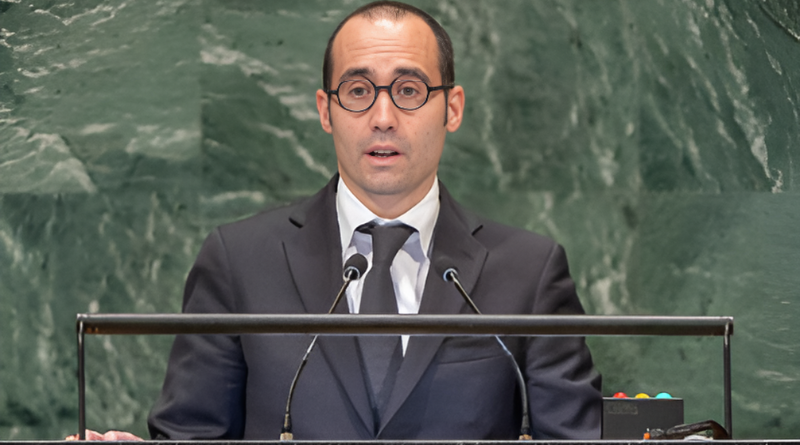
A precise picture of the laws San Marino will need to adopt ahead of the entry into force of the Association Agreement with the European Union, complete with timelines, priorities and genuine political debate before measures arrive already finalised. This was one of the central points raised by Nicola Renzi (Repubblica Futura) during a session of the Foreign Affairs Committee.
Renzi specifically pointed to the experience of Andorra, where a list of the rules needed to transpose the EU acquis had been presented, and called for San Marino to follow a similarly clear path. In his remarks, he also addressed the labour market, the methods for transposing European legislation, and the role that the Foreign Affairs Committee and the Institutional Reforms Committee could play in the process.
Below is the full text of Nicola Renzi’s (RF) remarks, unedited.
“Unfortunately, we have spent the last year essentially talking about the ‘Bulgarians’, about arbitration proceedings, and we haven’t used this time for anything else. In fact, at times there was almost a sense that the less we talked about the European Union, the better – because otherwise everything else would come along with it. And that has disappointed me. So what was I expecting? That we would finally get here and speak plainly to one another. When I visited Andorra with the parliamentary committee, they projected on the wall the seventy laws they believed they needed to adopt in order to transpose the EU acquis, and they told us: of these seventy, sixty-five, sixty-seven – I don’t remember exactly – we have already drafted. The President was with me, so he’ll remember the figures. I would have expected something similar: a framework saying that once provisional entry into force arrives, we will need to pass – not all at once, but staggered over time, three months, six months, nine months later and so on – fifty to seventy laws, of which we are already well advanced on these particular ones. That was the fundamental framework I expected. Perhaps you already have it, but if it isn’t shared with us, we don’t know it, and so we have to ask: what exactly are we talking about? Why are we discussing amendments to the Council’s standing orders? I would rather have started from the roots, from the fundamental basis. So: we need these seventy laws, to use that example. Then, based on what we obtained during the negotiation phase – because let’s not forget we must always demonstrate the merits of this Agreement – the laws we go on to implement will have certain characteristics. Let me give an example: the labour market law, as far as the private sector is concerned, has these safeguards that we have secured, but we will need to adapt it in this way relative to current legislation. Forgive me, but I lose my patience over this. I heard a Secretary of State say, at a public evening event, that as far as labour legislation is concerned, nothing changes with the Association Agreement. I throw up my hands: white flag, I surrender. If we approach it this way – certainly not you, Secretary, I don’t mean you – but if we go around telling people that nothing changes in the labour market with the Association Agreement with the European Union, I believe we are telling people lies. Because if someone genuinely believes, as a political stance, that nothing changes, I am terrified, because the matter changes enormously. It might not change for the worse – it could increase competition, it could give us many opportunities and so on. So, at that point, what would I have expected over the last two years? I would have expected, in this forum, in the parliamentary committee with jurisdiction over the matter, or wherever you like – I think this was the best forum – for someone to say: gentlemen, let’s focus on labour issues. We will transpose labour matters through three laws: one concerning public employment, one concerning private employment, and one concerning other secondary matters, perhaps for citizens and so on, which will then link up with the law on residency. And to share, before drafting them, what paths could be taken. Then perhaps we would have discussed, we would have argued, and in that case it’s clear that the Government and the majority carry forward their vision, while we could have offered our input, saying: excuse me, but on the labour market, I don’t know, do we apply online? In person? Do we adopt forms designed in a certain way? That, in my view, was the work that needed to be done on the major sectors. Then there’s the other issue, that of transposing the EU acquis. When I hear talk of the Institutional Reforms Committee, I get even angrier, because it was stalled for four months – not through any wish of mine, because the relevant item never reached the Council floor. We were told there needed to be input from the Council. I wouldn’t have chosen that method either, but the majority did. I would have proceeded differently. The Institutional Reforms Committee wrote a letter to all the Secretaries of State – and you, Secretary, rightly responded promptly – in which we said we were available to contribute input on European Union matters as well. So if that committee was meant to be the forum for discussing these issues too, all that was needed was to say so, and once the Council’s agenda-setting work was unblocked, it could have been done there. But these are all discussions that interest me very little – let’s set them aside, who cares. We have had some hearings that I believe were valuable, as was the technical work carried out and adopted through the agenda item. But that technical work on transposing the acquis left various forks in the road still to be chosen. In the Institutional Reforms Committee, some experts came to tell us that it may be necessary to amend our Declaration of Citizens’ Rights in order to achieve more immediate and more usable automatic mechanisms. I don’t know – let’s reflect on it – but these will be the issues to address, the fundamental issues. The Honourable De Luca came and gave what I thought was an excellent, very useful presentation, which was really an exposition of law – not only European law but also comparative law – on how Italy, for example, proceeds. That’s where the idea emerged of a transposition law, a kind of bottom-up parliamentary mandate, so to speak, setting out which policies we want to retain control over, which ones we want to delegate, and what our areas of concern are, alongside the transposition law itself. So will this be the tool? The transposition law? Let’s discuss it, with whatever pros and cons it may have. But this, in my view, is the way to approach the issue if we want a serious debate. Otherwise we have no framework within which to operate, no timelines, and we’re here talking about everything and nothing. Then perhaps we’ll be handed a finished piece of legislation and have to take it or leave it, depending also on the transposition methods that get decided – and for those too, it will be take it or leave it. We are very clear on this: we are delighted that the Agreement is being signed, delighted about its provisional entry into force. You have never seen us stir up pointless controversy over the EU Association Agreement, or against the Secretary responsible for managing it. I was the only one who stood up in this Chamber to personally defend the Secretary against ridiculous accusations – insults, really – from the usual troublemakers who occasionally wander around the Republic. Now it’s up to you to decide how you want to repay us for that, bearing in mind that nothing is owed to us. We did what we did because we believed in it. So, if we want to get down to serious work, let’s get to work. If not – and this is another legitimate path for a majority and a Government to take – tell us: we’ll go it alone. And carry on that way. We try to cause as little disruption as possible, but certain things still need to be said.”