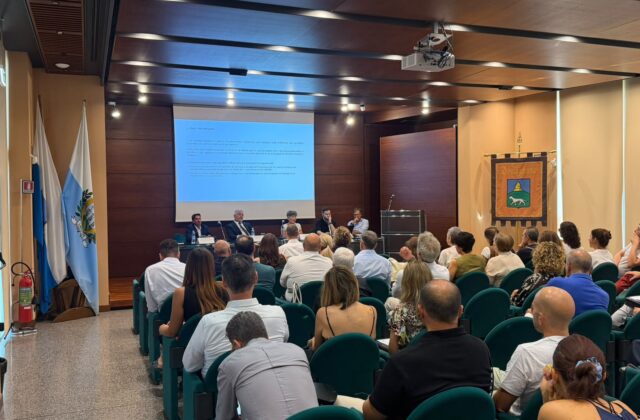
The Grand and General Council (Consiglio Grande e Generale) reopens on Monday, September 7 and closes on Wednesday the 23rd, in a session staggered over sixteen days – the 7th-9th, 15th-18th, 21st-23rd – with seventeen bills on the agenda and the election of the Captains Regent for the six-month term running from October 1 to April 1 set for the afternoon of the 15th, with candidacies already formalized and no surprises expected.
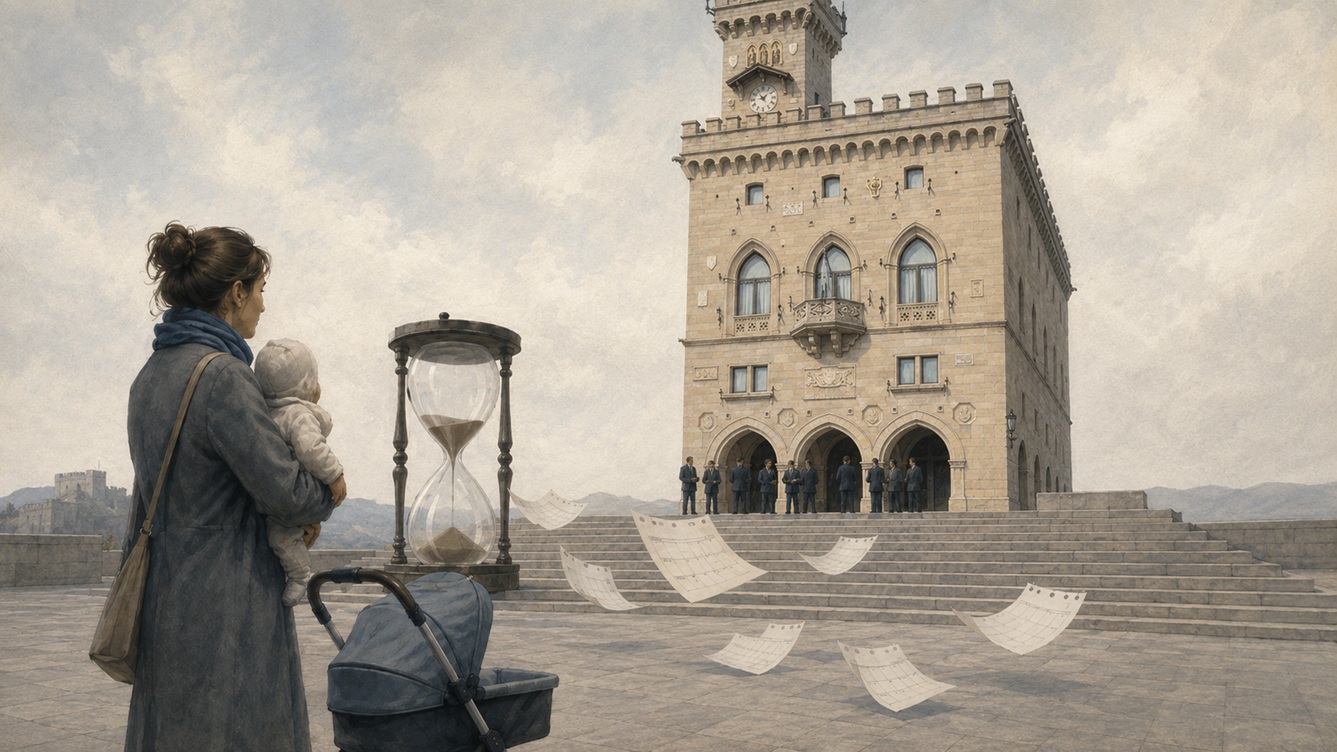
Within that list are two dossiers that mirror one another: the family reform, in its second reading, which fifty-five mothers of children born or expected in 2026 have been asking since August to have approved without delay, and the amendment to the council’s own rules of procedure pushed by the majority, scheduled for Friday, September 18. The first concerns the country. The second concerns the Palazzo itself. Sixteen days to see which of the two comes first – and under what conditions.
There is a moment, every year, when San Marino’s political class sheds its summer costume and realizes it is still wearing, unchanged, every problem it had convinced itself it had left under the beach umbrella.
This year that moment arrives with almost theatrical punctuality, complete with its usual sideshow: the small comedy of lawsuits between former party colleagues turned adversaries.
This time it’s Michela Pelliccioni‘s turn. Having left Domani – Motus Liberi in July 2025 and remained in the Council as an independent, she has now been sued by her former party. Not for changing her mind – that would be too simple, and it wouldn’t be true: the lawsuit is a civil matter concerning breach of a statutory clause, the one requiring an outgoing councilor to vacate their seat, with a request for reimbursement of allowances and sums up to fifty thousand euros.
The detail no novelist would have dared invent: that very clause was introduced at the party’s 2022 assembly, which Pelliccioni attended and, according to the records, voted in favor of.
The first hearing is set for September 24 – the day after the council session closes. An ending scripted on purpose.
A Palazzo preoccupied with itself is an ancient craft, perhaps the oldest of all. The problem is when it indulges in it while someone else is still waiting for an answer.
It should be said plainly: the family reform was not written by the mothers. It is a government bill, cleared by the relevant Commission between April and May. The mothers have only asked that it reach the floor before their children learn to walk.
At the heart of the measure is the extension of parental leave – three months at 80% pay after the current one hundred and fifty days. Today, extending leave is technically possible, but only at 40% of income – a freedom of choice that exists on paper, not in the bank account.
A partial answer already came in August: the relevant Secretariat has guaranteed final approval in September and clarified that there will be no retroactivity in the strict sense, apart from recognizing post-partum leave for purposes of career progression.
In plain terms: the new protections will benefit those who meet the requirements once the law takes effect. Everyone else simply gave birth in the wrong year.
The rules of procedure, by contrast, were designed by the majority for itself: a drafting role for the standing commissions – which will discuss and vote on articles and amendments, leaving the general debate and final vote to the full Council – along with tighter limits on speaking time. A sound idea, probably.
The opposition calls it a gag order and argues its real purpose is to silence the minority.
Back in July, the issue already deflated once: the majority agreed to limit the intervention to a few specific points by September, postponing a full-scale reform to the Institutional Reforms Commission until March 2027. The fact remains that it is the political class writing the rules of its own patience, while asking citizens to hold onto a little more of theirs.
There is nothing scandalous about a Palazzo tending to its own affairs.
The problem lies in the order in which it does so.
Between now and September 23, it will become clear whether San Marino’s political class can distinguish, in setting its priorities, between what matters to the country and what matters only to those who govern it – and whether the calendar, for once, will say what the press releases do not.
History usually answers with some delay. This session promises to answer within sixteen days.