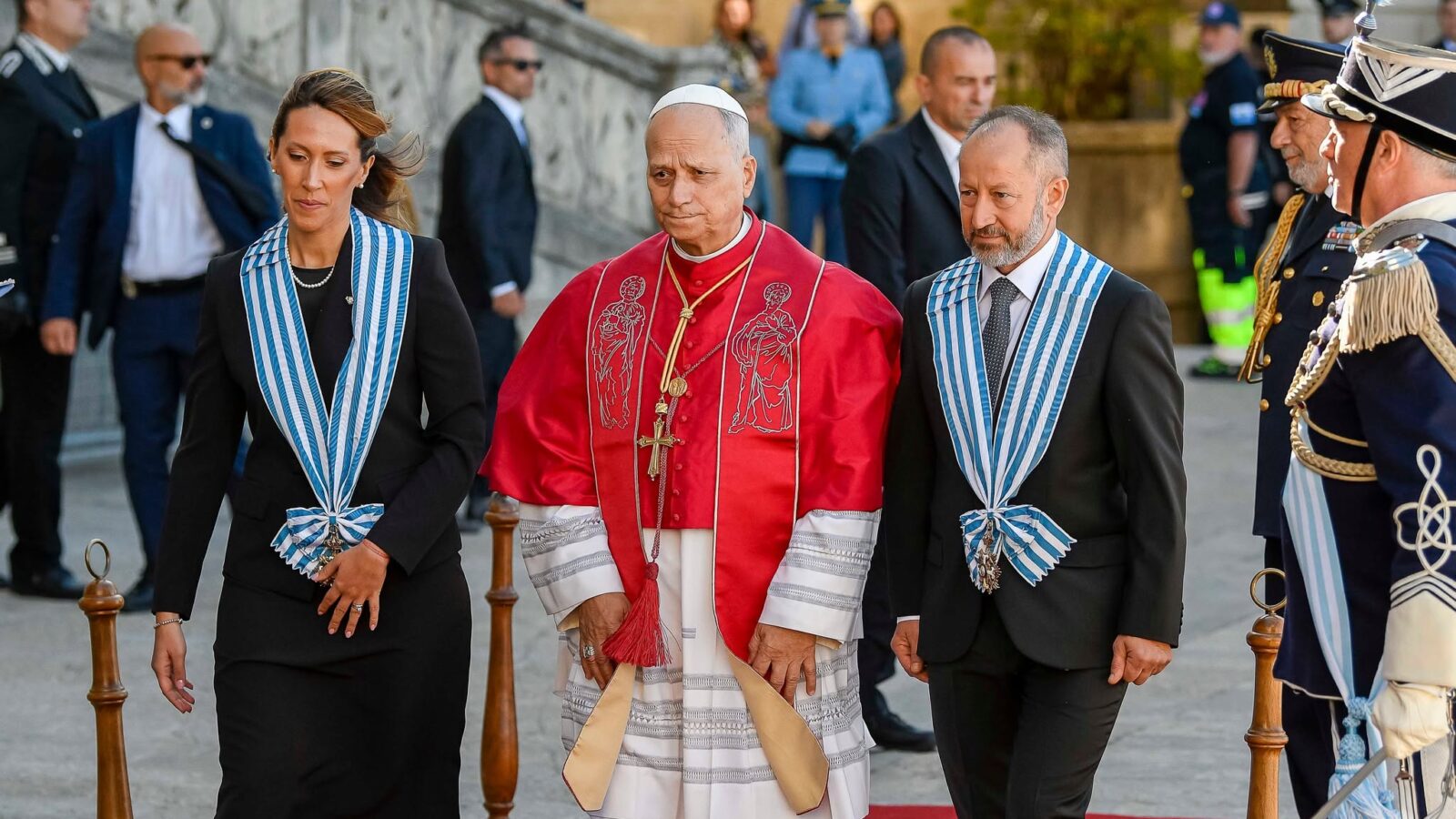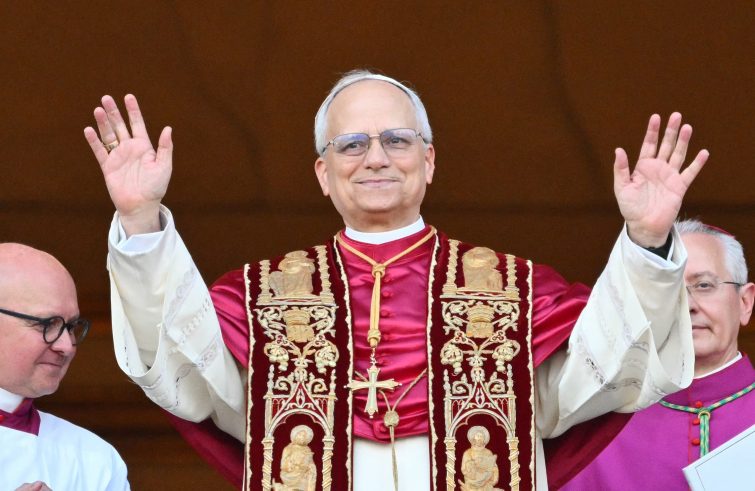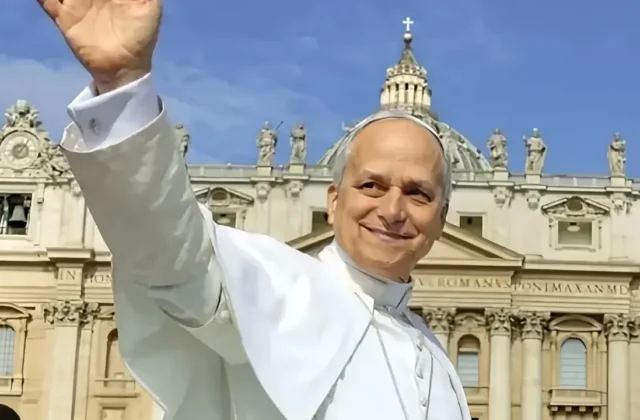
A day awaited for months, prepared down to the smallest detail and then gone in the space of a few hours. San Marino came to a standstill yesterday for Pope Leo XIV, showing the Pontiff the face of a small Republic capable, at least for a day, of gathering as one around a single event. Institutions, Church, young people, families, volunteers and ordinary citizens alike. From early morning until the helicopter’s take-off from Torraccia, Titano lived through one of those days destined to end up in family albums and history books alike.
This was no ordinary visit. Fifteen years after Benedict XVI, the Pope returned to the world’s oldest Republic. And behind the protocol, the military honours, the handshakes and the official meetings, what emerged above all was the symbolic weight of this visit: Leo XIV spoke to San Marino starting from its history, its freedom and its small size, turning them into a message addressed well beyond the borders of the Mount.
The day began early. The arrival at the Torraccia airstrip, the welcome from the authorities, then the climb up to the historic centre. Along the route, hundreds of people waited for the Pontiff to pass, while on Titano an imposing organisational machine had been running for hours, between security, traffic management, volunteers and staff overseeing access points.
Then came the institutional heart of the visit. Piazza della Libertà, Palazzo Pubblico, the Captains Regent and the honours reserved for the head of the Catholic Church and head of state of Vatican City. Ceremony gave way to substance, and here the bond between the Holy See and San Marino became the thread running through the morning.
At the centre, inevitably, was that word which on Titano means far more than a motto: Libertas. A freedom that Leo XIV linked to responsibility, to peace-building, to dialogue and to the ability to be part of the international community without giving up one’s own identity. For a small state like San Marino, accustomed for centuries to defending its independence and sovereignty through relations and diplomacy, the reference carried particular weight.
This is perhaps one of the passages that will endure from the visit. The Pope did not look at the size of the Republic, but at the role that even a small entity can play in a world crossed by wars, tensions and divisions. It was both an acknowledgement of San Marino’s tradition of dialogue and, at the same time, an invitation not to treat freedom and peace as mere ceremonial words.
After Palazzo Pubblico, the tone of the visit shifted. Leo XIV walked to the Basilica of the Saint, where he was welcomed by the Bishop of San Marino-Montefeltro, Domenico Beneventi, and by the rector, Don Marco Mazzanti. Here, the meeting with priests, consecrated men and women and representatives of the ecclesial community, together with eucharistic adoration and veneration of the relics of Saint Marinus, opened the more pastoral part of the morning.
And it was precisely inside the Basilica that the Pontiff reconnected the present to Titano’s deepest roots. He recalled Marinus and Leo, the Christian history of these lands and that communal model born around the principles of freedom, mutual respect and communion. A heritage which, in the Pope’s words, does not belong only to the past but continues to challenge the San Marino of today.
Leo XIV placed strong emphasis on young people, families, education and civic engagement. He asked young people not to settle for shortcuts and not to fear life’s important choices — from marriage to career, from religious vocation to social and political commitment. It was an invitation to get involved, rather than watch from the sidelines, and to help build that “testimony of peace speaking to the world” chosen as the motto of the visit.
But there was also room in his address for very concrete issues. The depopulation of inland areas, the loss of services, the risk of isolation for smaller communities. Leo XIV pointed precisely to the solidarity that endures in less populated areas as an example not to be lost, contrasting it with individualism and division. He also spoke of a magnifica humanitas — a rich humanity made of relationships, closeness and community — as a possible antidote to the loneliness of our times.
The Pope then went back outside, among the people. That was probably the moment when protocol finally gave way to the embrace of the square. Greetings, handshakes, raised phones, applause. Many young people gathered in front of the Basilica, to whom Leo XIV addressed simple, direct words.
“Libertas”, once again. But explained to the young. The Pope urged them to recognise the value of their own lives, to build genuine friendships, to put themselves at the service of others and to form community. Freedom, he reminded them, does not mean shutting oneself off but seeking truth and walking together.
These were the final images of an extraordinarily dense morning. From Piazza Garibaldi came the transfer back to Torraccia, then the farewell from the authorities. At 12:05 p.m. the helicopter lifted off from the airstrip bound for Pennabilli, closing the San Marino leg of the pastoral visit.
What remained were the barriers, the squares slowly emptying out, and above all the images of a Republic that, for a few hours, had been swept up by an extraordinary event.
For San Marino, the significance of the day goes well beyond the physical presence of a Pontiff on Titano. It was an international, institutional and spiritual recognition of a community of just a few tens of thousands of inhabitants carrying centuries of history on its shoulders. But it was also an occasion to reflect on the present-day meaning of words San Marino has always repeated: freedom, independence, community, peace.
Leo XIV has departed. What remains on Titano is a day that will not easily be forgotten. And above all, what remains is the message left with the Republic: being small does not mean being irrelevant. Even from a mountain wedged between Romagna and Montefeltro, a voice capable of speaking to the world can still rise today.