How a dedicated food line comes to be, and why for those living with coeliac disease or diabetes, choosing a registered product is a matter of health, not just taste.
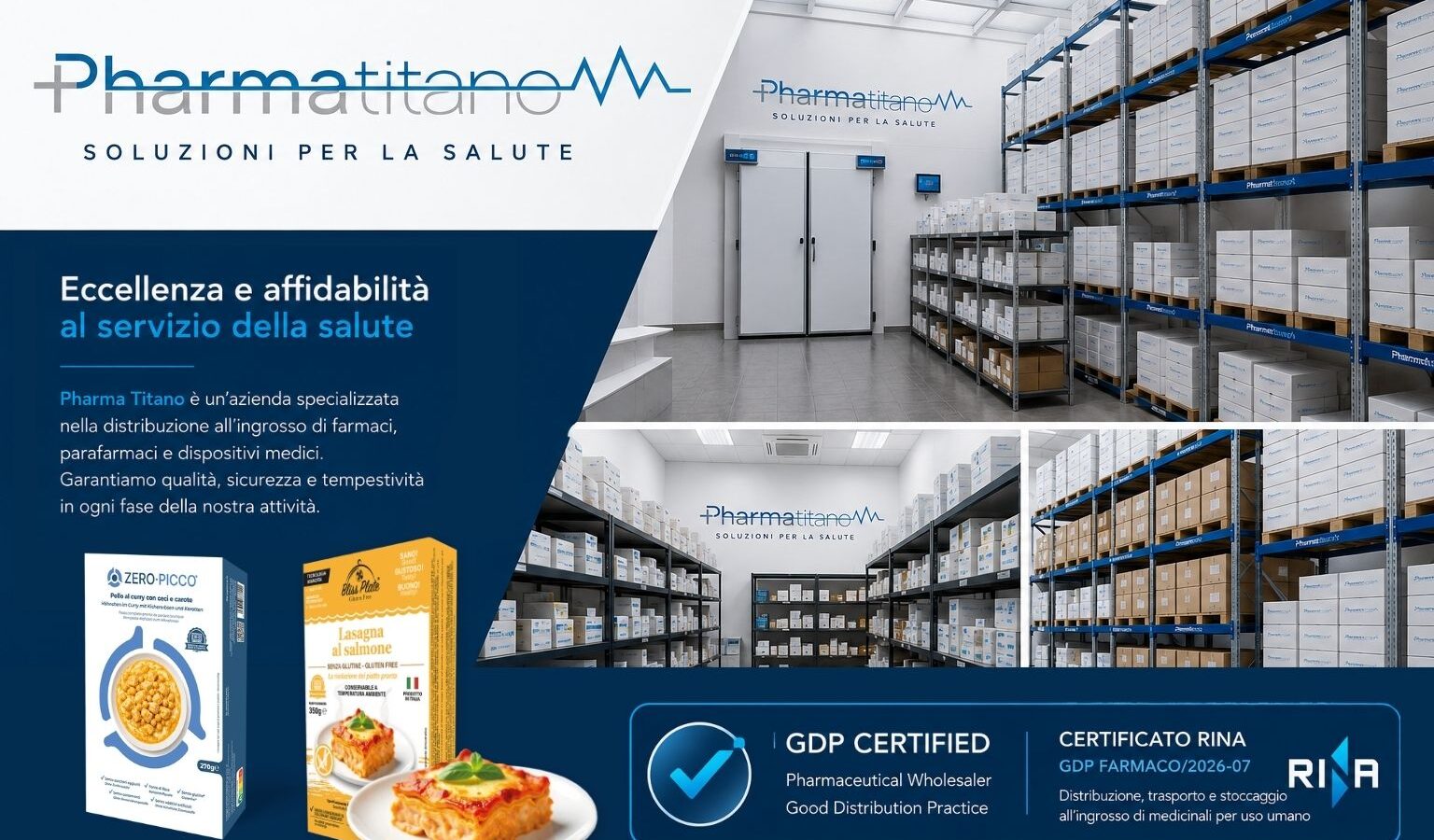
For most people, reading a label is an absent-minded gesture. For someone with coeliac disease, it is an act of precision: a mere trace of gluten, the equivalent of a crumb, is enough to trigger a reaction. Coeliac disease affects roughly one person in a hundred, while diabetes touches a far larger share of the population, and for all these people, food stops being simply a matter of taste and becomes part of the daily management of their health. It is in this territory, where diet and safety intersect, that Pharma Titano also operates – the San Marino-based company best known for pharmaceutical distribution, which also runs a dedicated food line among its activities.
Two lines, two needs
There are two lines, each calibrated to a distinct need. Bliss Plate is aimed at coeliacs: gluten-free products registered with Italy’s Ministry of Health and available under an exemption scheme, meaning they are among the foods a coeliac patient can obtain with the support of the national health service. Zero Picco, on the other hand, addresses the needs of people living with diabetes: low-glycaemic-index foods, developed in partnership with the national diabetes association and formulated to limit blood sugar spikes after meals.
A product that keeps without a cold chain
There is one often-overlooked aspect that has a major impact on the lives of people with these needs: foods in both lines contain no preservatives and require no refrigeration. This result comes down to the production process. Before the packaging is sealed, the product undergoes a heat treatment that sterilises its contents, ensuring long shelf life at room temperature without the need for additives. In practical terms, this means the products can be taken along while travelling, to school, or anywhere away from home, without depending on a cold chain or the availability of a specialist store. These are Italian-made products, distributed through large-scale retail across Europe – a market where the quality of Italian goods continues to be a competitive edge.
Why registration makes the difference
For those with coeliac disease or diabetes, improvisation is not an option, and this is where a product’s official registration takes on real weight. A registered food, formulated according to specific criteria, offers a certainty that a generic label simply cannot provide, freeing the consumer from the burden of doubt. It is the same principle – grounded in control and traceability – that the company applies to pharmaceutical distribution, here extended to the food sector.
Behind a package of gluten-free or low-glycaemic food, in other words, lies a whole supply chain, an official registration and a deliberate commitment to quality. And perhaps this is the thread linking a company capable of handling oncology drugs with, at the same time, a line of products for coeliacs and diabetics: the conviction that, when people’s health is at stake, how a product is made and controlled matters just as much as the product itself.