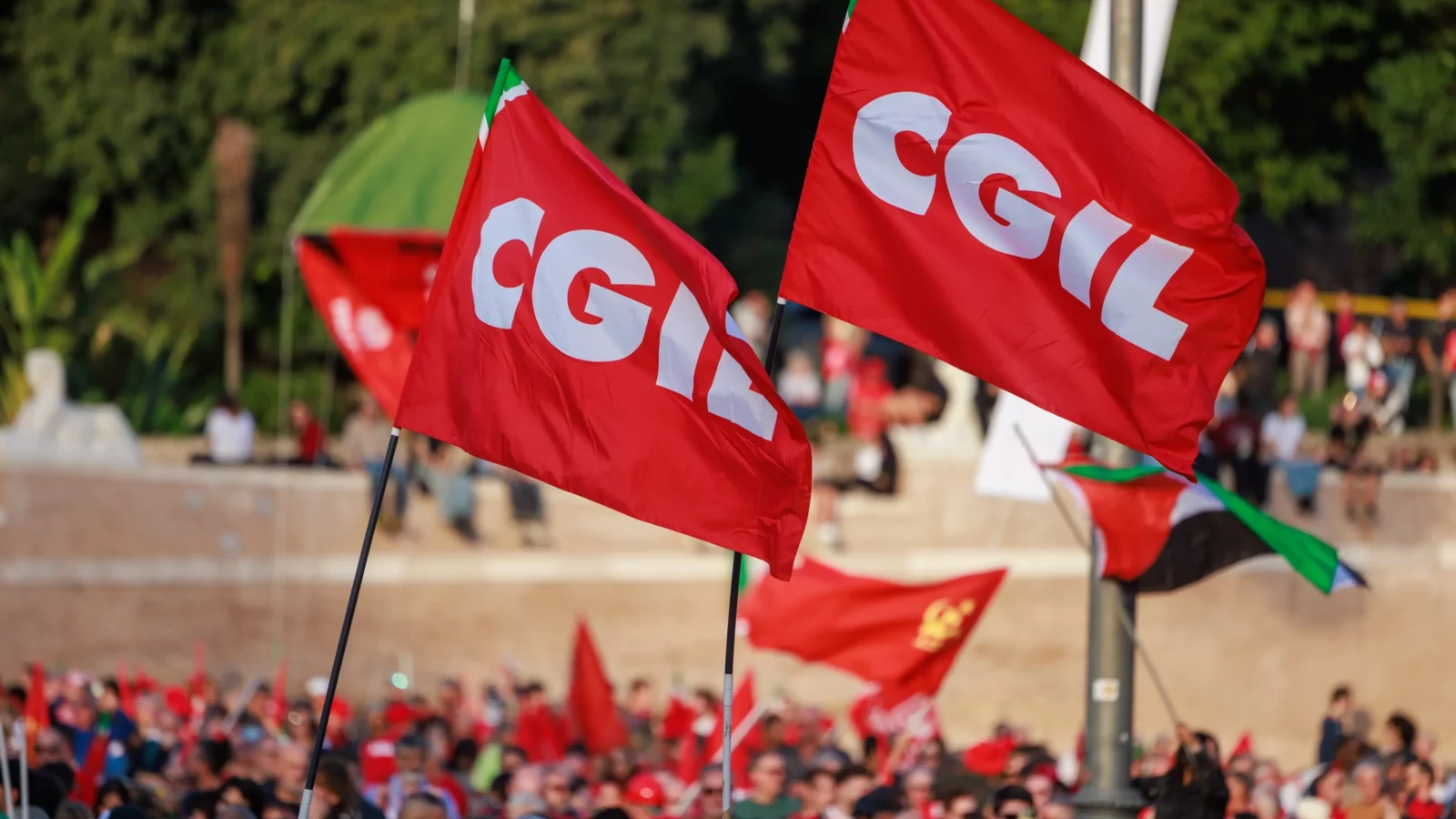
Workers and students took to the streets on Friday 20 November for the general strike.
The CGIL‘s protest was joined by mobilisation from the Cobas grassroots union and a Europe-wide student movement. The 24-hour stoppage affected both public and private sectors, from schools to healthcare, from ports to taxis.
For buses, trams and metro services, locally established guarantee bands applied, with some companies exempted from the strike.
In Rome, the CGIL march set off from Piazza Vittorio and made its way to Via dei Fori Imperiali. At the head of the demonstration, alongside general secretary Maurizio Landini, were Elly Schlein, Nicola Fratoianni and Angelo Bonelli.
Giuseppe Conte spoke at a press briefing near Piazza Vittorio.
Landini put the number of participants across more than a hundred Italian squares at over a million and announced that the protest would continue.
“We will keep going in the coming days and continue with mobilisations in the squares,” he said.
In Milan, according to ANSA, around 20,000 students gathered in Piazza Duomo, where banners were displayed in front of the cathedral and on the monument to Vittorio Emanuele II. In Genoa, at the end of a march against rearmament, war and the cost of living organised by Osa and Cambiare Rotta, students occupied the university building on Via Balbi.
In Bologna, thousands marched with workers from Kemet at the front of the procession. Demonstrations also took place in Turin, Florence, Perugia and Aosta.
In Bari, organisers estimated between 6,000 and 8,000 people took part in the march from Piazza Massari to Piazza Libertà.
Mayor Vito Leccese also joined the protest, criticising the budget law for failing to address workers’ purchasing power.