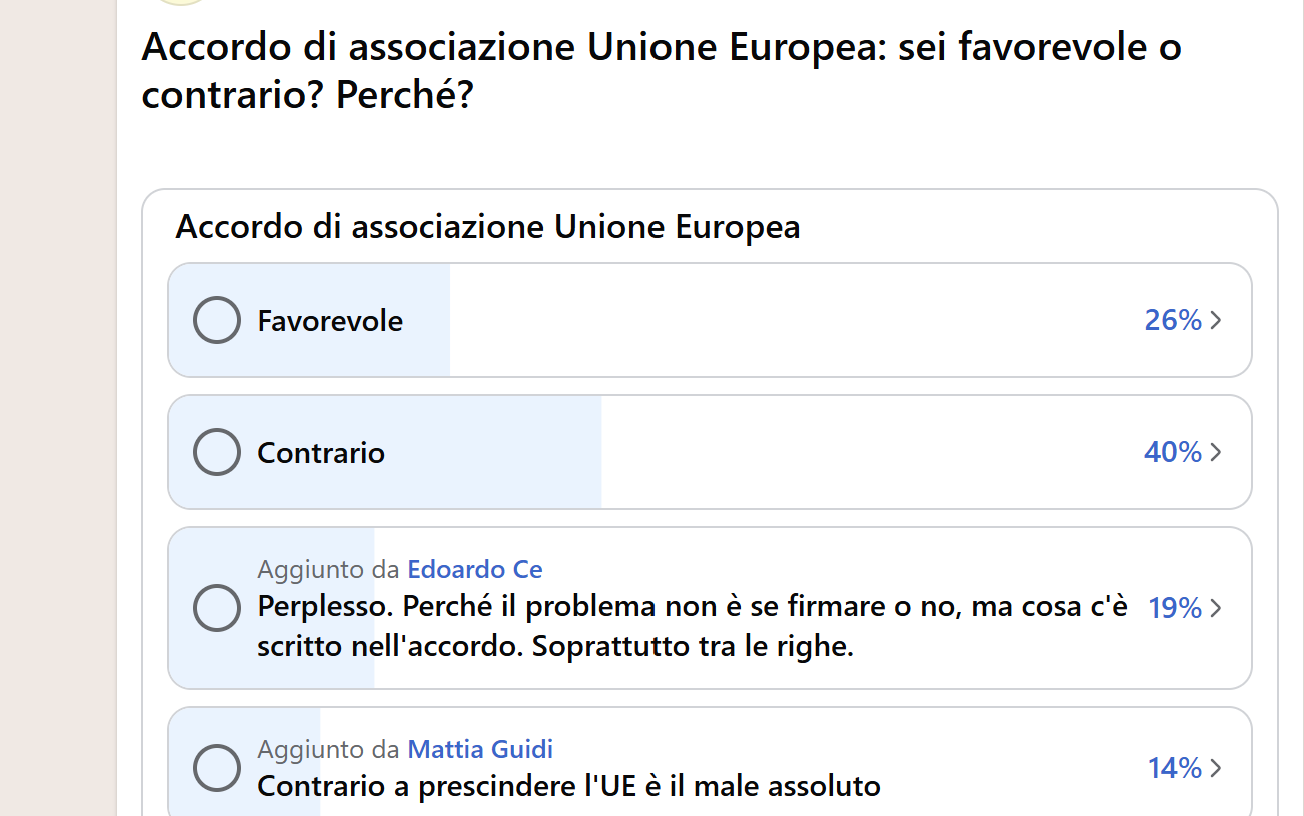
Twenty-six percent. That’s all the Association Agreement with the European Union manages to secure in an open poll on “San Marino risponde,” the country’s most active Facebook group: 78 votes in favor out of roughly 296. Against, combining the two available options, 162 people: 54%. And no one is voting in secret — next to every preference sits a first name, a surname and a profile photo.
There’s a third figure too, perhaps the most interesting one: 19%, or 53 votes, went to an option added mid-poll by a user labeled “Perplexed,” because the problem isn’t whether to sign or not sign, but what’s actually written into the agreement. Especially between the lines.
Two against for every one in favor, then. On a platform where every voter can be identified and where saying “no” carries a social cost that normally pushes people toward the cautious answer. Here, the cautious answer lost.
The context makes the figure less folkloric than it might appear. On July 16 the Council of the European Union gave the green light for the signing and provisional application of the Agreement. The Commission’s preliminary signature is expected in September, followed by the European Parliament and then ratification. In the very same session of the Grand and General Council (Consiglio Grande e Generale) in which the majority celebrated the breakthrough, a request by Domani Motus Liberi for a confirmatory referendum was rejected; the CSdL trade union confederation is calling for a popular consultation a few years after ratification; and the CapiFamiglia (heads of household) committee is pushing back too. On the most significant outcome of San Marino’s foreign policy in the last twenty years, the only public figure that even remotely resembles citizens’ opinion is a Facebook poll.
Which, it must be said right away, is not actually a poll.
The sample is self-selected, Facebook groups attract those who have something to say rather than those who are indifferent, no one knows how many voters are residents or citizens, and the options were added by users while voting was already underway: there are two boxes for saying no and none for saying “in favor, but with reservations.” A serious survey would be designed differently and would produce different numbers.
And that’s exactly the point.
If the figure is unreliable, the only way to disprove it is to produce a reliable one: a representative sample, a stated methodology, published results. So far, no one has done this — neither those bringing the Agreement home nor those contesting it. In the meantime, the vacuum is filled by a Facebook post, and those in government have no hard number of their own to counter the calls for a referendum.
The last time San Marino voted on Europe, in 2013, the quorum wasn’t reached and the result became a dead letter. Thirteen years on, knowing what Sammarinese people actually think is apparently worth less than three hundred clicks.