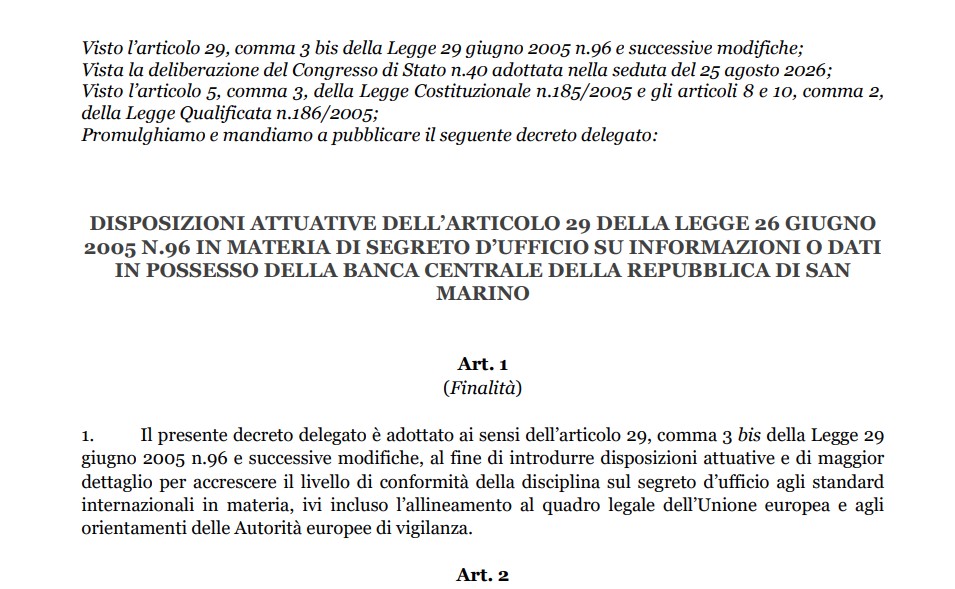
It is dated yesterday, September 7, is called delegated decree number 134, and in two pages establishes who can see the documents held by the Central Bank and under what conditions. It arrives while the Commission of Inquiry into the attempted takeover of Banca di San Marino is already at work, and it says two things at once.
The first: the Commission retains the power to have documents handed over and to question, in closed session, anyone bound by official secrecy, and this is written in black and white.
The second, three clauses further on: information that the Central Bank has received from foreign supervisory authorities can only be handed over with the written consent of whoever sent it, and that constraint applies to the Commission of Inquiry as well.
It’s worth starting with why this matters to anyone who lives here, not only to those who read decrees for a living.
When a San Marino bank runs into trouble, the bill doesn’t stay inside the bank.
The State steps in, public debt grows, and citizens pay off that debt for years: it has already happened more than once, and it remains the heaviest item in the Republic’s accounts. The Bulgarian affair has already produced a visible cost: this summer’s budget adjustment set aside two million euros for the international arbitration that arose from it.
The Commission of Inquiry exists to establish whether supervision was influenced during that affair, whether there were entanglements between politics and business, and whether there was pressure connected to the Association Agreement with the European Union.
It is, in effect, the only channel through which citizens can learn what actually happened: the criminal trial, if and when it arrives, has its own timeline and its own rules.
This is why a rule deciding which papers enter that room is news.
The decree operates in three steps.
The first favors parliamentary oversight: for the purpose of establishing political and administrative responsibility, anyone bound by official secrecy waives it when the Commission requests it, whether in hearings or in handing over documents. The second isolates a separate category: information received by the Central Bank from foreign authorities – central banks, supervisory, regulatory or resolution authorities with which BCSM has relationships or memoranda of understanding. These are subject to usage limits and the requirement of prior written consent.
The third step is paragraph 6, and it is the decisive one: both restrictions also apply to the Commission of Inquiry and to the Finance Commission.
The decree provides for only one exception to that consent requirement: when the Central Bank is legally obliged to hand over documents to the national authorities listed in Article 29, paragraph 3 of its own Statute. In the 2005 statutory text, that paragraph names only one entity, the judicial authority, and only for investigations into crimes; the Statute has however been amended several times since, most recently this year, and verifying the text currently in force falls to the Institutional Secretariat.
If the list has remained the same, the outcome is stark: the magistrate obtains those papers, while the parliamentary Commission must ask someone else for permission.
And that is precisely the point.
The takeover attempt at Banca di San Marino involved a foreign group: to process that case, San Marino’s supervisory authority almost certainly exchanged information with supervisory bodies from other countries.
Assessments of the buyer, the extremely long timeline before the rejection, any reports that came in from abroad are material that by definition did not originate in San Marino: precisely the category that, as of yesterday, now depends on a foreign entity’s approval.
On which, it should be added, the decree sets no deadline. Only in another passage – the one concerning access to facts older than ten years – is it stipulated that silence from the foreign authority “within a reasonable time” legitimizes refusal. For the Commission of Inquiry, if consent never arrives, the text does not say what happens.
There is a second aspect, and it is perhaps the most delicate.
The decree establishes that, when the Finance Commission requests information, the documents remain classified for as long as confidentiality requirements persist, and that it is the Central Bank itself that verifies whether those requirements still apply, communicating in a reasoned manner whether secrecy is to be maintained.
It adds that, if informational needs can be met with aggregated and anonymous data, BCSM will provide it in that form. Put bluntly: on part of the process, the one deciding when it’s possible to speak is the very body under investigation.
The decree does, however, contain genuine openings, and it would be unfair to leave them unmentioned.
Anyone who needs to defend themselves in court against a Central Bank measure can obtain copies of the documents concerning them, subject to a series of exceptions. And most notably, secrecy is eased regarding so-called archival matters: facts at least ten years old that can no longer cause current harm. On these, anyone demonstrating a direct, concrete and current interest can request access to the records.
For savers who lost money during the season of past banking crises, this is no small development.
What remains is the method, and each will judge it for themselves. The decree stems from a resolution of the State Congress dated August 25 and was signed on September 7, with the Commission of Inquiry having been at work since July.
It is a delegated decree: the Grand and General Council (Consiglio Grande e Generale) delegated that power months ago when it approved the reform of the Central Bank’s Statute, at which time the implementing measure was presented as a technical alignment with international and European standards. For the most part, that is indeed what it is.
But paragraph 6 is not technical: it decides who gets to know what within an inquiry that is already underway.
From here on, three questions suffice, all requiring brief answers.
Had the Commission of Inquiry been informed of the decree’s content before it was signed, or did it read it yesterday like everyone else?
Of the papers it needs, how many fall into the category now subject to foreign consent?
And what happens, in practical terms, if that consent never comes: will the Commission state in its final report that it was unable to see certain material, or is there a path forward?
These are not questions for legal scholars.
They are the questions of those who, had that bank collapsed, would have footed the bill.