San Marino’s European tradition is as old as Europe and the Republic itself, but political and parliamentary discussions on integration into the European Economic Community developed starting in 1973.
On 1 April 1979, Altiero Spinelli, regarded as one of the “founding fathers” of a united Europe, delivered the official address at the installation ceremony of the Captains Regent.
The integration process began in 1983, with the establishment of official relations between the Republic and the European Economic Community.
Since then it has involved several generations and, over the last fifteen years, has taken on unprecedented importance for Sammarinese public opinion.
A crucial date is 20 October 2013, the day of the proactive referendum in which a majority of voters supported launching the procedure for accession to the European Union.
The referendum, held in full respect of the principles of legality and constitutionality, had no legal effect because the quorum was not reached, but it had significant political consequences.
Since then, integration into the European Union has become one of the major themes of our political life – perhaps the major one.
This is why 19 October 2026 is another crucial date: it marks, exactly thirteen years later, the arrival point of a political community that has long reflected on its European destiny and sought its place in Europe.
This arrival takes shape in the association agreement, a multilateral treaty that transforms the Republic from a “third” state into an associated state.
This is a collective achievement, the result of compromise, reached during one of the most difficult periods in Sammarinese history – first marked by an unprecedented economic crisis, caused by external attacks and internal mistakes; then by a pandemic, faced in near-total isolation; and finally by wars and international crises triggered also by irresponsible great powers.
Faced with this growing insecurity, the response has been to seek greater security through European integration.
A response founded on three pillars: preserving national unity, defending the general interest, and affirming multilateralism.
For more than a decade, the Republic has maintained a fundamental continuity in its European policy.
This has taken place within a framework of democratic pluralism: Parliament, the Government and public opinion have all recognized in European integration through the agreement a genuine Sammarinese general interest.
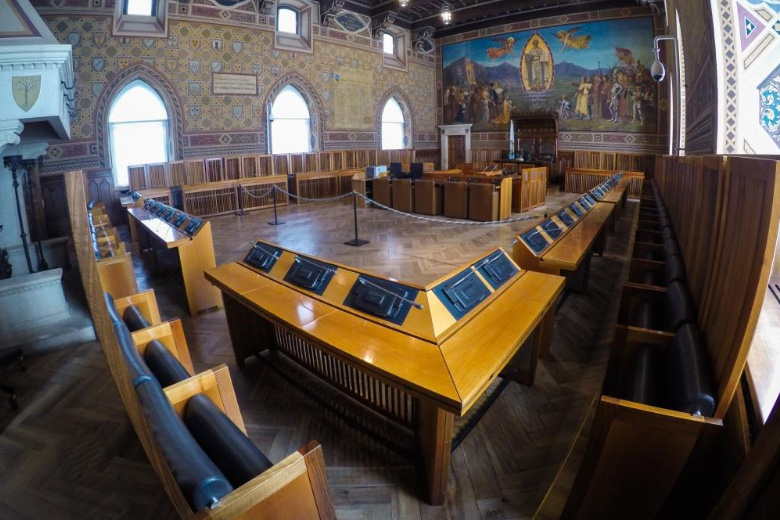
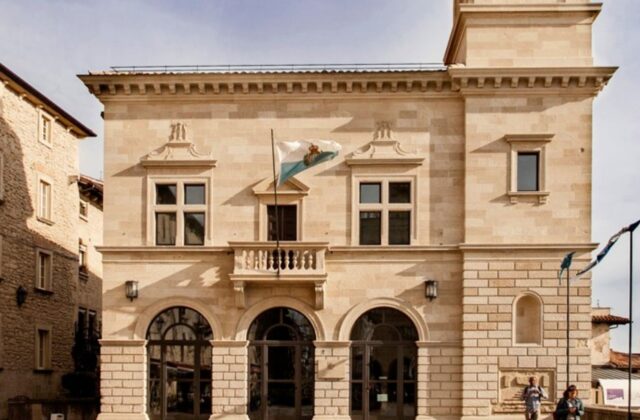
Otherwise, 19 October would not be a historic date worthy of being inscribed on the walls of the Hall of Audience at Palazzo Valloni.
It is historic because it represents a triumph of multilateralism, a founding principle of Sammarinese foreign policy, understood as a commitment to pursuing common and coordinated policies rather than unilateral or merely bilateral ones.
It is historic because its importance in our centuries-long history is equal to that of milestones such as joining the Council of Europe and the United Nations.
And finally, it is historic because it fulfils the commitment of generations devoted to upholding Sammarinese values and interests.
Since 2013, four Sammarinese legislatures and four European ones have succeeded one another, with different political majorities, all in favour of the agreement.
These democratic representations have given the process constant popular legitimacy, right up to the conclusion of the negotiations.
Indeed, the agreement establishes, first and foremost, on a reciprocal basis, a principle of non-discrimination and guarantees the four fundamental freedoms of the European Union.
The substantial end of “non-EU” status represents a true liberation, and it is above all on this principle that the most representative social organizations – such as those of workers and industrialists – have based their support for the agreement.
We have thus reached the signing: an international success for the Republic, the European Union and its member states, all of them democracies.
The shift from “third” state to associated state is a turning point in history and the creation of a future.
The agreement, however, creates the conditions for the future without determining it.
Its concrete implementation, once it enters into force, will lie in the hands of the Sammarinese people.
It will require renewed, and even more collective, commitment to turn its ambitious prospects into reality.
If this happens, and the Sammarinese people are satisfied with the result, the next step could be negotiated accession to the European Union.
If we fail, we will have wasted ourselves.
*******
Michele Chiaruzzi, professor of History of Political Thought and International Relations at the University of Bologna and director of the Research Centre for International Relations at the University of San Marino