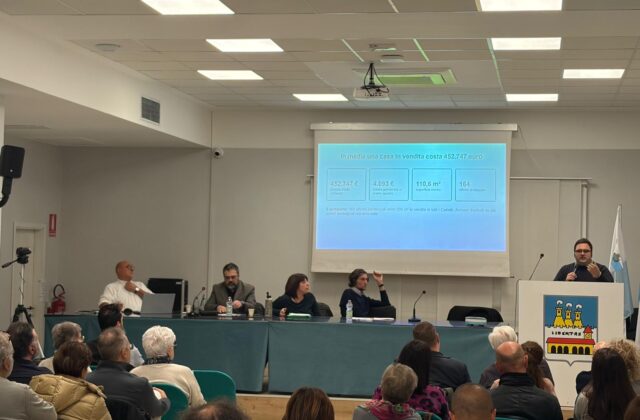
In the Communications item of the Grand and General Council (Consiglio Grande e Generale), Giovanni Zonzini (Rete) presented the results of his party’s survey on San Marino’s real estate market. Of the 164 residential properties analysed, the weighted average price was around €4,100 per square metre. Zonzini announced the filing of a draft law on the right to housing and, at the outset, expressed solidarity with Councillor Casali.
Below is his speech in full.
«First of all, allow me to respectfully voice my disagreement with your decision to prevent an opposition colleague from addressing a matter that, in my view, is not at all covered by the report on the state of justice.
I believe that in a Parliament the rules of procedure should not be stretched beyond their normal interpretation in order to silence a councillor during the Communications item.
I therefore wish to express my solidarity with colleague Casali and hope that his case can also be debated.
Regardless of whether it is discussed or not, this does not strike me as a manner befitting a democratic Parliament.
I say this with all due respect, but firmly.
Returning to my remarks, I wanted to inform the Chamber that our party held a public evening on 12 November dedicated to the right to housing and the issue of homes.
Turnout was high, and we are pleased about this, because it shows strong public interest in a social issue of primary importance.
During the evening we presented the findings of our working group’s research into San Marino’s property market.
The group analysed more than 225 listings as of 26 October 2026.
We excluded those that did not state a price or floor area, as well as particularly luxurious properties, which would have skewed the statistics.
Our survey captures what was on the market at that date, and the figures that emerge are, objectively, worrying.
Across the 164 properties analysed, the weighted average price is around €4,100 per square metre, dropping to roughly €3,600–3,700 for second-hand properties and rising to about €4,500–4,600 for new ones. We are naturally talking about residential property.
It takes only a few simple calculations to understand that someone on a normal salary, or even slightly above average, simply cannot afford a mortgage.
On average, the cost of a home is equivalent to around 18 years of gross salary. This means that a worker earning around €2,000 gross a month would be able to buy a home only if, for 17 years, they neither ate nor drank nor paid any taxes.
As you can clearly see, this is an impossible scenario.
Our research therefore shows that today in San Marino, anyone earning less than €3,000–3,500 a month who does not already own a home cannot manage to live in their own country — or can only do so by renting, with great difficulty.
The rental market is extremely small.
The ratio between income and housing expenditure considered sustainable — according to both the European Union and the United Nations, as well as, broadly speaking, the banks that grant loans — is around 30–35%.
To stay within that threshold, a worker or a family would need to earn more than €3,000 a month.
We all know very well that in our country such incomes are the preserve of a minority of workers and entrepreneurs.
We see the effects of this when we talk to people and when we look at social media.
An ever-growing number of citizens, especially young people who are not fortunate enough to have a family home that can be passed down to them by their parents, are choosing to emigrate.
Not far away — not to France, Belgium or Argentina, as our grandparents did — but to Coriano, to Ospedaletto.
To me this is a major problem, because a fundamental right of San Marino citizens is being trampled on: the right to live in one’s own country.
We cannot become a country where anyone earning less than €3,000–4,000 a month has no right to live here.
What kind of society do we want?
What kind of country are we building?
I believe the political class, both majority and opposition, must seriously address this social problem, without planting flags or scoring political points.
The law passed a year and a half ago, even assuming it were perfect, is certainly not solving the problem.
I believe we need to sit down at a table and, regardless of where the proposals come from, look for new legislative measures capable of intervening radically.
This is an extremely serious and deep-rooted problem, one that cannot be addressed with half-measures or by simply increasing rent deductions.
What is needed is political investment, because property prices must come down.
This will inevitably cause harm to some, but for the vast majority of the population it would mean seeing a basic right respected: the right to be able to live in one’s own country on a normal salary.
Here we are talking about workers earning €1,800 a month, who cannot afford to buy even a 50-square-metre flat and struggle even to rent one.
Can we continue to have a system in which property ownership is concentrated in the hands of a few, in which real estate companies or large landowners see the value of their assets grow enormously without lifting a finger, while workers can no longer live in this country and are effectively pushed out?
For us, this is a social injustice that can no longer be tolerated.
During the public evening we presented the data collected along with some policy guidelines.
I am ready to provide anyone who wishes with all the tables and sources used, and to make the full analysis available.
I am announcing to the Chamber that in the coming weeks we will file a draft law. From what I understand of how things work here, the majority will never approve a bill of ours on the housing emergency and the right to housing.
But let me say now that, if you are willing to accept at least some of our proposals, we are prepared to withdraw our bill and vote for one of yours that incorporates them.
If you want to plant your own flag on this, that’s no problem at all.
But, colleagues, I say this with my hand on my heart: we need to act seriously and radically, even if that means having the courage to go against the interests of a small group of large property owners who clearly wield great political influence, but who cannot be allowed to go on trampling — coldly and cynically, and with impunity — on the basic rights of San Marino’s workers».