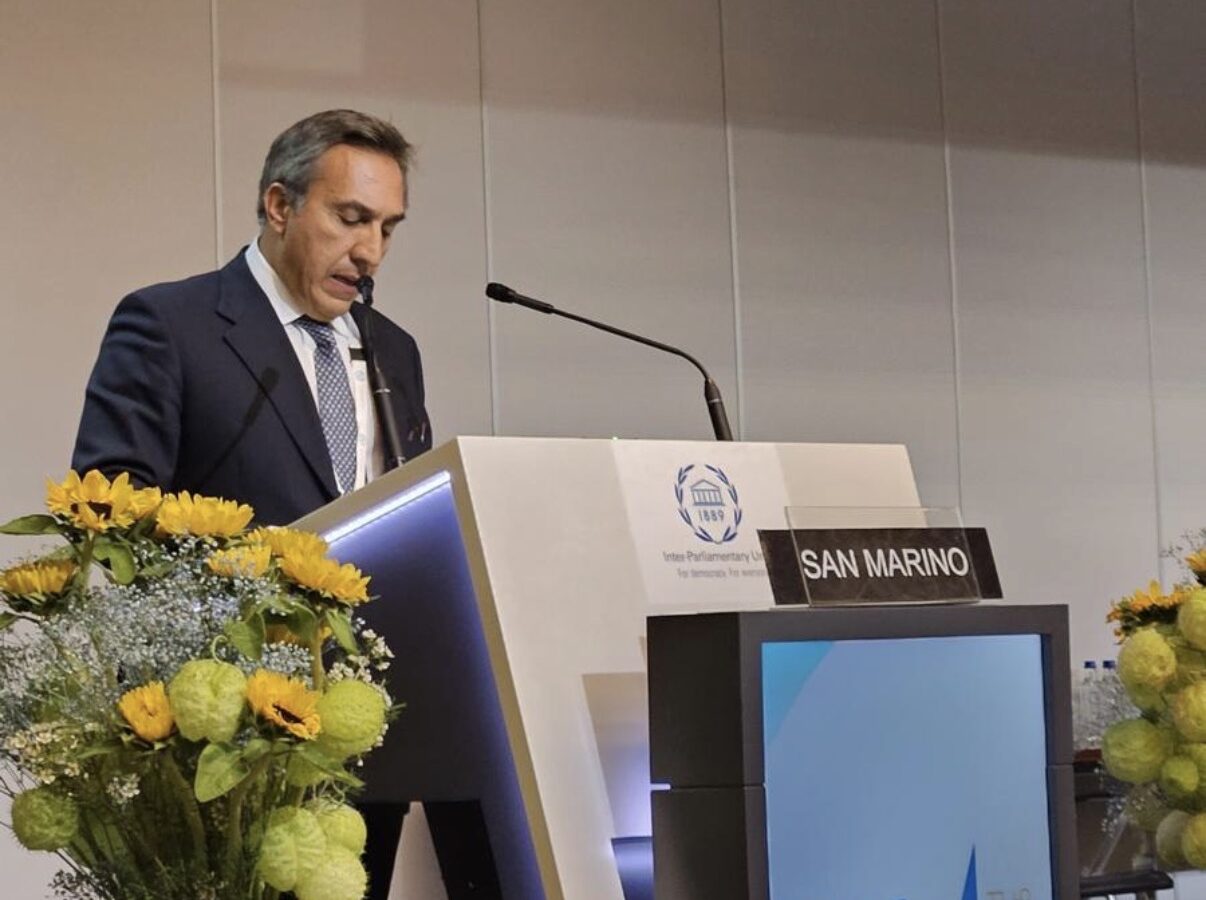
Sala Montelupo, Domagnano, Tuesday 13 October. On the occasion of the presentation of the reprinted volume Alcide De Gasperi. Rivoluzione, Riforme, Libertà by Igino Giordani, lawyer Francesco Mussoni offered a reflection on the political and moral legacy of the Italian statesman, dwelling in particular on relations between Italy and San Marino, the roots of Christian democracy, and the Republic’s path toward the European Union.
*****
FREEDOM, RESPONSIBILITY AND THE COURAGE TO BUILD THE FUTURE
Address by Lawyer Francesco Mussoni
Your Excellency, Mr Secretary of State, Mr Ambassador, Magnificent Rector, distinguished speakers, authorities, ladies and gentlemen,
I would first like to thank the organisers for this initiative, which gives us the opportunity to reflect on the figure of one of the greatest protagonists of twentieth-century European political history: Alcide De Gasperi.
The title of the volume presented today, Revolution, Reforms, Freedom, evokes three words that do not belong solely to history. They are words that also question our present.
I would like to begin with a question: why speak of Alcide De Gasperi still today?
Because, more than seventy years after his death, his teaching retains an extraordinary relevance.
And above all because De Gasperi reminds us of a fundamental distinction that contemporary politics sometimes seems to have lost: the difference between governing the present and building the future.
The politician must certainly address day-to-day problems. The statesman, however, bears a further responsibility: to imagine what kind of country will be handed down to future generations.
De Gasperi belonged to this second category.
1. De Gasperi: politics as responsibility and service
When De Gasperi took the helm of the Italian government in December 1945, he found a country devastated by war, economically prostrate, cut through by deep ideological divisions and still searching for a new institutional identity.
He could have limited himself to managing the emergency.
Instead, he chose to build a vision for the future.
He contributed to consolidating the democratic Republic, guided reconstruction, backed Italy’s participation in the Marshall Plan, firmly anchored Italy within the system of Western democracies, and was a leading figure in the process of European integration.
Difficult decisions, at times unpopular, certainly controversial.
But decisions inspired by a vision.
One example is particularly telling.
In 1948, after the extraordinary electoral victory of the Christian Democracy party, which won an absolute majority of seats in the Chamber, De Gasperi could have governed alone.
Instead, he chose to involve liberals, republicans and social democrats.
He understood that the strength of a democracy lies not only in the numbers of a majority, but also in the capacity to build consensus, balance and institutional stability.
Being strong does not necessarily mean governing alone. It means knowing how to use one’s strength to build more solid institutions.
This is a lesson that retains extraordinary value even for small political communities such as our own Republic.
2. De Gasperi, Christian democracy and San Marino
There is also an ideal and historical bond worth recalling.
The birth of the San Marino Christian Democratic Party (Partito Democratico Cristiano Sammarinese), on 9 April 1948, fits within the broader movement of European Christian democracy.
A movement that had found in Don Luigi Sturzo one of its earliest interpreters, and in Alcide De Gasperi the protagonist of its political and institutional affirmation.
It is worth recalling that already in December 1947, Zaccaria Savoretti and Federico Bigi travelled to Rome to meet Don Luigi Sturzo, receiving encouragement for the establishment of a Christian-democratic party in our Republic.
This was not simply about founding a new party.
It was about affirming a conception of politics grounded in the centrality of the person, in freedom, solidarity, social justice and the responsibility of institutions.
These are principles belonging to the tradition of Christian popularism, which have accompanied the history of San Marino’s Christian Democracy.
Naturally, our historical path has differed from Italy’s.
But there exists a shared ideal heritage.
It is the conviction that politics must serve the person and the community; that freedom cannot be separated from responsibility; that social justice must go hand in hand with the defence of democratic institutions.
And there is another principle, which I consider decisive: the Christian inspiration of politics must not translate into a confessional conception of the State, but into a moral responsibility in the exercise of public functions.
De Gasperi, a man of profound faith, knew how to defend the autonomy of politics and institutions.
And I believe that precisely this ability to hold together deep convictions and respect for pluralism represents one of the most precious lessons for our Christian-democratic tradition.
3. De Gasperi and San Marino: a page of history to rediscover
I would like to recall an episode less well known, but particularly significant for us Sammarinese.
In the years following the Second World War, relations between Italy and San Marino went through a very delicate phase.
In Rome, De Gasperi governed, at the head of a centrist coalition strongly oriented toward Western democracies.
In San Marino, by contrast, a socialist-communist coalition governed.
These were the years of the Cold War, of ideological confrontation and tensions that inevitably also involved our small Republic.
And yet, despite these differences, De Gasperi showed attentiveness to San Marino’s reasons and sovereignty.
In December 1950 he met with a San Marino delegation, at a time when bilateral relations were anything but straightforward.
The dialogue with Secretary of State for Foreign Affairs Gino Giacomini, a representative of the socialist-communist government, stands as a significant example of how diplomacy can and must overcome ideological divides.
There was no shortage of friction, pressure and moments of serious tension, even in economic relations between the two states.
We should not idealise that period.
In 1951 there was a police blockade at the state borders.
But precisely for this reason, the capacity to seek solutions through negotiation and mutual recognition takes on greater value.
De Gasperi understood that San Marino, notwithstanding its territorial size, represented a state entity endowed with a history, a dignity and a sovereignty deserving of respect.
In 1953 new bilateral agreements were reached; specifically, on 24 April 1953 an agreement was signed between Italy and San Marino, bearing the signatures of De Gasperi and Giacomini, revising the 1939 Convention of Friendship and Good Neighbourliness, concerning limits on the casino, regulation of radio and television broadcasting, and an Italian contribution toward rebuilding the Rimini-San Marino railway.
This agreement helped overcome one of the most difficult disputes between the two countries.
This episode teaches us something fundamental.
Respect for a state’s sovereignty cannot depend on its size, nor on the political colour of its government.
This is a principle that San Marino, with its more than seventeen centuries of institutional tradition, knows profoundly.
And it is a principle that must continue to guide our international relations.
4. De Gasperi and Europe: a political project before an economic one
But it is above all in his European vision that De Gasperi’s extraordinary contemporary relevance emerges.
He had lived through two world wars, the crisis of democracies, the rise of totalitarianism and the destruction of the European continent.
He understood that peace could not be entrusted solely to the goodwill of governments.
Institutions needed to be built capable of making cooperation among peoples stable and lasting.
For this reason, together with Robert Schuman and Konrad Adenauer, he supported the process that would lead to the birth of the first European Communities.
But his vision went beyond economic cooperation.
De Gasperi did not simply envisage a common market.
He envisaged a political community founded on freedom, democracy and solidarity.
In his speech in Strasbourg on 12 January 1951, he spoke words that retain extraordinary relevance today.
He warned that building merely common administrations, without a higher political will, risked producing European institutions devoid of soul and genuine participation.
It is a warning that seems addressed to today’s Europe as well.
Europe cannot be merely a set of regulations, procedures, economic constraints and common administrations.
It must above all be a community of values and a shared political project.
De Gasperi also understood that European integration need not necessarily erase national identities.
On the contrary, through cooperation, states could strengthen their capacity to face challenges that none, in isolation, would be able to manage.
His personal experience was particularly significant in this regard.
Born in Austro-Hungarian Trentino, a parliamentarian in Vienna before becoming a leading figure in Italian politics, he knew the value of territorial, linguistic and cultural identities.
He knew that one can belong to a local community, to a nation and to Europe, without these forms of belonging necessarily coming into conflict.
Identity is not defended only by closing oneself off. It is also defended by building the conditions that allow it to continue to live and flourish.
5. San Marino and the European Union: a historic choice
This reflection leads us directly to the present circumstances of our Republic.
San Marino today faces one of the most important passages in its recent history: the definition of a new relationship with the European Union through the Association Agreement.
A complex path, developed over many years and supported by institutional and political dialogue involving several legislatures.
The signing of the Agreement, announced for next 19 October, represents a milestone of great significance.
I believe that De Gasperi’s vision can help us interpret the meaning of this choice.
For San Marino, the relationship with Europe should not be seen merely as a matter of regulatory alignment.
It cannot be reduced to a set of obligations, regulations or procedures.
It must be conceived as a strategic choice about the future of the Republic.
A choice that concerns the opportunities available to our young people, the competitiveness of our businesses, the quality of our institutions, legal certainty, and the ability of our economic system to engage with a wider space.
Naturally, this choice also entails responsibilities.
It requires preparation, administrative competence, negotiating capacity and attentiveness to the particularities of our reality.
We must not hide the difficulties, nor underestimate the legitimate concerns that accompany a process of this magnitude.
But it would be an equally serious mistake to interpret every form of integration as a renunciation of our identity.
San Marino has endured through the centuries precisely because it has known how to adapt to historical change while preserving the essential core of its independence.
Sovereignty does not consist merely in the right to decide alone. It also consists in the concrete capacity to determine one’s own future.
And in a world characterised by large economic and geopolitical blocs, this capacity can be strengthened through more structured international relations.
It is not a matter of ceasing to be Sammarinese in order to become European.
It is a matter of finding the best way to be fully Sammarinese within twenty-first-century Europe.
I believe De Gasperi would have recognised in this challenge a question deeply familiar to him: how to reconcile identity, autonomy and international cooperation.
6. The statesman’s lesson: the courage of the future
I would like to conclude by returning to the human and political figure of De Gasperi.
He was not a man without flaws, nor a figure removed from the harsh confrontations of his time.
He was a political leader capable of taking on responsibility, of making difficult choices and of accepting the risk of unpopularity.
But above all, he was a man who knew how to look beyond his own personal experience.
His European project was not yet complete when he died in 1954.
And yet, he had helped lay foundations upon which others would continue to build.
This is perhaps the most authentic meaning of the word “statesman.”
The statesman is not merely one who achieves something during his own term. He is one who makes possible something that will mature even after he is gone.
This is why De Gasperi remains relevant today.
Because he reminds us that politics cannot be reduced to the pursuit of immediate consensus.
Because he teaches us that compromise, when grounded in principle, is not weakness but responsibility.
Because he shows that a strong political identity can coexist with respect for other sensibilities.
And because he hands down to us a conception of freedom that is not isolation, but conscious participation in building a shared destiny.
For us Sammarinese, for our Christian-democratic tradition, and for the responsibilities we are called upon to assume today, I believe this teaching holds particular value.
To safeguard our history does not mean remaining prisoners of the past. It means finding in our history the strength to face the future.
And perhaps the best way to honour Alcide De Gasperi today is not simply to remember what he did.
It is to recover his courage to choose, his capacity to build, and his conviction that politics, when it is authentic service to the community, must always keep its gaze fixed on the generations to come.
Thank you.