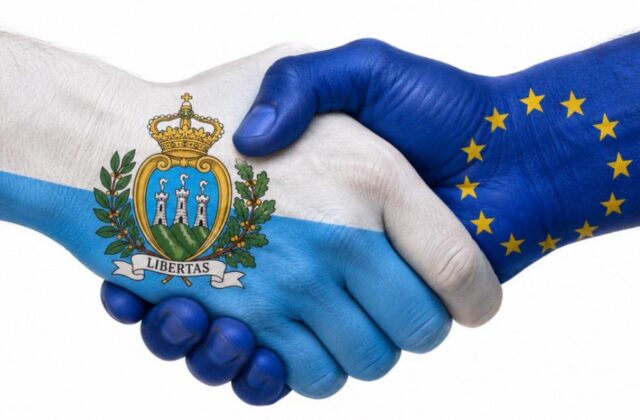
Access to the single market to support industry, paired with tighter controls on the banking system. These are the two central themes of an analysis by Matteo Fabbri, published on 24 October by Linkiesta Europea, examining the association agreement between San Marino and the European Union signed on 19 October.
The agreement will allow the Republic to take part more fully in the single market without joining the EU. For San Marino’s businesses, this means fewer obstacles to cross-border activity, in an economy where manufacturing generates roughly a third of national value added and exports nearly 90% of its output.
The sector also employs more than one in three private-sector workers. According to the analysis, these figures place the Titano closer to Liechtenstein than to Andorra, where industry carries far less economic weight.
The shift follows the collapse of the old model, built on banking secrecy and the inflow of capital from Italy. Between late 2008 and mid-2010, Linkiesta Europea notes, deposits fell by around 35%, under pressure from Italy’s tax shield scheme and growing international demands for transparency.
In the years that followed, the number of banks dropped from twelve to four, with repeated public bailouts along the way. Cleaning up the sector remains an unfinished task: according to International Monetary Fund data cited in the article, the ratio of net non-performing loans to net loans stood at 11.1% in 2025.
For this reason, access to European financial markets will open gradually, conditional on checks regarding regulation and supervision. Opportunities for San Marino’s banks will therefore hinge on compliance with the terms set out in the agreement.
Ties with Italy also remain close. As of September 2025, more than 8,600 cross-border workers were employed in the Republic, a significant workforce for local businesses.
Economic integration will require San Marino to adopt a wide range of EU rules. The Republic will be able to take part in the consultations provided for under the agreement, though without the voting rights granted to member states within EU institutions. The treaty must still complete the procedures needed to enter fully into force.