The problem with extensions, almost always, isn’t the extensions themselves. It’s the weight. A strand that’s too heavy on fine hair pulls at the root, and after a few months the root gives way. In salons along the Riviera, more and more women are arriving with hair broken by poorly done applications. In Acquaviva, there’s an atelier that has built its entire method around one question: how much does each strand weigh?
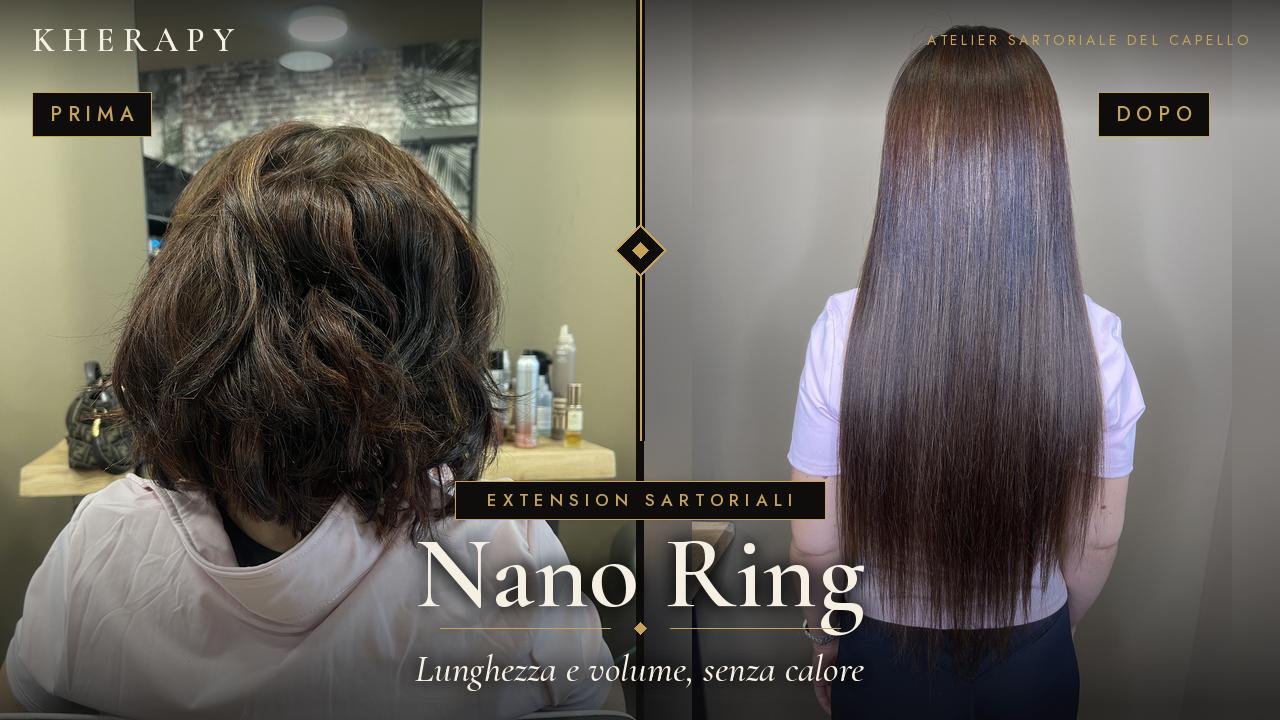
It’s called Kherapy, and it describes itself as a “tailoring atelier for hair.” Based on Strada Genghe di Atto, it works with clients from San Marino, Rimini and Riccione. Its first location opened in Verona in 2016. Before applying a strand, the atelier weighs it on a scale, and before that, examines the hair under a microscope. Sometimes, after that examination, it sends the client home.
The founder is named Flò. She graduated at a very young age in Ukraine and later studied trichology between Italy and San Marino. “I’ve seen too many women devastated by aggressive bleaching, scorching hot irons and harsh extensions,” she says. That’s where the idea came from: a method to lengthen and thicken hair without weighing down the natural strands. She arrived in San Marino thanks to a long-standing friendship with Verona-based Emanuele Tinazzi, founder of Pharma Titano, who suggested she open a branch in the Republic and became a partner in the atelier.
Let’s start with the diagnosis. Is it really necessary?
It helps avoid mistakes that end up costing you for months afterward. With a micro-camera, we can see the thickness of each individual hair, its density, and the condition of the scalp. Fine hair can’t bear the same weight as thick hair. If you ignore that, the root gives way. Sometimes the diagnosis leads us to say no: if the hair isn’t ready, we suggest restorative treatment first, or we wait. We’d rather lose an appointment than ruin someone’s hair.
Many women worry that extensions will look fake or damage their hair. Are they right to worry?
They’re right to be afraid, because it happens often. Many common techniques use strands weighing a gram or more, with wide, flat attachment points. On fine hair, these are visible and tug at the roots. We work with micro-strands weighing between 0.2 and 0.6 grams, with an attachment point half the size of a grain of rice. We won’t claim they’re invisible — that would be false: an attachment point does exist. What we can say is that it blends in, even with a high ponytail.
What techniques do you use?
Mainly two. Nano-Keratin secures the strand with a small point of real keratin, which we prepare ourselves in the atelier — none of the polymers or resins that many call “keratin” but aren’t. Nano Ring, on the other hand, uses a tiny ring, applied cold, without heat and without glue. The consultation determines which one is right.
And where does the hair come from?
We use RAW Single Donor hair: each set comes from a single donor and has not undergone any chemical treatment. The cuticles — the tiny scales that cover each hair — remain intact and all aligned in the same direction, which is why the hair doesn’t tangle. Industrial hair mixes different sources together: to prevent tangling, it’s treated with acids and coated in silicone. It feels incredibly soft right after application, but turns to straw after just a few washes. Virgin hair, on the other hand, behaves just like your own: it can be cut, coloured, straightened. And because it lasts, each maintenance session reuses the same hair instead of requiring new purchases.
Do clients ever come to you with extensions done elsewhere?
Often. And many have been told that after four or five months, the extensions need to be thrown away. That’s not always true: it’s often the attachment that fails, not the hair itself. If the hair is still in good condition, we reapply it, even if the original application wasn’t done by us. We want to turn this into a proper service — a kind of “extension SOS” to salvage what the client has already paid for.
Is there a case that stands out more than others?
A woman came to us after chemotherapy. She walked in wearing a blonde wig, which she used to cover her hair that was still growing back, very short at the time. She was a radiant woman, but she no longer recognized herself in the mirror. We applied wavy blonde extensions using the Nano Ring technique, blending them into her short hair. For about a year and a half, at every session, we also worked on her natural hair: restorative treatments, hydration, occasional lightening when the hair’s condition allowed it. Today she has her own hair back and no longer wears extensions. For us, that’s the whole point: extensions are a bridge, not a dependency.
Are you working on anything new on this front?
Today, after a course of treatment, patients usually have to wait six or seven months before they can get hair-thickening extensions. We’re currently testing even lighter micro-attachments and micro-strands to allow us to intervene after just two or three months of regrowth. We’re in the final stages of testing the durability of the attachment points.
Any advice for those considering it?
Before asking about the price, ask how much each strand weighs, what material the attachment is made of, and where the hair comes from. If they can’t answer you, you already have your answer.
Besides extensions, Kherapy offers thickening treatments for fine and thinning hair, restorative treatment for damaged hair, formaldehyde-free smoothing keratin treatments, and oxygen therapy for those suffering from hair loss. The Acquaviva atelier is located at Strada Genghe di Atto 136, tel. and WhatsApp +39 366 845 1114.