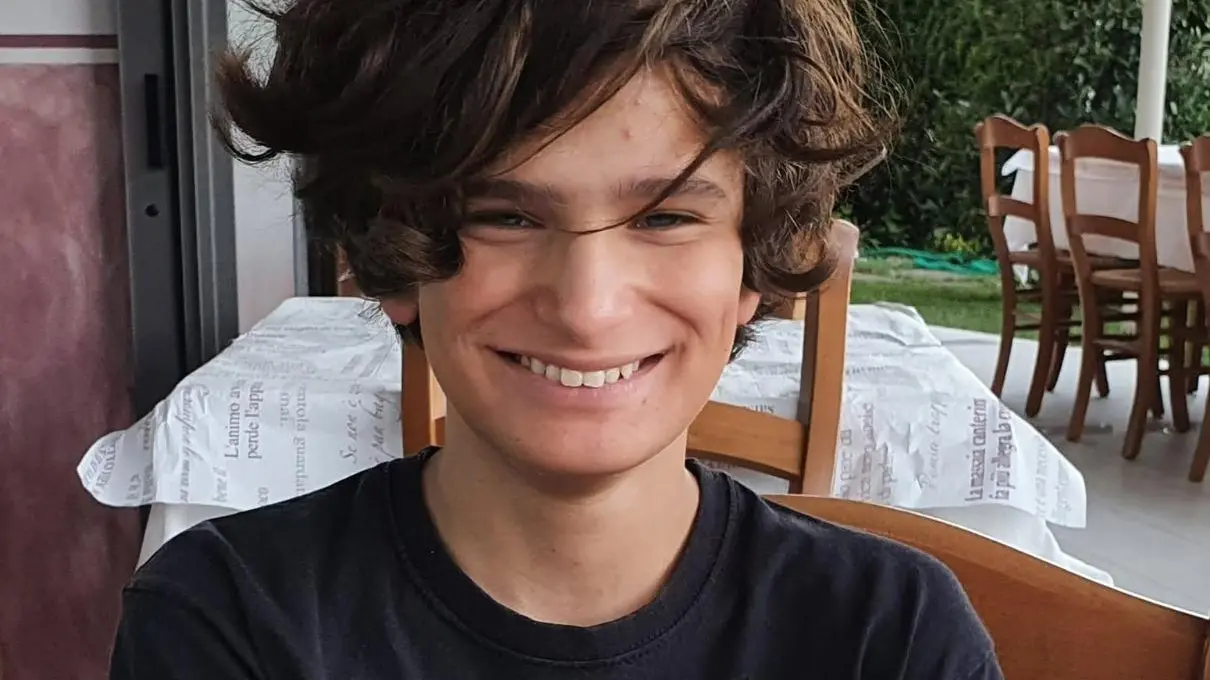
Teachers at San Marino’s high school remember Riccardo Gualtieri. In a letter dedicated to the 18-year-old who died following a domestic accident at his home in Verucchio, the teaching staff of San Marino’s high school recall the student they knew in the classroom and share his reflections on literature, indifference and relationships with others. Riccardo was in his final year of the scientific high school track.
“Dearest Riccardo, we, your teachers, overwhelmed with thoughts and short on words at this moment more than ever, would above all like to thank you for how you managed to be UNIQUE in your humanity and as a student,” they write. The tribute also becomes a reflection on their relationship with students: “Thank you for reminding us, even more and even better, that every young soul sitting at the desk in front of us is unique, original, special and irreplaceable. Thank you for reminding us that it is not right – indeed it is foolish – to expect students to be cast from the same mould.”
His classmates left the words “Misunderstood genius” on his desk. The teachers say that in recent days they reread Riccardo’s essays, rediscovering aspects of his personality in them: “We teachers were perhaps fortunate enough to understand you a little more, privileged to find more than one open door into your world, as we reread in these days the beautiful essays you wrote in class.”
In the message, they remember a young man passionate about science, literature and philosophy, with music accompanying all his interests. “There was a world inside you, Riccardo. A world you jealously guarded, behind your fringe and your blue eyes, so full of light. There was YOUR world, made up of so many interests, coloured by your passions for science, literature and philosophy, and always threaded through with music.”
Among the school memories is the surprise at his appreciation for Manzoni, while in one essay he had described himself as an “absurdist,” a follower of Albert Camus. The letter also evokes Giacomo Leopardi, whom the teachers imagine he might have loved for his paradoxes and for his tenacity in the pursuit of happiness.
However, it is Riccardo’s own words that take up the concluding part of the farewell. “To certain passages from those texts, to your words, Riccardo, we would like to give space at the end of this tribute in your memory. We consider them a true gift to all of us,” the teachers explain.
On the meaning of writing, the student had written: “Writing can allow us to leave something of ourselves that lasts forever, or simply be a Pascalian ‘divertissement.’ One can also write because one is afraid of living, because our reality, our world, our universe are so limited that we fear we won’t truly live unless we entrust ourselves to the pen. One can write to slow down or speed up time, to etch a precious memory or to explore a hypothetical world in which we chose to do something else, to start from scratch, leaving our imagination completely free.”
Addressing indifference, Riccardo had contrasted the ease of neglecting things with the satisfaction of building and seeking meaning: “For us it is much easier to destroy than to build, to neglect than to consider, to be indifferent and throw everything away rather than be inquisitive; but none of these first options compares in any way to the satisfaction we gain from the second. As Camus writes in his myth of Sisyphus: however hard life may be, a man can find meaning within it. Although Sisyphus is condemned to push a boulder up a mountain for all eternity, the effort alone is enough to warm his human heart. Therefore one must imagine Sisyphus happy.”
Another essay, dedicated to the song “Fango” by Jovanotti, contains his account of solitude and shyness: “For me, solitude is a fairly normal condition: it shouldn’t be stigmatised or necessarily seen in a negative light, but nor should it be adopted dogmatically as a lifestyle. After all, it is true that man is a social creature, some perhaps more than others. I often find myself alone, but I’m not sad: aside from the fact that I prefer having my own space to think and pursue my interests undisturbed, if I ever feel like socialising – I too sometimes want my share of attention and relationships – I still know people I care about who share similar interests to mine, whom I can see. I must admit, though, that I’m also a bit shy. Much less so than in past years, but I still don’t think my shyness will ever go away completely, partly because in a way I want it as part of who I am: it’s a character trait that can also be positive, one that – as the Smiths song ‘Ask’ puts it – ‘can hold you back from doing all the things in life you’d like to.’ So – as the Smiths also sing in another of their songs, ‘Rusholme Ruffians’ – ‘even though I’ll go home with a broken heart, I am still human and need to be loved, just like everybody else does.'”