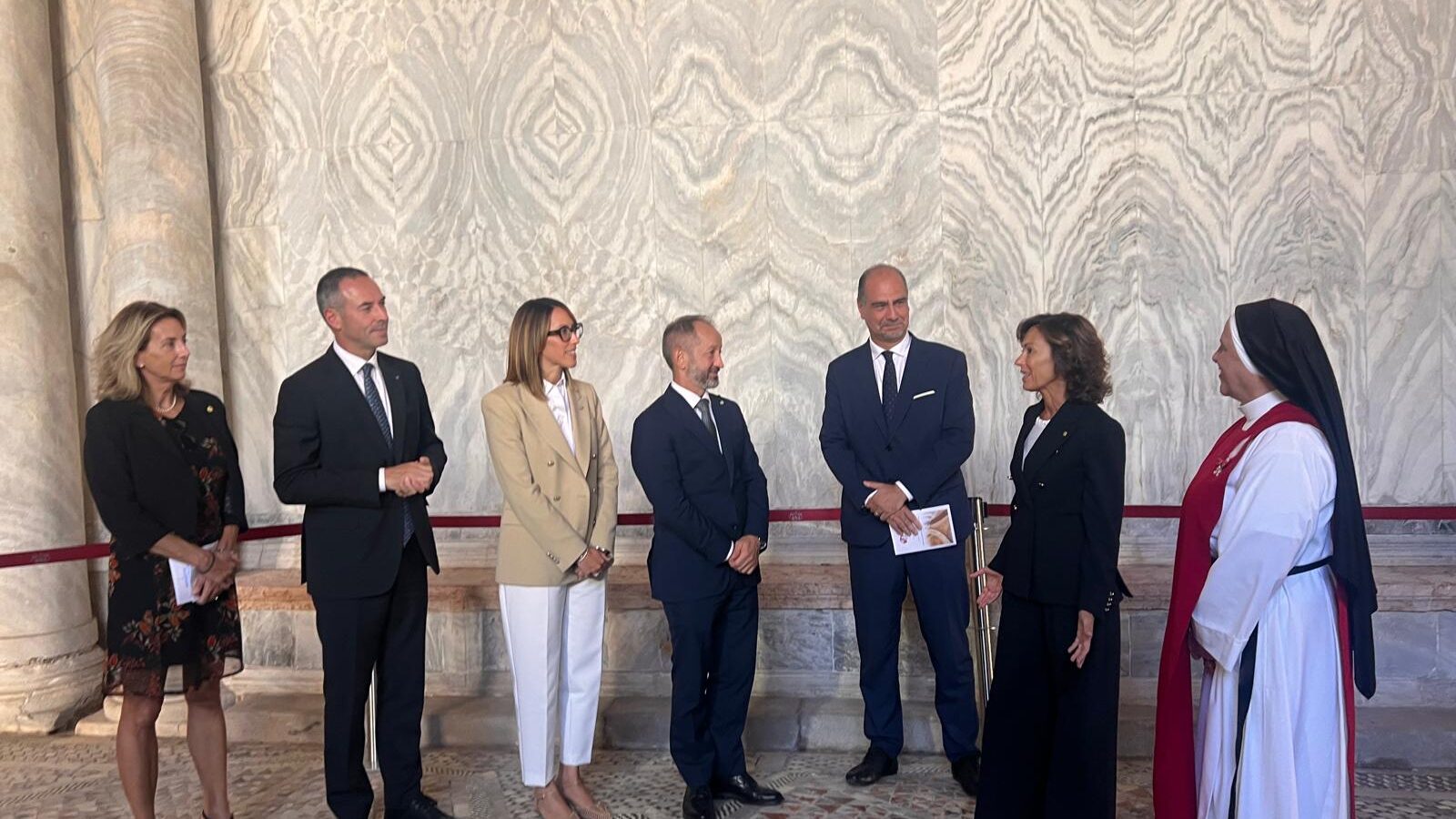
An image that has remained among the mosaics of St Mark’s Basilica in Venice for more than seven centuries has been identified as a depiction of San Marino, Founder and Patron Saint of the Republic. The confirmation brought the Captains Regent, Alice Mina and Vladimiro Selva, to the lagoon city this afternoon, accompanied by the Secretary of State for Culture Teodoro Lonfernini, the Republic’s Consul in Venice Lorenza Mel, and a San Marino institutional delegation.
The visit was organized following the recent identification of the ancient mosaic effigy housed within the Basilica. The depiction is believed to date from the seventh decade of the 13th century, between 1260 and 1270, and its attribution to San Marino is also linked to the Latin inscription accompanying the mosaic: “S[AN]C[TV]S MARIN[VS”.
“This afternoon, the Excellencies the Captains Regent of the Republic of San Marino, Alice Mina and Vladimiro Selva, accompanied by the Secretary of State for Culture, Teodoro Lonfernini, the Consul of the Republic of San Marino in Venice, lawyer Lorenza Mel, and an institutional delegation, took part in Venice, in St Mark’s Basilica, in a ceremony organized together with the ecclesiastical and civil authorities of Venice, following the identification of an ancient mosaic effigy within St Mark’s Basilica depicting Saint Marinus, Founder and Patron Saint of the Republic,” reads the statement from the Institutional Secretariat Office.
The delegation was welcomed by the procurator of St Mark’s Basilica, Chiara Boldrin, and Deputy Prefect Giuseppe Vivola. The ceremony was also organized as an opportunity for dialogue between the institutions of Venice and San Marino.
Confirmation of the identification came from Professor Alberto Peratoner, director of the Office for the Pastoral Care of Culture at the Patriarchal Curia of Venice. The discovery originated from a study conducted by Sister Maria Gloria Riva, whose research laid the groundwork for the in-depth analysis that led to the attribution.
“The discovery, sparked by a study carried out by Sister Maria Gloria Riva, thanks to her deep expertise and knowledge on the subject, attests to a devotion and iconographic memory of San Marino, preserved at the heart of St Mark’s for more than seven centuries,” the statement reports.
The effigy is located in the northern arm of the Basilica’s atrium and depicts Saint Marinus as a half-length figure. According to the reconstruction, its presence within the mosaic cycle may be linked to several historical factors.
“The historical reasons behind the presence of Saint Marinus among the Basilica’s mosaics are manifold, ranging from his Dalmatian origins to the historical circumstances of the Venetian dominions of that period, as well as ties with the Adriatic coasts and surrounding territories, including San Marino,” the institutional statement explains.
During the ceremony, Captains Regent Alice Mina and Vladimiro Selva underlined the significance the Republic attaches to the recognition of the effigy.
“On this solemn day, when the memory of our Saint, Patron and Founder, Marinus, is revealed and honored beneath the dome of this illustrious sacred place, visited by millions of pilgrims and peoples from around the world, we express, on behalf of the people of San Marino, our profound gratitude and deep emotion. In the precious tesserae of these enamels and gold mosaics, the spiritual bond between the community of San Marino and that of Venice is renewed — united by the shared title of “Serenissima” and by centuries of mutual respect, age-old culture, and fruitful dialogue between the shores of the Adriatic.”
At the end of the ceremony, the Regency, Lonfernini and the delegation were received by the Patriarch of Venice, Monsignor Francesco Moraglia, in the Basilica’s Sacristy. During the meeting, the Institutional Secretariat Office reports, the historical and cultural ties between San Marino and Venice were reaffirmed.
“The Captains Regent and the Secretary of State expressed their gratitude to His Excellency Monsignor Moraglia for the warm welcome and for the profound spiritual significance of the exchange, expressing hope for the strengthening of cultural cooperation between San Marino and the Patriarchal Church of Venice,” the statement continues.
Secretary of State for Culture Teodoro Lonfernini also commented on the significance of the discovery. “There are moments when history speaks to us again with extraordinary force, and today we are experiencing one beneath the ancient vaults of St Mark’s Basilica. Discovering that the image preserved here depicts our very own Founding Saint, Marinus, stirs a deep emotion and reveals a solid bond between Venice and San Marino. Art once again proves to be a living and essential form of memory for understanding our roots, bearing witness to an ancient friendship that time has never eroded. My thanks go to the scholars and to all those who safeguard the soul of our country: may Saint Marinus continue to inspire the future path of our peoples.”
The Regency and the Secretariat of State for Culture also thanked the Patriarchal Curia of Venice and the Procuratoria of St Mark’s Basilica for their hospitality, along with the Prefect of Venice, the President of the Veneto Region, and the Mayor of Venice for their institutional support of the initiative.
Special recognition was given to San Marino’s Consul in Venice, Lorenza Mel, credited with playing “a crucial and decisive role in establishing institutional contacts and in the concrete realization and completion of this historic event.”
Thanks were also extended to Professor Alberto Peratoner for his study and confirmation of the identification, and to Sister Maria Gloria Riva for initiating the research process. The statement also mentions Valentina Garavini, Alessandra Frollo Mel and Fabio Righi, along with the other individuals involved in the work that led to the identification of the ancient depiction.
The discovery thus brings to light an iconographic testimony of San Marino dating back some seven and a half centuries, preserved in one of the emblematic sites of Venice and the Adriatic.