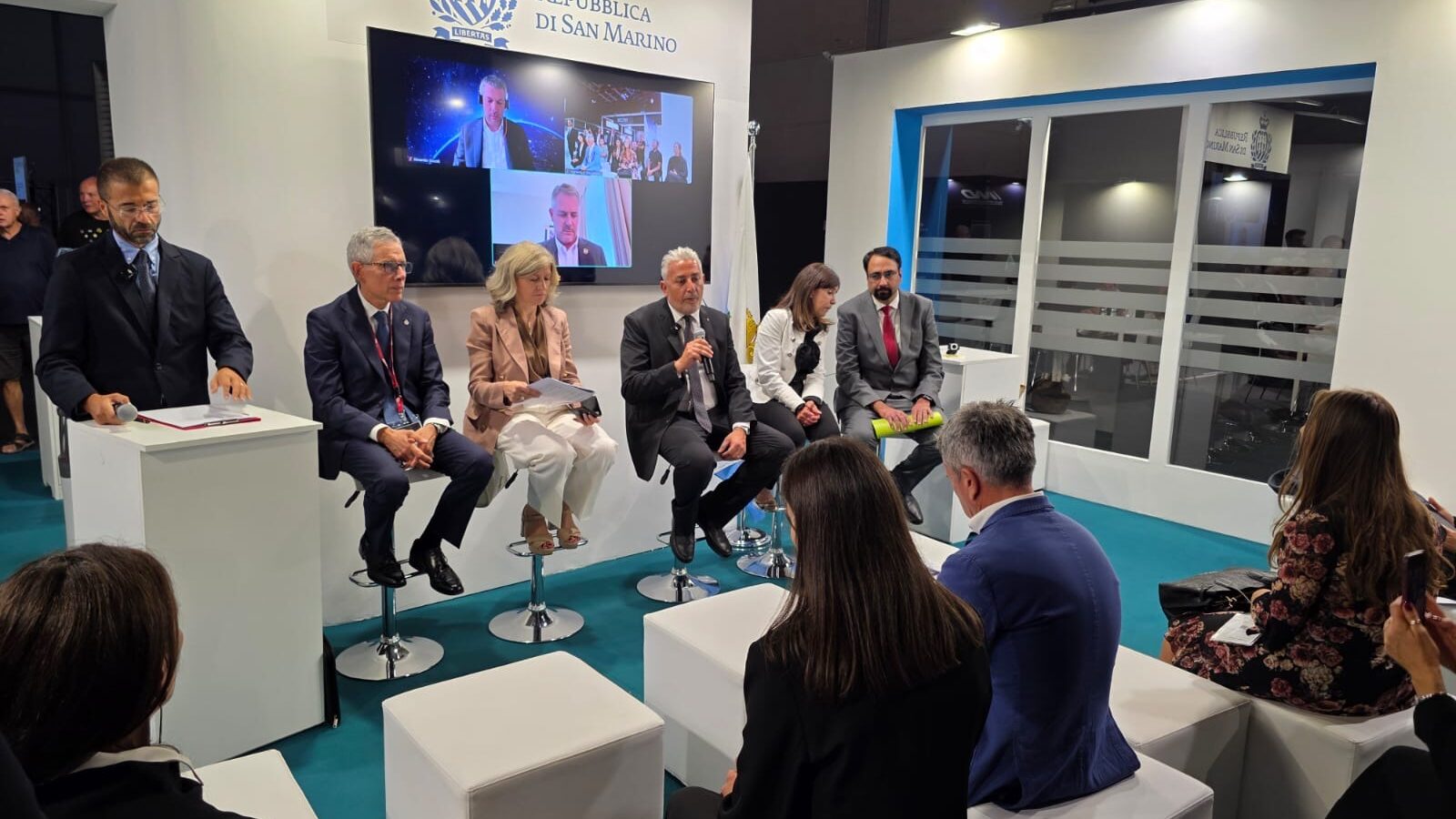
San Marino is seeking to carve out a role in the New Space Economy, betting on streamlined regulations, technological investment and partnerships with leading international agencies. This is the strategy presented today at the Rimini Exhibition Centre on the opening day of the Beyond Exploration Expo (BEX), where the Republic has its own space in Pavilion C1.
One of the pillars of the project is the new framework law on the Space Economy, drafted with the aim of creating a favourable environment for the establishment of aerospace companies, startups and investors. The text, presented by legal scholar Anna Masutti, a professor at the University of Bologna and author of the proposal, governs authorisations, liability and the national register of space objects, in line with international treaties and the European regulatory framework.
The first day saw Secretary of State for Industry Rossano Fabbri meet with representatives of San Marino Innovation, the Economic Development Agency-Chamber of Commerce and San Marino Enterprise. There was also an institutional meeting between Fabbri and Vincenzo Colla, vice-president of the Emilia-Romagna Region, in the presence of the Italian ambassador to San Marino, Fabrizio Colaceci.
The most significant development on the international front, however, concerns the Artemis Accords. San Marino has been welcomed as the 74th signatory state of the agreements promoted by the United States for cooperation in space exploration. The official signing is scheduled for Friday, 25 September at 9:30 am, in the presence of Fabbri, NASA representative Gregory Mann and US Consul General Joseph Tordella.
Also speaking at BEX were Amit Sachdeva of the Indian space agency ISRO and Alexander Soucek of the European Space Agency, in a discussion on the opportunities available even to small countries in the fields of software, data analysis and technological components.
“San Marino has chosen not to be a passive spectator,” Fabbri stressed. “We intend to offer a responsive legal infrastructure, capable of providing certainty to operators and fostering technology transfer.”
Looking ahead, the government’s vision also leaves room for the possibility of a Sammarinese citizen travelling to space — not through an independent programme, but through collaborations with organisations such as NASA, ESA and ASI. Before that, Fabbri explained, the priority will be to send into orbit technologies, components and services developed by companies and incubators based on Titano.
The programme continues tomorrow, Thursday 24 September, with meetings dedicated to startups, spin-offs and technology transfer, and with the operational launch of the permanent working group between San Marino and the Emilia-Romagna Region on aerospace.