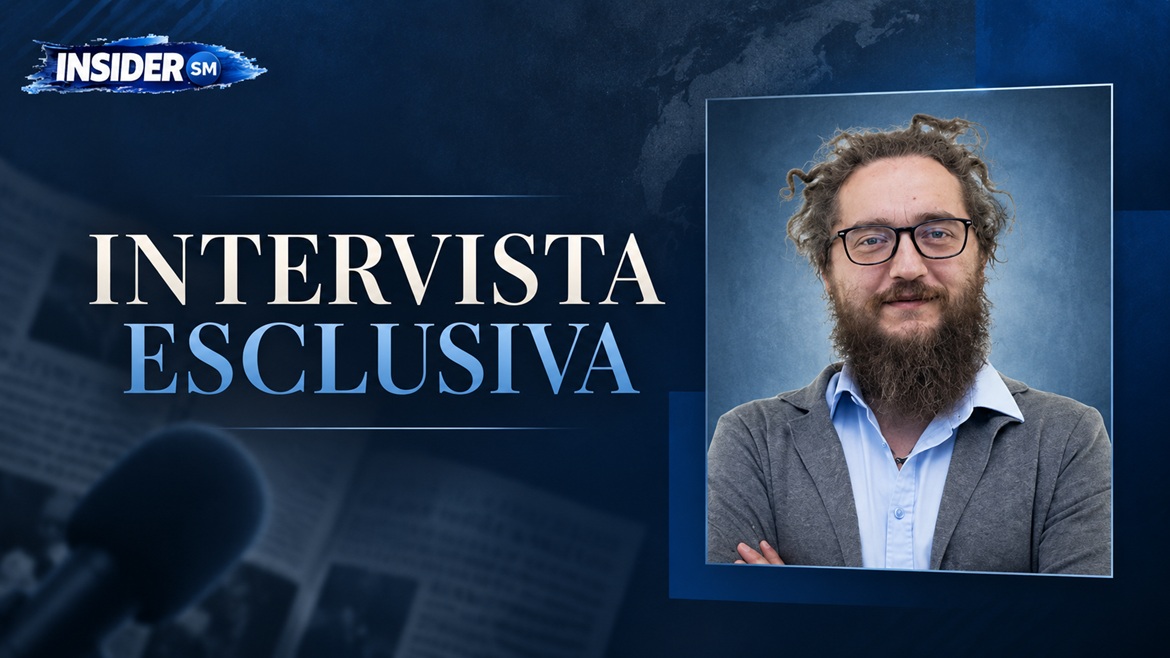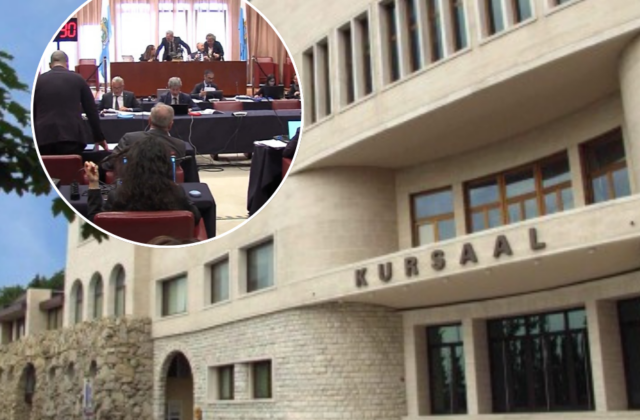
A post targeting Muslims, the debate over welcoming Palestinians, and an online discourse that, according to Matteo Zeppa, increasingly tends to distort words and facts to fuel fear and resentment. The Rete councillor revisits his remarks made in Committee and sounds the alarm over the political and social climate in the Republic, in an exclusive interview for Insider.sm.
Zeppa, what struck you most about the anti-Muslim post, and why did you decide to bring it before the Committee?
“That is just one of the latest episodes.
Certain blogs frequently put forward positions that are extremely harsh and very far removed from my own thinking. I wanted to raise the issue in Committee because I consider what happened symptomatic of a much broader social phenomenon: today, thoughts of extreme harshness are expressed without almost anyone being scandalized.
Given my own conduct in Council, I could myself be considered outspoken, and I am certainly not someone who is easily shocked. In this case, however, I believe it was necessary to take a stand.
Statements of that kind are used to reconstruct reality and steer public opinion. This is not the first time it has happened.
It had already occurred, for example, when discussing gender-based violence, when someone claimed that San Marino didn’t need to address femicide because no cases had been recorded for years”.
In your speech you spoke of a “very dark period”. Were you referring to the international scene, or to San Marino as well?
“Both. Through social media we experience, as if reflected back at us, what is happening in the society around us.
Every day we are hit with news of violent crime and war. I’m passionate about history, and I know that certain phenomena are cyclical: precisely because they have already occurred before, we should be able to recognise them.
These attitudes and these statements recall dynamics already seen in other eras.
Each time, the question is whether we are facing freedom of thought or something else. The institutional role I hold requires me to say this clearly, even if it costs me credibility in the eyes of those who fuel such phenomena: frankly, I have no interest in being in their good graces.
I have never managed to remain neutral: when I believe it is necessary to take a stand, I do so”.
Those who have criticised you argue that your remarks amount to an attempt to censor differing opinions. Where do you draw the line between condemning certain messages and freedom of expression?
“Freedom of thought must be defended: everyone can say and write what they want. The problem arises when this freedom is used to harm the dignity and freedom of others.
It’s not enough to put a question mark at the end of a sentence to escape the consequences of what one is saying.
When ideas are spread that attack entire ethnic groups or religious communities, in my view we are no longer talking about freedom.
One must take responsibility for what one says, rather than constantly hiding behind ambiguity”.
Some accounts published after your speech attributed to you references you say you never made.
“My speech was taken apart and reassembled according to a specific agenda.
I was attributed references to people I never named and had not even thought of.
The audio recording of my speech is available and anyone can listen to it.
Freedom of expression cannot become the freedom to put words in other people’s mouths that were never spoken. In Committee, I spoke about the strengthening of the far right in Germany and the risk posed by certain political phenomena. The rest is a fabrication”.
The affair has become intertwined with the controversy over the arrival of some Palestinians in San Marino. What happened?
“In that case too, certain words were taken apart and reassembled.
Foreign Minister Luca Beccari had responded to a query of mine, in which I asked what the situation was.
Two Palestinian students arrived in San Marino through the University.
The imminent arrival of another thirty people was never announced. There is a decree and a resolution of the Congress of State, regarding which Rete was the only group to request certain amendments. At the moment, moreover, getting people out of Gaza is extremely difficult.
And yet, from those words a completely different narrative was constructed, almost as if there were already a ready-made plan to bring dozens of Palestinians to Mount Titano”.
You defended Beccari despite often holding differing political positions.
“Politically, Beccari and I are on different sides, but that doesn’t mean I should use a false reconstruction against him.
The same thing had already happened during the debate on Europe, when he was accused of having called citizens ignorant. I was present, and I can say he never said those words. I could have exploited that controversy politically, but it would not have been right.
Political rivalry cannot justify the falsification of facts”.
San Marino has historically prided itself on a tradition of welcome. Why, in your view, has the prospect of welcoming Palestinians triggered such heated reactions?
“That is a question we need to ask ourselves.
We welcomed Ukrainians without witnessing any so-called popular uprising.
When it came to Palestinians, however, a different climate immediately took hold. The story of our grandparents and the shelter provided during the war are constantly recalled.
That memory, though, must translate into consistent behaviour in the present as well”.
Do you believe there could be a political or electoral strategy behind this narrative?
“Yes, I am convinced of it.
There is a segment that says no to Palestinians, no to the European Union, and no to everything that would allow San Marino to break out of its isolation.
It is the fear on which nationalism feeds. In the most difficult geopolitical periods, if a clear distinction is not made, there is a risk of becoming almost self-sufficient, focusing only on one’s own small space and closing off from the outside world.
San Marino, however, with its 61 square kilometres, is in no position to isolate itself. So I do sense a political project at work, even if I don’t know whether it will actually succeed”.
You have also recently flagged a possible confidentiality issue within the institutions. What happened?
“I was referring both to matters handled by the Council of Twelve and to residency requests in the Foreign Affairs Committee, where the first operates under confidentiality and the second under secrecy.
It can happen that I abstain or vote against a measure, but I am only one of fifteen members, and the matter is often approved anyway.
The problem is that, despite the sessions being confidential, someone evidently reports outside who raised doubts and what they said. A month after certain matters were approved, I was contacted by a person who seemed to know exactly what position I had taken during the session”.
Did you interpret that contact as pressure?
“Pressure doesn’t worry me and has never influenced me.
I didn’t reply to the message, and I continue to carry out my role according to my conscience.
The real issue is different: how did that person come to know what I had said during a confidential meeting?
If what happens in those sessions is being leaked outside, then there is an institutional problem.
I have been in Council for fifteen years, and I will keep showing up with my head held high and looking people straight in the eye. If anything, it is others who lower their gaze when they meet me”.