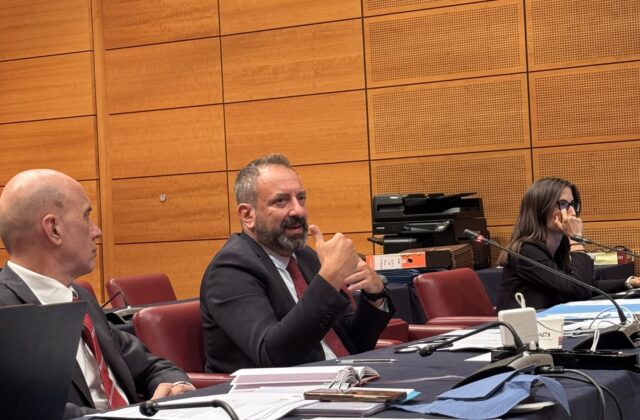
«Perhaps this is a law that frees Parliament from the blackmail of those who can table fifteen hundred, two thousand or three thousand amendments». Gian Nicola Berti (AR) defended the mechanism known as the “guillotine” (tagliola) during the examination of the articles of the bill on “Amendments to the Rules of Procedure of the Grand and General Council” (Consiglio Grande e Generale).
Berti began by referring to the marathon sessions that have characterised the examination of some budget laws, challenging the notion that it should be considered normal to continue proceedings day and night, at times for as long as 72 consecutive hours. According to the councillor, a majority must be able to decide to focus debate on proposals that can genuinely lead to a result, preventing hundreds or thousands of amendments from ultimately blocking the passage of a law.
His remarks also served as a direct rebuttal to Matteo Zeppa (Rete), who had accused the majority of intellectual dishonesty. Berti firmly rejected the accusation and defended his own fairness in political debate.
Below is the full text of Gian Nicola Berti’s (AR) speech:
Gian Nicola Berti (AR): I would like to thank Councillor Zeppa, who accused us of intellectual dishonesty. Perhaps he too shows a degree of intellectual dishonesty when, as happened on the previous article, he speaks without even having read the current Rules of Procedure of the Council. That said, I do not believe one can present a narrative of the budget laws approved over the years in which it is considered normal to hold plenary sessions lasting day and night. We have even reached seventy-two consecutive hours, and I wonder what kind of legislative product can be produced by people who remain in this Chamber for seventy-two hours and end up voting more out of exhaustion than out of conviction or free will. This is a serious problem. Councillor Zeppa argued that this is a recurring practice during all budget sessions. I believe it should not be so, and that different approaches are possible. There exists a system, little known in this Chamber, called parliamentary debate, together with the rules proper to parliamentary democracies. In Parliament there are majorities that could also express their dissent in advance. If, in a Chamber made up, for example, of sixty members, thirty or thirty-one were absolutely opposed to examining one hundred and fifty amendments tabled by the opposition, or a thousand out of the fifteen hundred submitted, they could decide not to address them, shortening and streamlining the proceedings and focusing only on those proposals that, through discussion, joint examination and reflection, could produce a positive outcome. I believe this should simply be regarded as a legislative approach useful for improving the quality and productivity of parliamentary work. I do not know whether it can be called a “guillotine law”, an expression that suggests the cutting away of something important. Perhaps it is instead a law that frees Parliament from the blackmail of those who can table fifteen hundred, two thousand or three thousand amendments, preventing a majority from approving a budget law, sometimes through proposals that have nothing whatsoever to do with it. I believe we should return to a more respectful dialectic, one in which we treat each other with greater regard. When we speak of intellectual dishonesty, Councillor Zeppa, allow me to make clear that I am proud of my intellectual honesty, and I will not allow you to insinuate that I am dishonest. As for the other colleagues, if they wish, they may answer for themselves.