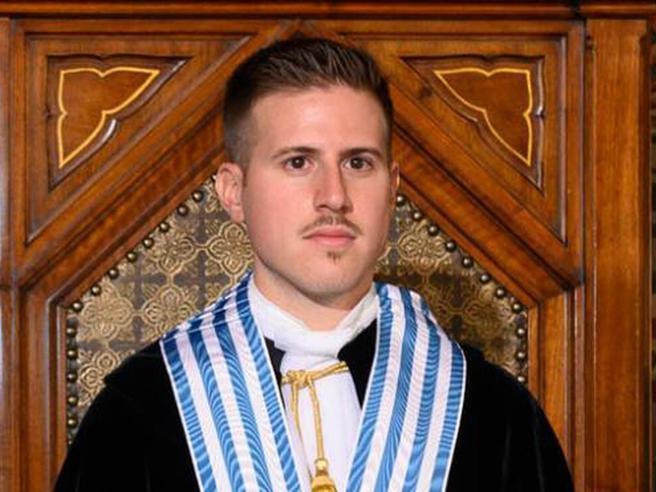
The positions still held by Giacomo Simoncini following his final conviction for “indecent acts” have once again become the focus of a statement by Unione Donne Sammarinesi (UDS). The association returns to the case of the former Captain Regent, raising in particular the issue of his presence on the Federal Council of the San Marino Football Federation (FSGC), framing it as a matter of “credibility.”
This latest statement follows news, also flagged by UDS itself, that the Authority for Equal Opportunities and the Excellent Chamber are reportedly reaching a settlement agreement with Simoncini over compensation owed as a result of the judicial case.
The association reconstructs the events that took place at Palazzo Pubblico on 1 March 2022, recalling that the criminal proceedings concluded, after three levels of judgment, with Simoncini’s final conviction for “indecent acts” and an obligation to pay compensation to the victim, the Excellent Chamber, and the Authority for Equal Opportunities.
UDS also recalls the subsequent Regency Impeachment (Sindacato della Reggenza) and the ruling issued by the Guarantor Panel (Collegio Garante) on 27 November. According to the association, Simoncini was handed a “permanent disqualification from ever holding the office of Captain Regent and exclusion from the Grand and General Council and from the roll of Councillors.”
It is precisely this backdrop that underpins the association’s complaint. According to UDS, following the publication of the ruling there was no genuine public reckoning, particularly from the political sphere. “No further comment was heard in the country in the following months, at least not publicly: the silence from politics has been especially deafening,” the association states.
Attention then turns to the San Marino Football Federation. Simoncini, UDS points out, was elected to the Federal Council in January 2025 and reportedly still holds that position today.
The association notes that the provisions added to the federation’s statute following the law of 23 September 2025 on combating gender-based violence and abuse of minors in sport apply to limited circumstances and would not, therefore, directly apply to this case. UDS’s criticism, however, shifts from strictly legal grounds to the question of appropriateness.
“Setting the rules aside, one cannot help but ask how a Federation with such visibility and importance for the country can continue to keep on its governing board someone who displayed such contempt for respect toward women and, given the role he held at the time and the setting in which the events took place, toward San Marino’s institutions at their very highest level,” states Unione Donne Sammarinesi.
UDS also points to initiatives carried out by the Federation itself on the front of preventing gender-based violence, including the “Quasi invisibile” (“Almost invisible”) campaign, as well as projects run in partnership with schools. Hence the question posed by the association: “How can the FSGC – which just a few months ago backed the ‘Almost invisible’ campaign against gender-based violence and which has run numerous projects with our schools for years – consider itself credible while lending prestige and visibility to a former Captain Regent who committed indecent acts during his term, within an institutional setting, against a person under his hierarchical authority?“
The statement also raises a second point. “As far as we understand, Giacomo Simoncini also appears to be a member of the Uniformed Militia Company (Compagnia Uniformata delle Milizie),” UDS writes, calling for scrutiny of this possible role as well. On this point, the association itself uses more cautious wording.
The statement closes by broadening the discussion once again to the fight against gender-based violence. For UDS, legislative and institutional measures, or the work of specialists, are not enough unless accompanied by a broader cultural shift.
“We repeat it once again: the fight against gender-based violence certainly requires legislative improvement, institutional support, and the commitment of experts and associations, but it also demands a collective awakening that leads society as a whole to stop downplaying and turning a blind eye to serious matters that cannot be allowed to fade into oblivion,” concludes Unione Donne Sammarinesi.