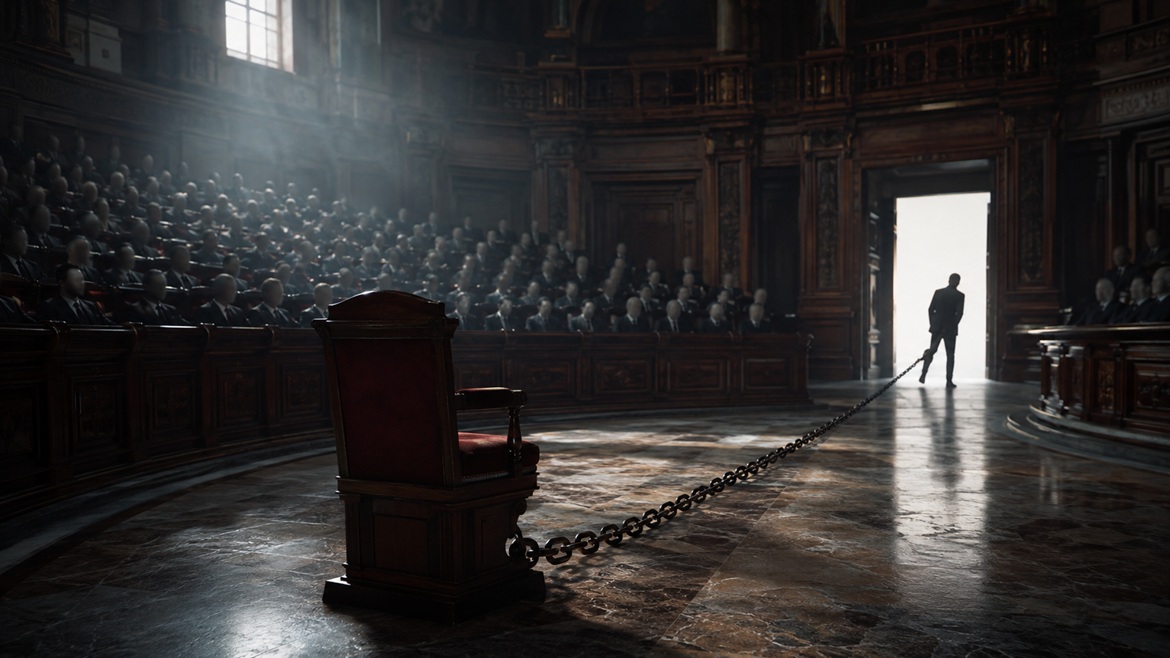
Tomorrow Motus Liberi will bring councillor Michela Pelliccioni to court. She left the movement on 16 July 2025 and has remained in the Chamber as an independent opposition member. The party is seeking up to €50,000 in damages, claiming she violated Article 24 of its own statute – the clause that binds its elected members to an imperative mandate. The first hearing is set for 24 September 2026, civil case 241/2026, before Commissioner of Law Isabella Pasini: nothing like this has ever happened before in San Marino.
But the point missing from the Sammarinese debate is another one, and it is the heaviest of all: that clause is not a debatable technicality – it is a practice the Council of Europe has already examined and rejected. And San Marino has been a member of that body since 16 November 1988.
The document exists, it is public, and this newspaper did not write it.
In its 2009 report on imperative mandates, the Venice Commission – the Council of Europe body that sets constitutional standards across the continent, and to which every member state, including San Marino, adheres – concluded that the principle prohibiting an imperative mandate, or any other way of stripping a representative of their mandate for political reasons, must prevail as a cornerstone of European democratic constitutionalism.
In its opinions on Ukraine, where the Constitution allowed a party to strip a deputy of their seat for switching parliamentary groups, the same Commission used one word: deplorable. Because that mechanism, it wrote, places the parliamentary group above the electorate.
This is not an editorial stance: it is the standard of the very club we belong to.
And it is also the standard of the club we are now knocking on the door of through the Association Agreement – precisely the issue at the root of this rift.
So what is the point of political plurality in the Chamber?
If the mandate belongs to the party, then the Grand and General Council (Consiglio Grande e Generale) is not made up of sixty representatives: it is made up of five or six delegations with sixty raised hands. Votes are no longer counted by head, but by symbol. Citizens still write a first and last name on the ballot – and in San Marino, the name on the ballot is everything – but once that name takes a seat, it no longer answers to the person who wrote it.
Then there is the question nobody wants to ask out loud: what about conscience?
Over the course of a legislature, a party can change course. It can back a policy for years and then reverse it. Under a binding-mandate system, whoever stays loyal to the position they were elected on becomes the traitor, while whoever follows the U-turn becomes the loyal one. Political accountability is turned on its head: the party is free to change, the elected member is not. And if a movement drifts in a new direction, the representative is left with only two options: stay somewhere they no longer believe in, or leave and pay the price.
This is what turns the lawsuit into a systemic issue, not a personal dispute.
In San Marino, a councillor is not a professional politician.
They are private employees, public employees, students, pensioners – people who keep doing their own jobs and receive an attendance allowance for sittings. This is written into Council records, not something we are inventing. A €50,000 claim against someone in that position is not a dispute between equals: for anyone living off a salary, it is a sum measured in years.
And the deterrent effect, mind you, does not fall on the one who has already left. It falls on the next one. From today, any Sammarinese councillor who disagrees with their party leadership will have to run a calculation they never had to make before, and in that calculation a figure now appears. That is the real damage, and no ruling can undo it.
Intellectual honesty, however, all the way through.
Pelliccioni herself voted for that clause, present at the assembly of 31 May 2022, before a notary.
That is the party’s strongest argument, and it would be dishonest to hide it.
And her countermove too – asking the Institutions to cover her defence costs up to €50,000 – deserves a serious debate, not an automatic round of applause: it opens a whole chapter on who pays for what, one that the Council cannot settle in five minutes.
The party, for its part, is exercising a right the law grants it: seeking damages for breach of an internal agreement. No one here disputes that.
But something can be lawful and wrong at the same time. The fact that it can be done does not mean it should be, and it does not mean the country should treat it as normal.
On 24 September, a judge will decide whether a private agreement can override a public freedom.
The rest is a political decision, and it does not need to wait for the ruling: a movement that put the word “Liberi” (Free) in its own name is asking a court to make a woman pay for having been exactly that.
The bill comes to €50,000. But the real price is one we all pay.