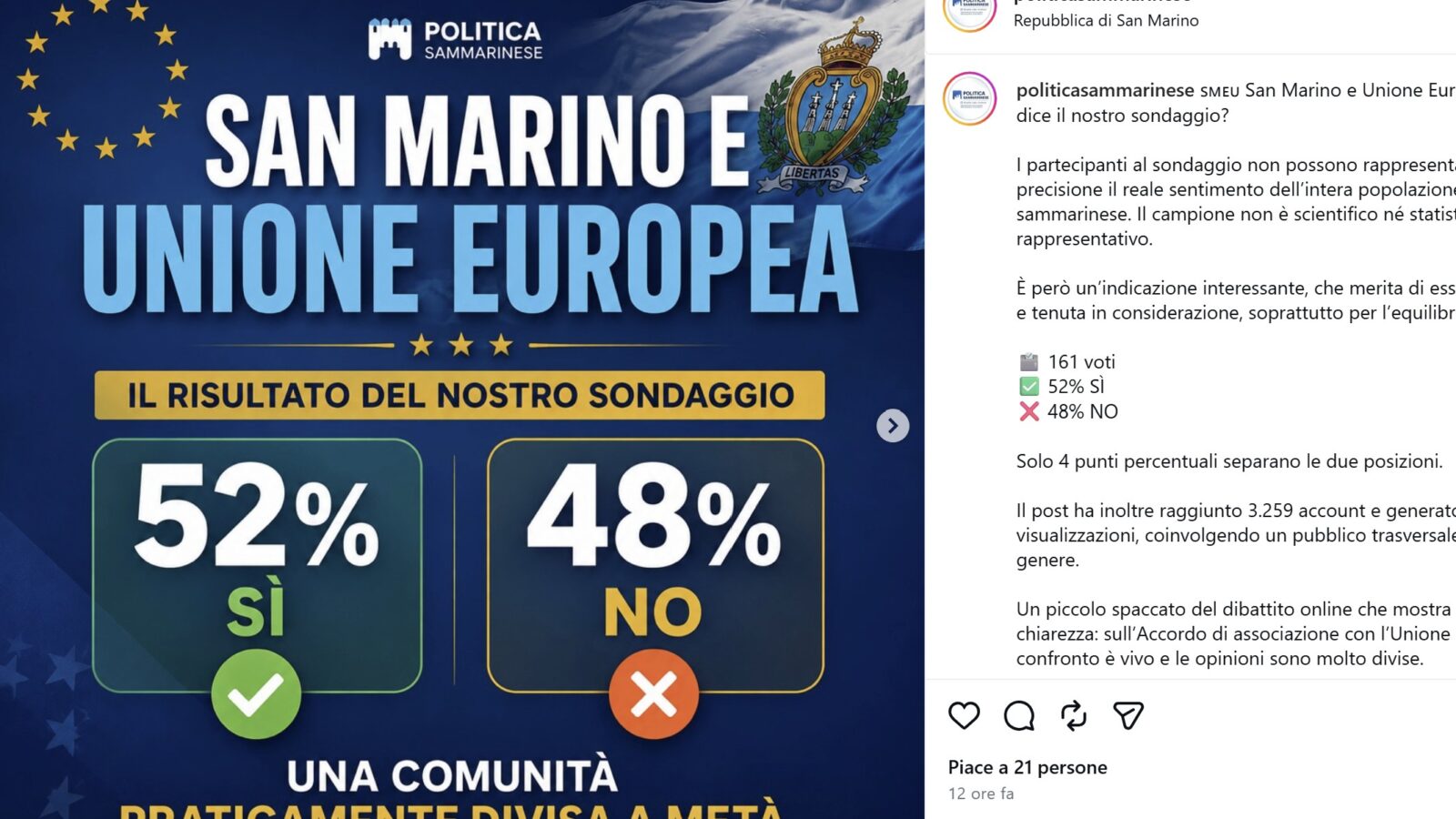
The poll on the Politica Sammarinese Instagram page about the Association Agreement with the European Union closed with 161 votes: 52% yes, 48% no. Four points apart, a community split down the middle. On the Facebook group “San Marino Risponde”, just a few days earlier and with roughly 296 votes, the same question produced something entirely different: 26% in favour, 54% against when combining the two negative options.
Same country, same week, opposite results.
Anyone looking for a single truth in this will find plenty of ammunition either way: there’s the figure showing San Marino residents are opposed, and the one showing they’re divided. Just pick your preferred social network.
The explanation, though, is more interesting than the tribalism. First: the audience changes.
In San Marino, Facebook is where people debate under their real name and surname, carrying thirty years of personal history behind them; Instagram tends to be younger and votes anonymously.
Second: the question itself changes. On Facebook, users were asked “in favour or against,” with two separate boxes for saying no and a middle option added on the fly by users — the “undecided” category, at 19%. On Instagram, the question was simply “which side are you on,” yes or no, with no middle ground. How you phrase a question determines a slice of the answer, and that’s exactly why properly conducted polls cost money.
The third detail is the most instructive. In the early hours of voting, the Instagram survey was running at around 79% yes on just 18 responses. By the time it closed, with 161 votes, the “yes” share had dropped to 52%. Twenty-seven points evaporated as the sample grew wider — a vivid snapshot of just how little a spontaneous poll’s numbers are worth before it has gathered enough responses.
Credit is due to the page for saying so itself, unprompted: the sample is neither scientific nor statistically representative, and participants don’t reflect the population’s actual sentiment. That kind of honesty isn’t something to take for granted in this country, and it makes the data more useful, not less.
Because that remains the core issue.
The post reached over three thousand accounts in a country of thirty-four thousand residents: interest is real, and it’s far from lukewarm.
What’s missing is the right tool. On the most significant outcome of San Marino’s foreign policy in the last twenty years — signature expected in September, followed by the European Parliament, then ratification, with the request for a confirmatory referendum already rejected by the Grand and General Council (Consiglio Grande e Generale) — the only public evidence of what citizens actually think consists of two social media polls that contradict each other, even if only by a few percentage points.
That’s not the fault of whoever ran them. It’s the fault of whoever failed to commission a real one.