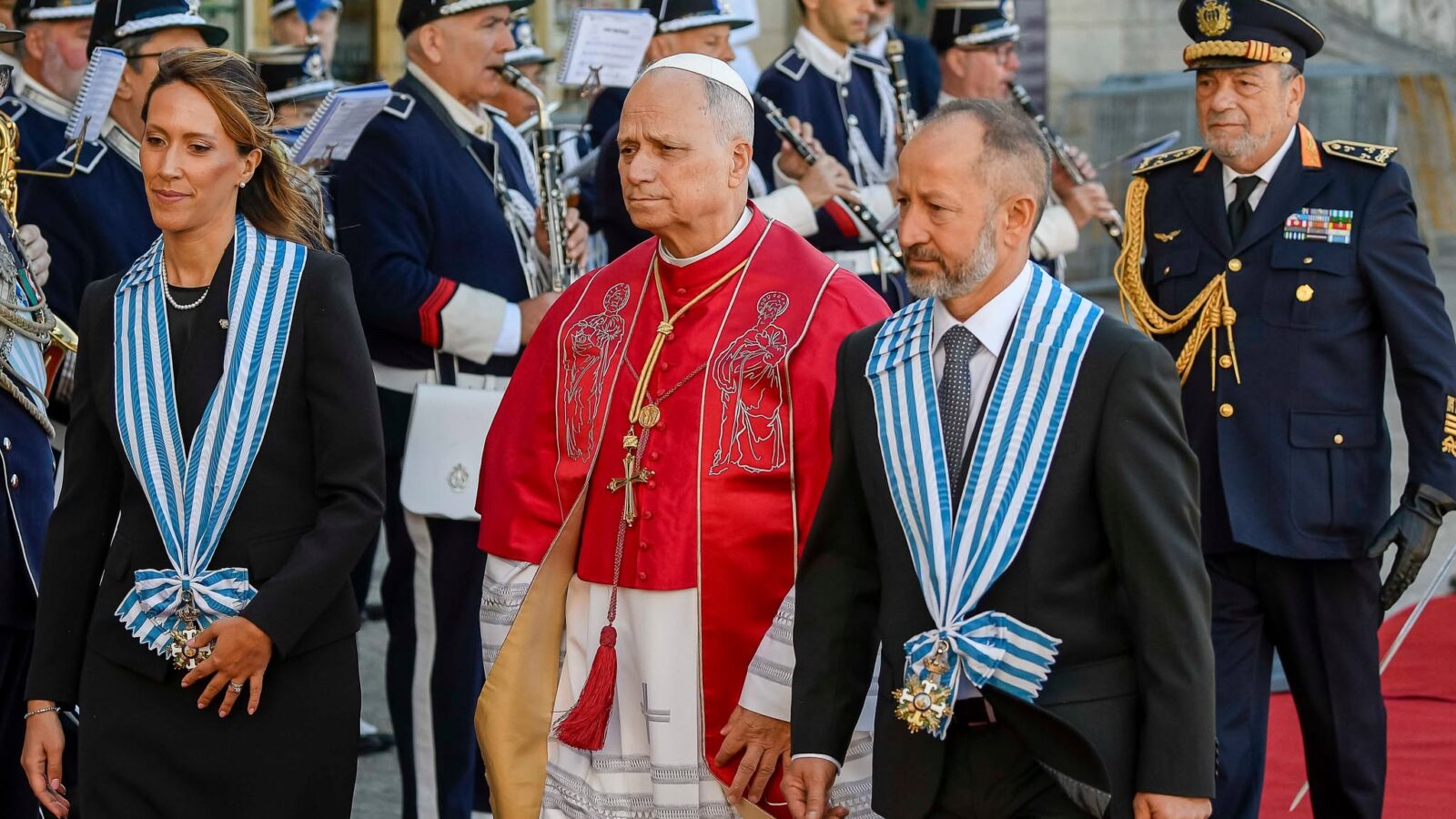
A welcome to the «Land of peace and ancient Liberty», but above all an address devoted to the great questions of our time, from wars and humanitarian crises to technological change and the need to put the human person back at the centre of public choices. This was the message delivered by San Marino’s Captains Regent to Pope Leo XIV on the occasion of the Pontiff’s historic visit to the Republic of San Marino.
In their greeting at Palazzo Pubblico, the Captains Regent first recalled the bond between San Marino and the Holy See, in the very year marking the 100th anniversary of official relations between the two states. A century of ties built on dialogue and mutual respect, sharing principles such as «the dignity of the person, peace, solidarity and freedom».
This relationship has also been marked by previous papal visits to Mount Titano: that of Saint John Paul II on 29 August 1982, the first pope ever to cross San Marino’s borders, and that of Benedict XVI on 19 June 2011. The presence of Leo XIV, the Regency noted, now opens a new chapter in this history.
A call over wars and hospitality
Considerable attention was devoted to the international situation. The Regency recalled a world in which, even as the demand for peace grows, wars, humanitarian crises, forced migration and inequality continue. «No progress can be considered complete if it is not able to safeguard the dignity of every person», the address underlined.
This led to a reference to San Marino’s long tradition of hospitality. The Captains Regent recalled the support offered to hundreds of Ukrainian refugees since the start of the war, and the country’s efforts to facilitate the arrival on Mount Titano of Palestinian families seeking refuge and assistance. It is a vocation rooted in the Republic’s history, recalling the shelter granted to more than 100,000 refugees during the Second World War.
The passage also became a denunciation of the consequences of humanitarian crises: the lack of food, water, medicine and shelter was described by the Regency as a condition that is «morally unacceptable and unjustifiable», alongside tribute to all those working on the ground to assist affected populations.
«Too often force prevails over law»
The address also included a direct appeal to politics and institutions. Faced with global crises, the Regency argued, governments and institutions must recover «the courage of responsibility and the strength of shared choices», at a time when too often «force prevails over law, confrontation over dialogue, and particular interest over the common good».
This reasoning was extended to new technologies as well. Their rapid development can open up extraordinary possibilities, but it must remain at the service of humankind and not become a further source of division. Referring to Pope Leo XIV’s encyclical Magnifica Humanitas, the Regency stressed that true progress must also be measured by the ability to defend dignity, freedom of conscience, responsibility, solidarity and the common good.
Libertas as responsibility
It was here that the address returned to the deepest roots of the Republic. For San Marino, the Captains Regent recalled, freedom cannot be seen merely as a privilege or an assertion of self, but as a responsibility towards others and towards future generations.
«Freedom takes on its highest meaning when it becomes respect, welcome and care for others; when it builds bridges instead of walls», the Regency stated, thus linking San Marino’s ancient Libertas to the challenges of today.
This also underpins the commitment to a society capable of supporting young people, valuing the family, protecting the elderly and people with disabilities, and placing individual dignity at the heart of public action. For the Regency, a state’s standing does not depend on its territorial size, but on its fidelity to the principles on which it bases its actions.
San Marino alongside the Holy See for peace
In the closing part of the address, the Regency reaffirmed the shared vision between San Marino and the Holy See on major international issues: peace, human rights, the rule of law, multilateralism, the protection of civilian populations and the peaceful resolution of disputes. Among the causes they share is the campaign for the universal abolition of the death penalty.
The Regency then summed up the day’s message in a few guiding principles: freedom finds its meaning in responsibility, peace is born of dialogue, progress is genuine only when it puts the person at its centre, and a society is measured by its ability to leave no one behind.
Finally, a pledge addressed directly to Leo XIV: «The Republic of San Marino will always stand alongside the Holy See» in efforts to advance peace processes, sustain dialogue and build lasting conditions of justice and coexistence.