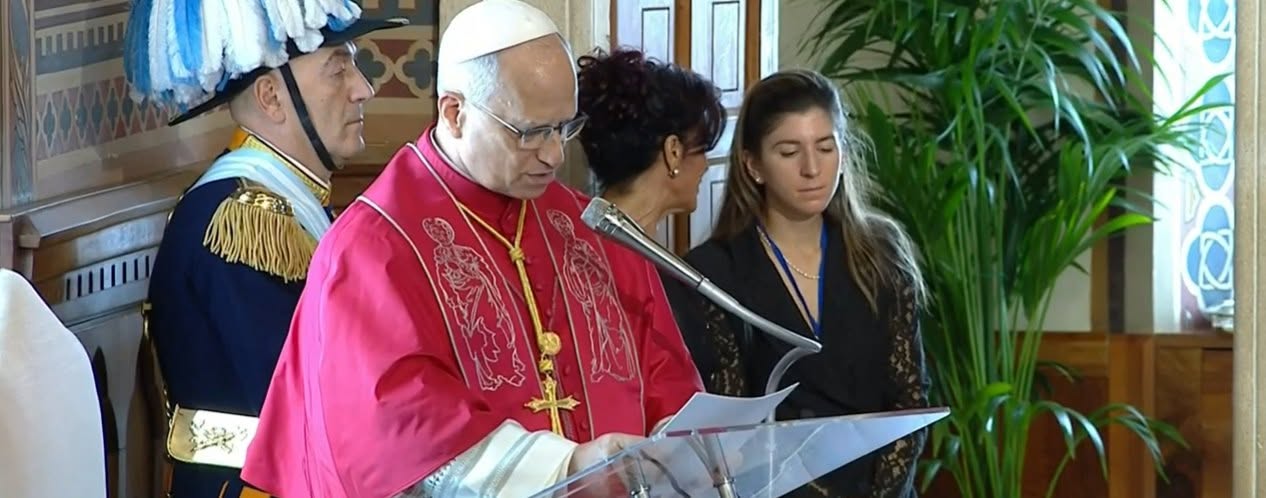
«I am very pleased to visit your country, which holds the distinction of being the oldest Republic in the world, with a tradition dating back to the early fourth century. I sincerely thank the Captains Regent for their gracious invitation and for the welcome extended to me, also expressed in the words they addressed to me on behalf of all citizens.
My visit follows in the footsteps of those made by Saint John Paul II in 1982 and Benedict XVI in 2011, and is intended to confirm the deep bond uniting Mount Titano with the Apostolic See. This connection is ancient, given the long historical coexistence, yet also recent, if we consider that it was only a century ago, in April 1926, that diplomatic relations between the Holy See and the Most Serene Republic of San Marino were formalized.
Throughout its long history, your Republic has kept perpetually relevant the words that could be called the spiritual testament of its founder: “Relinquo vos liberos ab utroque homine,” whose essence is clearly summed up in the motto Libertas. A single word, yet how rich in meaning. Within the history of a people and a state, it certainly expresses the aspiration to self-determination, to independence from other political authorities — but at the same time, freedom means much more than that.
First of all, I wish to emphasize that there is no true civil liberty without personal freedom — that is, without respect for and promotion of the dignity of the human person, of which freedom is an essential component. This freedom is ultimately given and guaranteed by God, whose voice resonates in the conscience of every human being. Promoting freedom means defending the spaces of conscience. My thoughts go to the many men and women who, in every era and every place, are martyrs of freedom because they bear witness precisely to the primacy of conscience. Even today, in many parts of the world, there are people who remain faithful to their conscience even amid great adversity. We express our solidarity with all those who, at this moment, are paying a personal price for refusing to betray their conscience.
Moreover, freedom is fulfilled through giving, communion, encounter and dialogue. It is like a tree that grows and puts forth branches and leaves, offering everyone oxygen, shade, fragrance, fruit and new seeds. In the Christian vision, freedom and communion stand or fall together.
In your case, it is always a source of particular interest that at the origin of your community stand men such as Saint Marinus and Saint Leo, whom we might call builders of free and peaceful cities. Their work can be interpreted through the biblical image of the rebuilding of Jerusalem inspired by the prophet Nehemiah: he builds bonds even before stones. The style is communion, not uniformity. This is how I like to think of the work undertaken by your founders, which is well reflected in the industriousness and ingenuity of this people and this land.
For you, Libertas also means an unwavering commitment to active and positive participation in building peace. On this point, I express my sincere appreciation and find a particular affinity with the approach of the Holy See. This is why we share a regard for diplomacy and multilateralism as privileged paths for cultivating international relations and fostering understanding among nations, in contrast to the impulsive communications, aggressive rhetoric and power-driven logics that mark our times.
The vocation of diplomacy is to foster dialogue with everyone, including interlocutors regarded as more difficult or considered illegitimate to negotiate with, using humility and patience to the utmost in order to mend even the faintest signs of goodwill among parties in conflict, so as to set peace in motion.
This visit also prompts me to underscore the distinctive value of a small state, built on a human scale, where it is possible to experience politics closer to the needs of citizens, and thus a more effective democracy — all the more so when it is also animated by Christian inspiration. The Republic of San Marino can therefore be a laboratory of good politics, where, without departing from the secular nature of the state, it is possible to draw on the principles of Catholic social doctrine: the pursuit of the common good, the universal destination of goods, the harmony of subsidiarity and solidarity, and social justice.
This commitment appears all the more valuable today as the Association Agreement with the European Union is about to become operative, and your Republic will find itself relating steadily, albeit in its own distinctive way, with a complex reality that stands to benefit greatly from your contribution.
Going even deeper, the primary goal to strive for in this laboratory is care for the human person. A community like yours, rich in traditional values while also keeping pace with technological progress, can effectively pursue this goal through care that translates into the protection of every life at every stage, from conception to natural death.
The quality of a civilization is measured not by the power of its resources, but by the care it is able to offer, by its capacity to recognize the other as a face rather than a function. The ability to care for one another is an important dimension of our humanity. Technology can support mutual care between people if it offers tools that help us anticipate and organize, without ever undermining human freedom and judgment, since the human being remains the subject of relationships and the one responsible for decisions.
This care for others has been a distinctive mark of San Marino’s history since its earliest days, revealed in the tradition of hospitality that has never wavered through the centuries toward those who suffer and are undergoing trial. This was recently demonstrated through the support and hospitality shown to the Ukrainian people, especially at the outbreak of the conflict, as well as through your commitment to international humanitarian law, at a historical moment when it is routinely disregarded, if not outright trampled upon.
This sensitivity is also the fruit of this country’s Christian tradition and of the constant, positive collaboration between political authorities and the Bishop in seeking the common good. I am therefore especially grateful for this commitment and witness of yours, and I encourage all of you — leaders, citizens and the ecclesial community alike — to continue this courageous and far-sighted commitment to the dignity of every human person and to the common good.
To each of you, I renew the expression of my joy for this visit to the Republic of San Marino, and I invoke upon all of you the Lord’s blessing».