The Pope returns to the Meeting 44 years after John Paul II and calls for a “change of course”: in his sights are power relations, inequality, profit, technology and finance. His appeal: «Let there not only be those who fan the flames of weariness and despair»
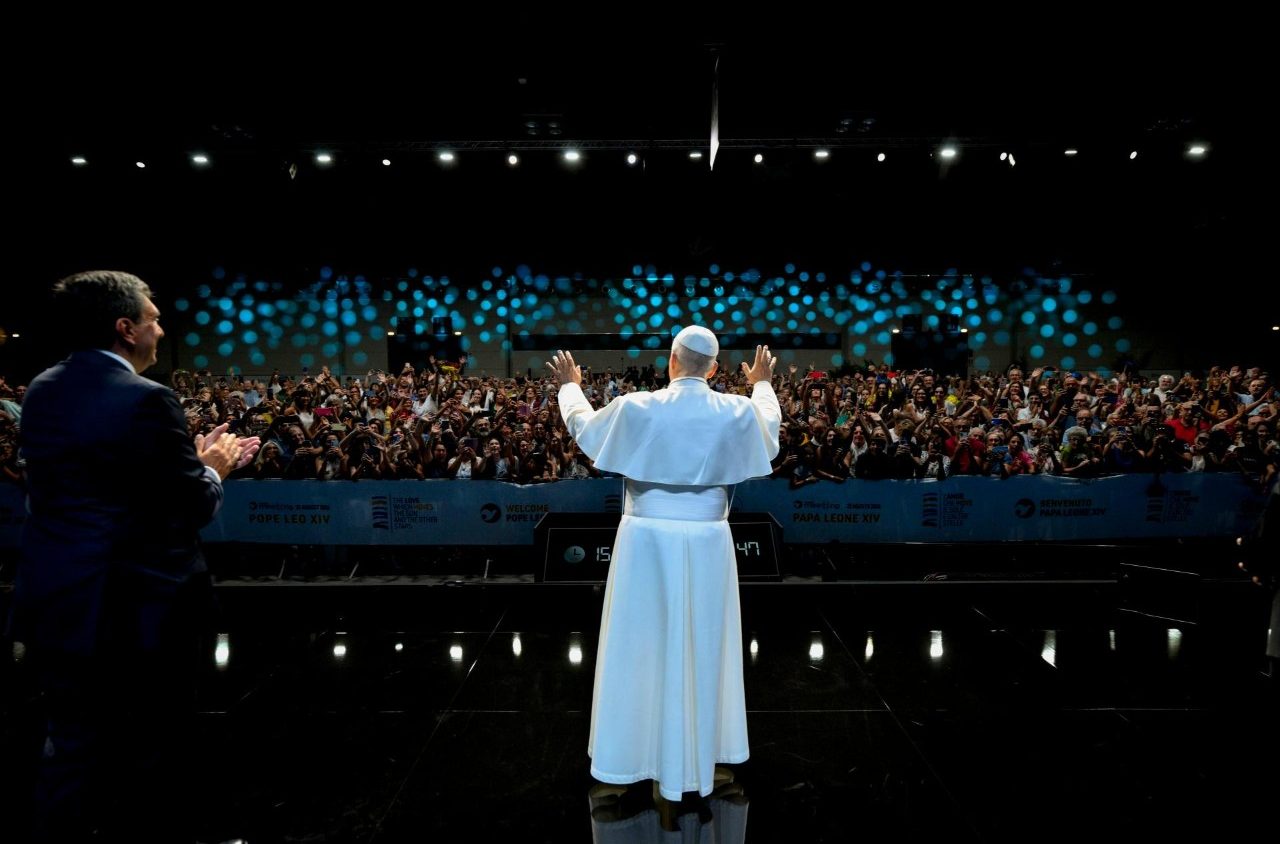
«Yes, dear friends, it is time for responsibility, especially for those who have received much from a thousand-year-old tradition of faith that becomes culture». This is one of the central passages of the speech delivered by Pope Leo XIV at the Rimini Meeting, before around 20,000 people gathered in the Great Auditorium and tens of thousands more present in the exhibition halls.
It marked a historic return: 44 years after John Paul II’s visit in 1982, a Pontiff has once again taken part in person in the Rimini gathering. Leo XIV did so with a speech that began with friendship among peoples and moved straight to the tensions of the present day: wars, inequality, power relations, ideologies, technological development and economic logic.
«Peace is safeguarded by those who love to meet»
The Pope recalled the very words spoken by John Paul II in Rimini in 1982, bringing them into today’s international context.
«Even today, peace is safeguarded and spread by people who love to meet one another and are not afraid to engage with one another», Leo XIV said.
The Pontiff then recalled Pope Francis’s encyclical Fratelli tutti and its call to cultivate social friendship, placing what unites people at the centre, ahead of differences and affiliations.
«We can put ourselves in one another’s shoes, listen to each other and become friends, between individuals and therefore also between peoples. Before borders, definitions and institutions, there are always people».
«Let us not fan the flames of despair»
The following passage turns to a society marked by distrust and fear. Leo XIV called for a choice between two paths he considers irreconcilable.
«Let there not only be those who fan the flames of weariness and despair; let there also be those who rekindle dreams and visions! The two paths are incompatible, because one exploits division, alienation and despair, while the other serves the Kingdom of God and his justice».
This is where the speech turns squarely to social and economic issues.
«Let us free coexistence from suspicion, culture from arrogance, education from ideology, work from the idolatry of profit, and technology and finance from the business of death», the Pontiff declared.
Poverty, wars and inequality: «Let us expose unjust power relations»
Leo XIV called for responsibility to begin within the organisations, communities and settings in which each person operates.
«Starting with the organisations we have created and in which we work, let us expose the unjust power relations that lie at the root of poverty and inequality, of war and environmental disasters. Let us disarm technological development when it becomes pervasive and destructive».
To change direction, he added, «we need courageous pioneers, who begin with their own change of course to make convincing and credible the conversion demanded of everyone».
The Pope against the «false realism» rearming nations
One of the most forceful passages concerned war and what Leo XIV called a “culture of power”. Against the logic that rearmament and confrontation are inevitable, the Pope proposed another notion of realism.
«To the false realism that rearms minds, words and nations, Catholic culture today must oppose the realism of mercy, according to which there can be no enemies, and everyone — even adversaries — are brothers and sisters to be looked in the eye and met in truth».
Evil, Leo XIV stressed, cannot be fought with more evil. The conversion he called for, therefore, does not concern only major political choices but reaches directly into people’s lives.
«Sin exists, of course, but the redemptive love of Christ is stronger, and it calls on us to purify our thoughts, interests, habits, relationships, plans, investments — every aspect of life — from all that the culture of power has polluted».
A compass even in the age of algorithms
The Pontiff finally broadened his gaze to digital transformation and a world crossed by competition to conquer markets and spheres of influence.
«In a world crossed by so many manoeuvres aimed at conquering markets and spheres of influence, often dressed up in reassuring rhetoric and seductive ideological constructions, our hearts feel the need to discover a different plan, one that is wise and benevolent, similar to the one Mary contemplates in the Magnificat», he said.
A design that, according to Leo XIV, must continue to guide humanity even through the «fastest and most turbulent passages marked by algorithms and global networks», becoming a compass for living the Gospel in the digital age.
The message the Pope left at the Meeting was, therefore, a call for concrete responsibility and a genuine change of course. Not merely an appeal against war, but an invitation to act on the economic, social, cultural and technological conditions that fuel division and inequality — starting from a principle Leo XIV reaffirmed before the Rimini audience: people always come before borders and institutions.