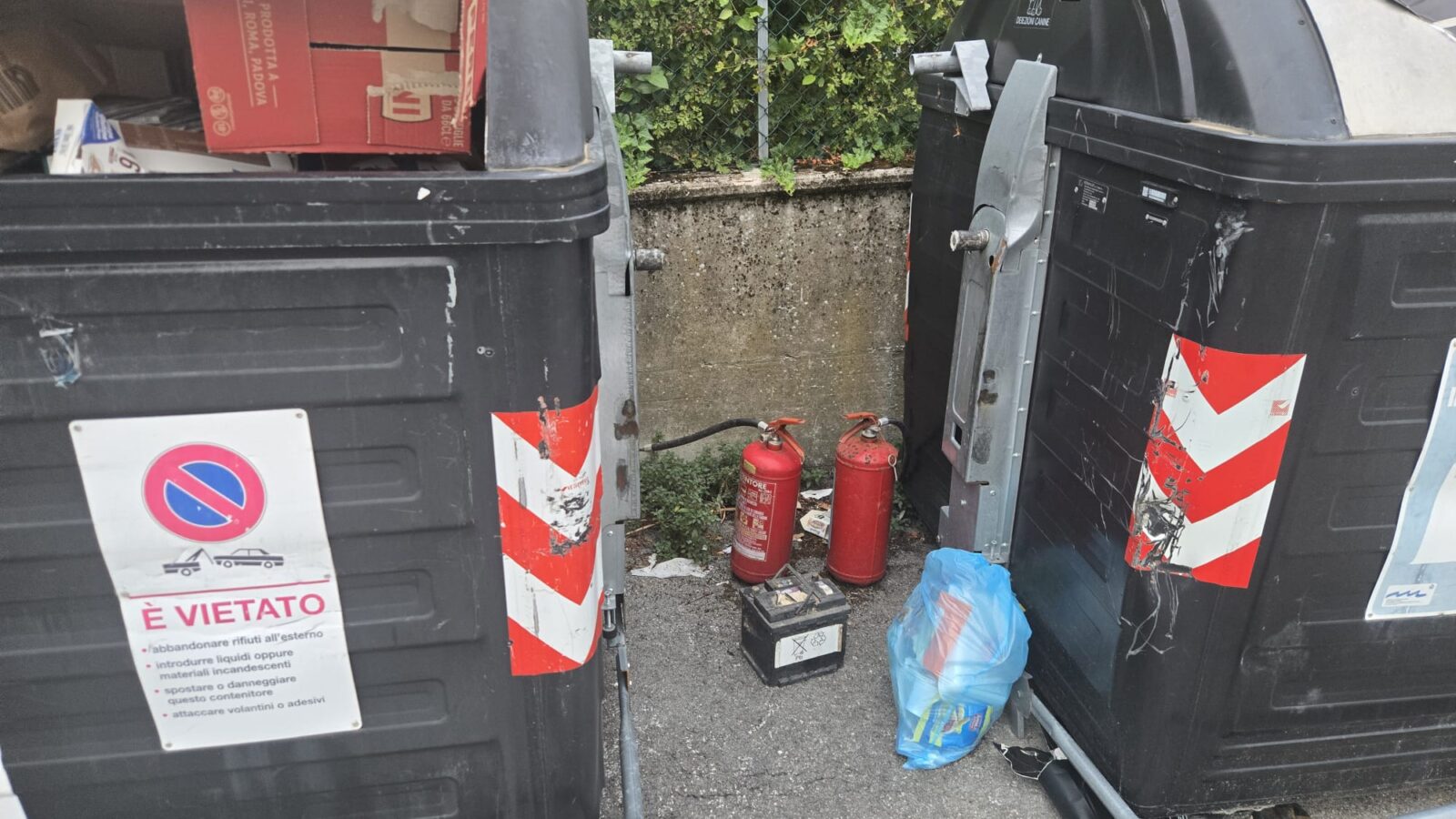
Two powder fire extinguishers, propped on the ground in the gap between two recycling bins in Borgo Maggiore, hoses still attached and maintenance tags still in place. Next to them, a lead car battery and a blue sack full of odds and ends that have nothing to do with those bins. The photos reached our newsroom from a reader who stopped, took in the scene, and did the only sensible thing: documented it.
On the side of the bin, half a metre from the pile, there’s a sign listing what is prohibited on that spot. First item on the list: dumping waste outside the bins. You didn’t even need to read it to know that — common sense would have done.
Let’s be clear about the technical side, because this isn’t a case of a cardboard box left outside a bin. A fire extinguisher at the end of its life is hazardous waste: it’s a pressurised vessel containing extinguishing powder, and it can’t simply be left on a pavement like a broken umbrella. It has to be returned to the company that services it, or handed over through the proper channels for this category of waste. The same applies — with the added complication of lead and acid — to the car battery that someone apparently thought fit for neighbourhood recycling collection.
The cost of doing things properly is negligible. It takes no more than a short car trip. Whoever chose the “dump and go” option didn’t do it out of financial hardship: they did it because they calculated that no one would notice.
And here’s where it gets interesting.
Fire extinguishers are not anonymous objects.
Every unit carries a stamped serial number, year of manufacture, and manufacturer details. And crucially, it carries a maintenance tag: dates of servicing, type of work carried out, and the technician’s details. In the photos those tags are clearly visible — yellow and blue, still stuck to the cylinder.
That tag leads back to a maintenance company. The maintenance company keeps a register of the units it services. The register shows where those extinguishers were installed and who was using them. It’s not a forensic investigation — it’s a phone call and a records check.
We are not pointing the finger at anyone, and we won’t until there’s confirmation. We simply note that two decommissioned extinguishers dumped together, plus a battery, are not the leftovers of a house move: they look far more like the disposal of a routine equipment changeover, the kind that happens when a business, a construction site or a vehicle replaces its fire-safety equipment. Whoever carries out that kind of replacement usually knows exactly how to dispose of the old units properly. Which makes the choice even harder to excuse.
We have passed the report on to the relevant authorities.
We trust that the serial numbers and maintenance tags will lead, without too much difficulty, back to the last owner, and that the matter will be resolved the way these things usually are once someone bothers to look: with a name, a fine, and the disposal bill charged to whoever offloaded it onto the community.
In San Marino, we often like to say we’re a small country where everyone knows everyone.
That holds true here too: no investigation is needed — just reading a label.
If you’ve seen or photographed similar situations, write to us. Photos, unlike bar-room gossip, don’t disappear.