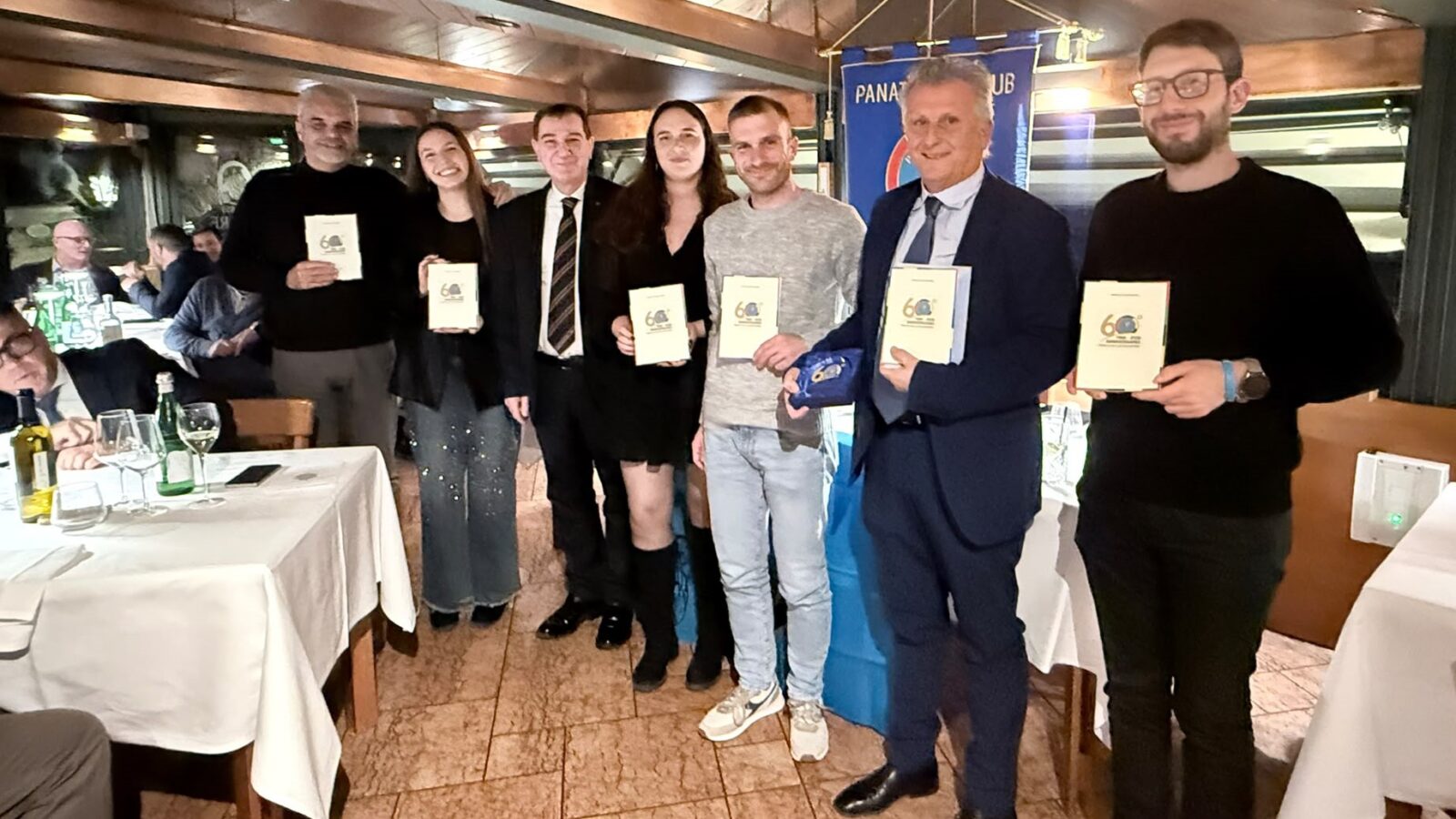
Thirty-seven medals won in international competitions, 15 of them gold. These are the numbers behind four athletes from San Marino’s national bocce team, Enrico Dall’Olmo, Jacopo Frisoni, Stella Paoletti and Giada Paoletti, who were guests at a Panathlon Club dinner evening alongside coach Marco Cesini and federation board member Pier Marino Paoletti.
During the evening, the athletes recounted their successes at World Championships, European Championships, the Mediterranean Games and the Games of the Small States, dwelling on the sacrifices, training and team spirit that allowed them to achieve these results.
Coach Marco Cesini outlined the characteristics of a discipline that demands strategy, precision in throwing, the ability to adapt to different playing surfaces, and emotional control at decisive moments in competition.
Cesini also recalled that San Marino’s Bocce Federation has held first place in the world ranking for three years running. It is a movement that also looks to the younger generation, as shown by the results achieved at the recent European Youth Championships, where San Marino won silver in the pairs event and qualified all of its athletes for the upcoming World Championships.
During the evening, Dr. Aldo Arzilli, who served for years as the national bocce team’s doctor, also spoke, recalling the historic first victory over Italy, which allowed the Titan’s team to qualify for the world finals in Argentina.
According to Cesini, the gap between Italy and San Marino has gradually narrowed in recent years, with the blue-and-white athletes increasingly able to prevail over their Italian rivals.
Among the topics discussed was also bocce alla sammarinese, a variant deeply rooted in the Titano’s tradition. The Paoletti sisters spoke of the pleasure they still find in playing this version of the game today, despite it being very different from the discipline practiced at competitive level.
Above all, what emerged from the athletes’ accounts was the importance of team spirit. Jacopo Frisoni, recalling the recent final in Brazil, when the Italian team led 10-0, recounted: “Simply being part of such a close-knit group allowed me to recover from a poor performance up to that point and come back to tie it 10-10.”
Enrico Dall’Olmo, meanwhile, dwelt on the difficulty of balancing training with work and family commitments: “Many times I was on the verge of giving up, of quitting, but then my longtime friends would show up, take me to the bocce court, and help me push through every sacrifice.”