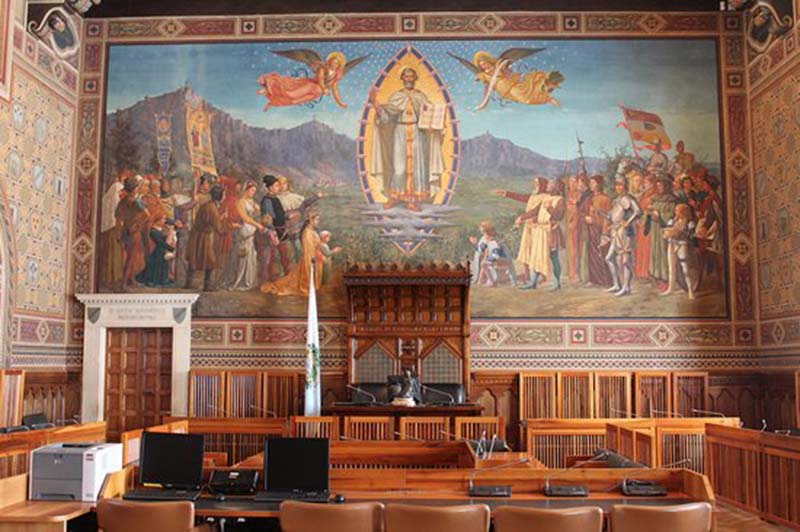
San Marino’s government is weighing whether to request a referral to the Grand Chamber of the European Court of Human Rights in the Ingrid Casali case. The deadline is 26 January 2027. Secretary of State Stefano Canti gave the update to the Grand and General Council (Consiglio Grande e Generale) on Monday, 23 November. “It is up to the government to decide whether to do so, and we are currently carrying out our assessments.”
The case originated from a social media post concerning Roberto Ciavatta, who was then Secretary of State for Health. Ingrid Casali had been convicted twice before being acquitted at a third instance.
That acquittal was later overturned through an extraordinary remedy known as the querela nullitatis. It is this step that Matteo Casali (RF) focuses his criticism on. “The judge responsible for extraordinary remedies assumed the power to annul a final, unappealable third-instance acquittal.”
The councillor criticised the government’s approach before the Court and called for those who contributed to the violations found in Strasbourg “to be held accountable and face the appropriate consequences.”
Enrico Carattoni (RF) asked the government whether it intends to comply with the ruling or seek referral of the case to the Grand Chamber. He noted that, nearly a month after news of the decision broke, his group’s parliamentary question remains unanswered.
Sara Conti and Nicola Renzi, meanwhile, returned to the matter of judge Oliviero Mazza’s resignation letter. Conti pointed out that the text has never been shared with Council members and asked the chamber to exercise its oversight role.
Canti replied that the Judicial Council (Consiglio giudiziario) has already ruled against its publication.
The clash also touched on the content of the post itself and the boundary between the right to criticise and attributing a specific act to a person. Matteo Zeppa (Rete) pushed back against Repubblica Futura’s interpretation.
“In my view, this amounts to an accusation. In a democracy, when there is an accusation, people react — regardless of their role in society or in politics.”
Manuel Ciavatta (PDCS) took a similar stance. Secretary of State Massimo Andrea Ugolini urged colleagues to start from what the Court actually established, and raised the issue of protecting individuals who are accused of acts they did not commit.
The exchange also reopened old wounds over San Marino’s judicial controversies between 2016 and 2019. Zeppa cited the Banca CIS case and accused those who supported the government of that period of having stayed silent.
Renzi countered that no Repubblica Futura member was ever involved in the first-instance trial over the criminal conspiracy tied to the bank — not even as a witness.
Aida Selva (PDCS) called on the opposition to also take a position on the first-instance convictions in the CIS case.
Iro Belluzzi (Libera) asked instead for clarity on which rules of San Marino’s justice system need to be amended in light of the Strasbourg rulings.
Secretary of State Luca Beccari noted that the State has a duty to defend itself before the Court and to examine rulings to determine whether changes to the rules are needed. “We do politics for the country, and we also discuss justice, which is a political matter — but let’s do it properly, without delving into individual judicial cases here in this chamber.”