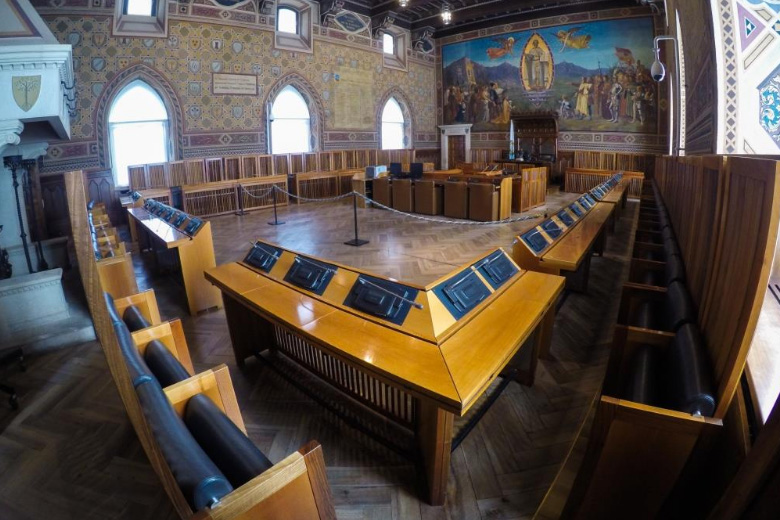
The Association Agreement with the European Union has reached the ratification stage before the Grand and General Council (Consiglio Grande e Generale). Under item 7 of the agenda, which also includes ratification of the amendment to the Monetary Convention, Secretary of State Luca Beccari retraced the course of the negotiations and explained what the agreement means for San Marino.
At the heart of his address was access to the European single market, which, according to Beccari, already accounts for more than 90% of Sammarinese businesses’ trade. The secretary also pointed to the possibility of provisional application while all 27 member states complete their own ratification processes.
Below is his speech in full.
«Today we arrive in this Chamber at the discussion of an agreement that has dominated our country’s political agenda for more than ten years. It is the result of a clear, strong and deeply rooted determination to place our relations with the European Union on a new footing.
This was, in essence, the substance of the letter sent to our European counterparts between the end of 2011 and 2012. It expressed a Sammarinese sentiment born from the particular circumstances the country found itself in at that time.
We were going through a phase of profound economic transformation and overall repositioning, and we realised we needed to bring our framework of relations with Italy and with Europe as a whole onto a different level.
Those were also the years in which we signed important agreements with Italy, which allowed us to re-establish our standing within the international community and to gain renewed recognition in terms of reputation as well.
In December 2014, the European Commission received a mandate to begin negotiations with San Marino, Andorra and Monaco, which at the time shared the same aspiration. That is how the negotiations began on what is now known as the Association Agreement. During those years, various options were examined, ranging from membership as a full state to entry into the European Economic Area, through to the format of an Association Agreement.
It is a structured agreement that goes beyond a simple neighbourhood relationship and sits at an intermediate level between the European Economic Area and full membership. It was the format that both San Marino and its European counterparts were willing to pursue.
It was a very long negotiation, spanning several legislatures. Every party represented in this Chamber today has, at some point, been part of a governing majority that supported this process. The negotiation went through countless twists and turns.
After an initial phase it intensified, then slowed during the Covid years, before picking up again. It was concluded in 2023, on the very day we welcomed President Mattarella here in this Chamber and celebrated the close relationship between San Marino and Italy.
Italy has always viewed this Agreement favourably, as has San Marino, not least because it can improve relations between the two countries. It places them on the same legal footing with respect to the single market and will allow us to make progress on matters that could no longer be addressed solely on a bilateral basis with Italy.
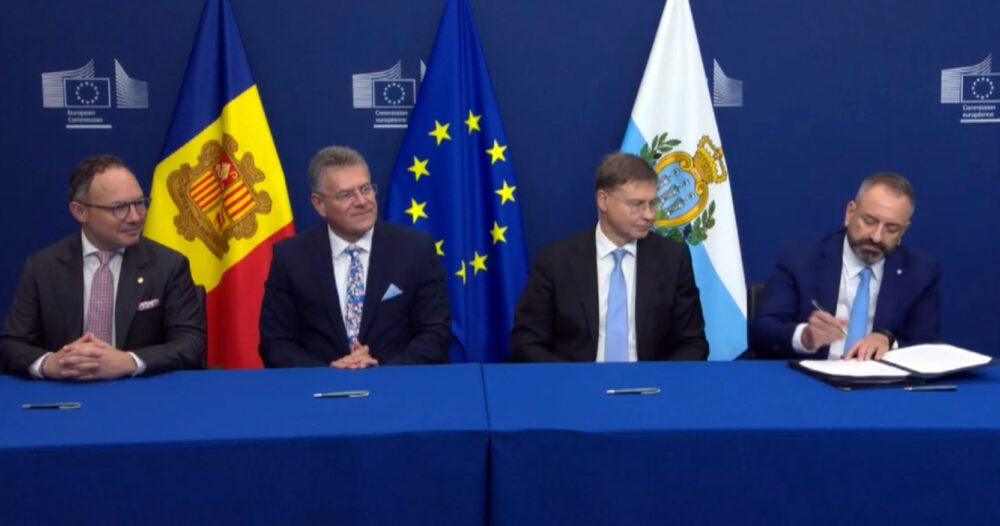
We reached the signing stage and, just a few weeks ago, passage through the Foreign Affairs Committee. The Agreement is now before the Council.
After that, we will have the possibility of provisional application and, given the mixed nature of the Agreement, the ratification process will be completed once all 27 member states have ratified it. Today, then, we are called upon to approve an important international agreement for the Republic of San Marino and to bring to a close a journey that has accompanied the life of this country for the past ten or twelve years.
What is the Association Agreement? It is impossible to describe it in nine minutes. You have on record a detailed report, along with all the documentation produced over the years.
Allow me to sum up its essence with the example I always use.
It is a right of equivalence — the right to be treated as equals with European citizens and businesses, to compete in the single market with the 27 member states of the European Union on the same footing, without being a member state ourselves. It is something unique and special, to which the European Union itself has attached real importance, as a form of enlargement that does not require accession.
It will finally allow San Marino to expand its room for development, currently limited by its status as a third country, an enclave within Italian and European territory.
Much has been said about costs, benefits and opportunities. The Association Agreement is the passport into the single market, which already has its own rules that we will need to comply with. At the same time, it will allow us to fully exploit economic opportunities and to achieve genuine free trade with the European Union.
Today that free trade exists, but it is limited in many areas, such as the financial and commercial sectors. Even now, our businesses do not have full freedom to sell certain products, provide certain services, take part in European public tenders, open branches directly controlled by Sammarinese companies, or operate in the market under the same conditions as their competitors.
And we are talking about a market that accounts for more than 90% of Sammarinese businesses’ trade. Then there is the social dimension. For Sammarinese citizens, this opens up the prospect of being able to settle freely within the territory of the European Union as students or workers, and of having their rights protected in all areas covered by the EU acquis.
Today, European and Sammarinese consumers — and indeed anyone using a service — are not on equal footing. One need only think of the restrictions our citizens sometimes face even in simple interactions with European bureaucracy, even something as basic as registering on a portal to handle a personal matter.
Over the years, some have viewed this Agreement with suspicion, as something that might somehow undermine our sovereignty and our capacity for self-determination. Today we live in a closely interconnected world.
Beyond geopolitics and the confusion we sometimes witness, everyday life involves a high degree of shared participation, while countries left outside the European Union, like San Marino, suffer from the limitations placed on their relations with the single market.
Europe, as Commission President von der Leyen recently stated at the European Political Community summit in Dublin, intends to continue its enlargement process. She said this enlargement could also take place through qualified association agreements. It is a tool that broadens participation within the European Union, bringing in third countries on an equal footing with member states.
It is also a way of giving Europe, as a macro-region, a development perspective in its dealings with the world’s major economic and geopolitical powers. The small Republic of San Marino, which for years made “known to us, unknown to others” a strategy of its own, realised back in 2008–2009 that this approach no longer worked.
Today, through this Agreement, San Marino retains its sovereignty and independence. It is precisely by virtue of that sovereignty and independence that we sat down at the negotiating table, and we now enter into a genuine and substantive dimension of cooperation with Europe, as a partner state officially recognised as an equal. This is a great asset we now hold in our hands, and it is a prospect we are offering to future generations.
For those of my age, or a little older, this Agreement will probably not change life all that much. But it is our duty to give future generations — in their studies, their work and, more broadly, in the opportunities they should have here — a country that is strongly interconnected with the European Union.
A country that preserves its distinctive character, fully safeguarded within the Agreement through a series of adjustments carefully designed and agreed upon precisely to protect the particular features of a territory like that of the Republic of San Marino.»