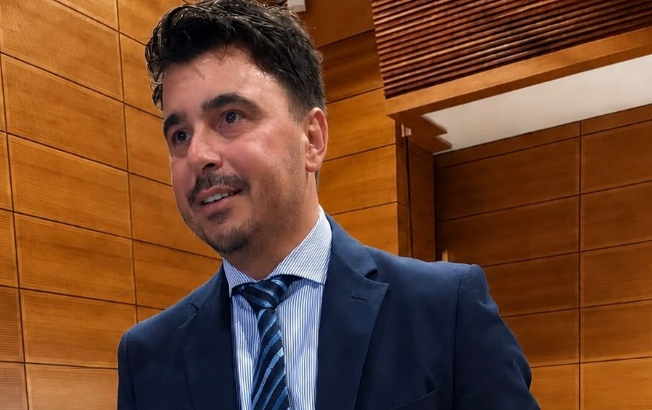
During the Communications item of the Grand and General Council, Matteo Rossi (PSD) reconstructed the dispute within the Presidency Office over the legal protection granted to councillor Pelliccioni, who was taken to court by Motus Liberi after leaving the party.
The group leader defended the right of a councillor to leave their political formation and remain in the Council as an independent. He noted, however, that Pelliccioni had signed the party’s statute, and called for a discussion on how economic contributions should be redistributed in cases of departure.
At the start of his remarks, he returned to the collapse of Banca Partner and Banca CIS and the burden that, in his estimation, continues to weigh on the public budget. Below is his address in full.
«For me too, 2011 was a watershed moment.
I remember the resignations of Caringi, Papi and Bossone, who had flagged the problems at Banca Partner. Those problems later spread to CIS, with a domino effect that has lasted until today, running through the events of the last legislature and perhaps even the one before that.
We are inheriting the consequences of events that go back a long way, perhaps to 2005, with the failure to sign the agreement with Italy. Many of us weren’t here at the time, but we can analyse today’s situation. Since we’ve been in office, the public accounts have recorded significant outlays to patch up that damage.
When we are criticised because the ECHR rules against us in cases tied to those interests, I think it is fair to point out that a great many millions in the budget we will approve at year’s end go towards guaranteeing savers who lost money in those banks, especially Banca CIS. Then there were the pension funds, worth over 100 million, which sat on that bank’s books and were lost.
I believe that every year we pay out roughly 15 to 16 million euros from the public budget to patch up that damage. With that money we could have made many other investments, in photovoltaics for instance.
I think of our schools, most of them dating from the 1970s and 80s, with fine architecture but now old and equipped with outdated facilities. I think of the hospital and of tourism infrastructure.
I heard it said that two more hotels have closed. I would ask the colleagues who said this to specify which ones, because I didn’t understand which establishments they meant.
I now come to the issue I had intended to address. Since the days before Council sessions are usually a prelude to debate, I expected today would bring a barrage of exchanges between Motus Liberi and councillor Pelliccioni. Even within my own party, people are asking me what happened in that Presidency Office meeting, because they see statements, counter-statements and battles unfolding on Facebook.
I want to set out the facts for those listening at home, because otherwise the message that gets through is that the majority group leaders paid for lawyers in a matter where they shouldn’t have, and that therefore everyone is entitled to have their legal costs recognised by the Presidency Office. As colleague Ciavatta said earlier, this matter goes back a long way. Last year I was Captain Regent when the first papers arrived.
We spent four or five Presidency Office meetings trying to get Motus Liberi — which brought the lawsuit against our colleague Pelliccioni — to see reason on one point. We represent the legislative power. We try to prevent a matter rooted in politics from being settled by the judiciary.
These are dynamics we see in every legislature. I am the PSD group leader, and I believe our party, more than any other, has set something of a precedent in this field.
Our colleagues in Rete also had three departures during the last legislature. When a person no longer identifies with the party on whose lists they were elected, they can become an independent councillor. Here, however, I found myself facing a party that had taken a councillor to court.
Together with colleagues, we worked to get the lawsuit withdrawn and the matter brought back into the political sphere, but we were unable to find common ground.
The Presidency Office therefore acted on the basis of its own prerogatives and of precedents already set in the past. Renzi, Matteo Ciacci and Elena Tonnini had needed financial support to pay for lawyers because they had been taken to court by outside parties. The Presidency Office had covered those costs because it had to defend a councillor’s prerogatives in the exercise of their representative mandate.
Here the case is somewhat different. It is a political party bringing a lawsuit against a councillor over a statute that was signed.
The statute is the set of operating rules that every party approves at its congress. Going by memory, and I may be mistaken, Motus Liberi’s statute provided that if a councillor no longer identified with the party line and decided to leave, they would also have to give up their Council seat and allow the next candidate on the list to take their place.
This is known as a binding mandate. It is a practice banned across Western jurisdictions.
Our mandate is a representative one. We represent citizens, and we receive votes from citizens who vote for a candidate within an organisation. This is a principle I personally do not intend to compromise on, and together with other colleagues, we extended our support to councillor Pelliccioni.
I’m clarifying this for those who, reading the articles these past few days, have asked us what was going on. A party decided to sue one of its own former councillors.
I understand that financial considerations matter too, and on that point I appeal to politics. Let’s look at how the system works. It is right that a councillor should be able to become independent if a party no longer represents them, but it is equally unacceptable for someone to walk away with a large share of parties’ economic contributions without then building a political structure.
In the past, when colleague Dalibor Riccardi left the PSD, he built a party, and so the financial commitment made sense. In other cases, truly significant sums end up going to a single councillor, and that is something worth discussing.
On the binding mandate, however, we are not open to discussion. We consider it outdated and incompatible with representative mandate. Beyond the institutional duty to protect a councillor taken to court over a principle I believe is wrong, I also want to stress the political dimension. It is true that no binding mandate exists in law, but it is equally true that councillor Pelliccioni had signed that statute.
I don’t believe she had a gun to her head. I think she supported those provisions in full awareness, not least because party congresses involve genuine debate, and statutes are born out of ideas, visions and synthesis».